

Best Shopify Inventory Forecasting Apps: Top 10 Platforms Compared
Compare the 10 best Shopify inventory forecasting apps by method, workflow, and price to find the right inventory forecast tool for your store.

Choosing the right Shopify inventory forecasting app comes down to matching the tool's forecasting method to how your store actually sells. Channel Bay forecasts demand and days-left stock at the SKU level, then carries that projection straight into reorder dates and purchase orders across multiple channels and locations. Prediko and Rewize build their forecasts around marketing events and growth targets. Stockful and Stockie lean on sales velocity and real sales history. IFH keeps things lightweight around demand and promotion planning, Fabrikatör factors in promotions and warehouse-level lead times, Cin7 runs AI-powered forecasting at enterprise scale, Monocle blends financial and logistics insight, and Sumtracker focuses on predictive reorder suggestions.
This guide compares all 10 inventory forecast tools on their forecasting features, day-to-day inventory workflows, and where each one is genuinely the strongest fit. If you're trying to shortlist the best inventory forecasting software platforms for a Shopify store specifically, the deciding factor is usually less about raw prediction accuracy and more about how tightly forecasting connects to your actual reorder and purchasing process.
Key Takeaways
Channel Bay's forecasting engine projects demand and days-left-in-stock, then translates that directly into reorder dates and purchase orders across multiple channels and locations, starting at $60/month.
Cin7 offers the most advanced forecasting horizon but requires a $349+/month Core subscription plus an additional AI module.
Budget-conscious, single-location Shopify stores are generally better served by Stockful ($19.99/month) or IFH ($25/month).
If you sell on more than Shopify, check whether a tool's historical sales data syncs across all your channels, several tools on this list, including Sumtracker, only backfill Shopify history natively and start forecasting other channels from the connection date.
The forecast itself matters less than what a tool lets you do with it: turning a prediction into a purchase order, a reorder point, or a multi-location transfer.
Best inventory forecasting software platforms compared at a glance
App | Key Capability | Best For | Starting Price |
Channel Bay | Demand and days-left forecasting tied directly to reorder dates and lead-time tracking | Single-channel and multi-channel, multi-location sellers | Free trial, $60/month |
Cin7 | AI-powered demand forecasting (ForesightAI) | Multiple channels, larger operations | $349/month (Core) + add-on |
Sumtracker | Predictive reorder suggestions, lead time and safety stock integration | SMB multichannel eCommerce sellers | $119/month (Replenish plan) |
Prediko | AI demand planner, revenue target forecasting, seasonality adjustments | Single-channel (Shopify native) D2C | $49/month |
Fabrikatör | Promotional demand factoring, lead time and multi-warehouse tracking | Single-channel (Shopify native) | $99/month |
Rewize | Location-specific tracking, financially lean purchasing advice | Multichannel D2C brands | $79/month |
Monocle | Basket analysis, logistics-aware advice, AI financial forecasting | Single-channel (Shopify native) | $67/month |
Stockie | Forecasts from real sales history, synced with Shopify in real time | Single-channel (Shopify native) | $29.99/month |
Stockful | Seasonal forecasts plus reorder points | Single-channel (Shopify native) | $19.99/month |
IFH | Lightweight demand planning, promotion planning | Single-channel (Shopify native) | $25/month |
Note: Pricing (USD) reflects each vendor's currently published starting plan and may vary by revenue, order volume, SKU count, or location count. Verify current pricing before publishing, since SaaS pricing pages change often.
Channel Bay - Inventory Forecasting
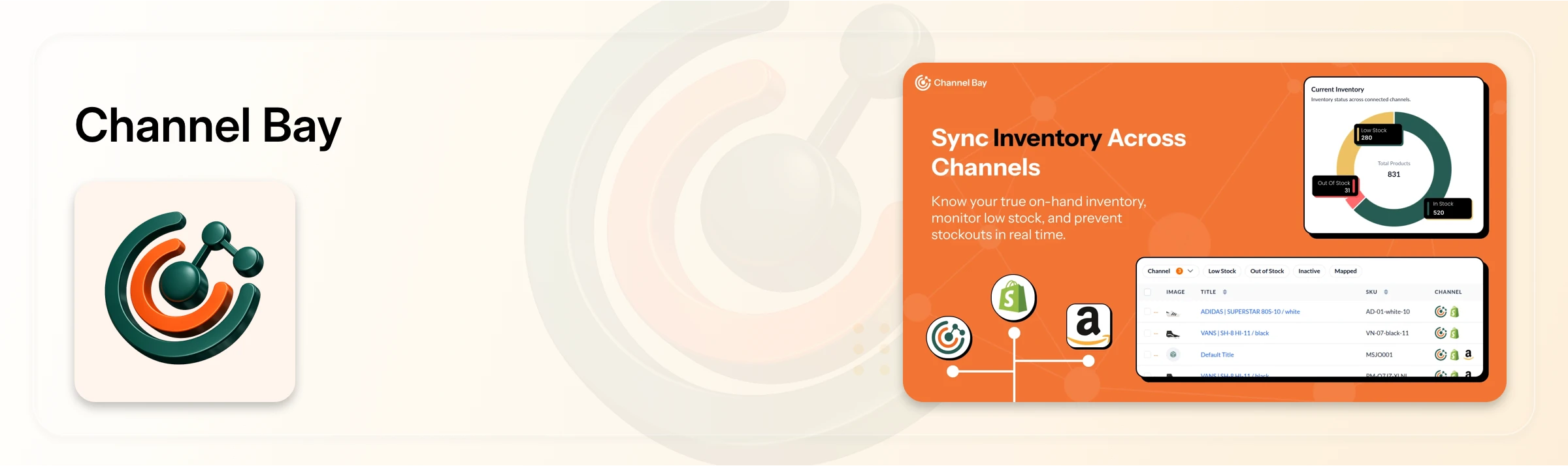
Best for: Merchants who want an accurate, SKU-level demand forecast to be the starting point for every reorder decision, not a report they have to manually translate into action. Channel Bay's forecasting works for single-channel Shopify stores and multi-channel, multi-location sellers alike, projecting demand for the same SKU consistently regardless of how many places it sells.
Core forecasting capability: Channel Bay forecasts demand and days-left-in-stock at the SKU level, using current inventory, incoming stock, and supplier lead time as direct inputs, so the forecast reflects what's actually moving through the pipeline rather than a flat historical projection. That forecast is the engine behind everything else the platform does: it sets reorder date recommendations, drives reorder point calculations, triggers low-stock and out-of-stock alerts, and feeds purchase order planning automatically as the numbers shift. Forecasts run across multiple channels and locations, so demand for the same SKU selling in different places is projected and reconciled in one place rather than channel by channel.
Where it falls short: Channel Bay's forecasting models are newer than category veterans like Cin7 or Fabrikatör, and the underlying logic is still developing in response to merchant feedback rather than positioned as a mature, enterprise-grade statistical model. That's a real trade-off for businesses that need proven, advanced forecasting today, but it's an advantage for merchants who want a forecasting engine that keeps adapting to how they actually reorder, rather than a fixed model built years ago for a different kind of store.
Pricing: Forecasting is available on the Pro plan, starting at $60/month, which also includes advanced inventory management and reporting.
Cin7
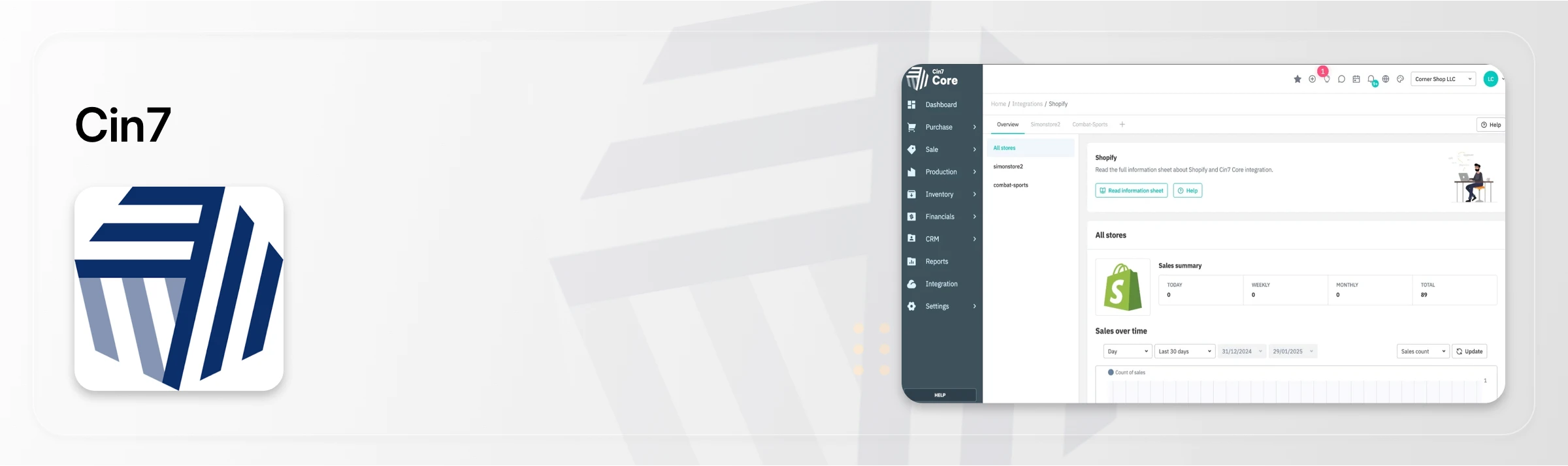
Best for: Growing and established product businesses that need advanced demand forecasting alongside inventory, purchasing, warehouse, and multi-location planning.
Core forecasting capability: Cin7's ForesightAI uses historical sales data, trends, seasonality, and AI-based modeling to forecast demand up to 24 months ahead, with SKU- and location-level detail. Forecasts connect to smart replenishment, safety stock, reorder points, supplier lead times, and purchase orders.
Where it falls short: ForesightAI is an add-on, not a standalone tool, so it requires a Cin7 Core or Cin7 Omni subscription underneath it. Cin7 recommends at least six months of sales history for reliable forecasts, which limits its usefulness for brand-new products.
Pricing: Cin7 Core starts at $349/month. ForesightAI is an additional paid module (with a 14-day free trial) that scales with the business's GMV, so the combined cost isn't fixed.
Sumtracker
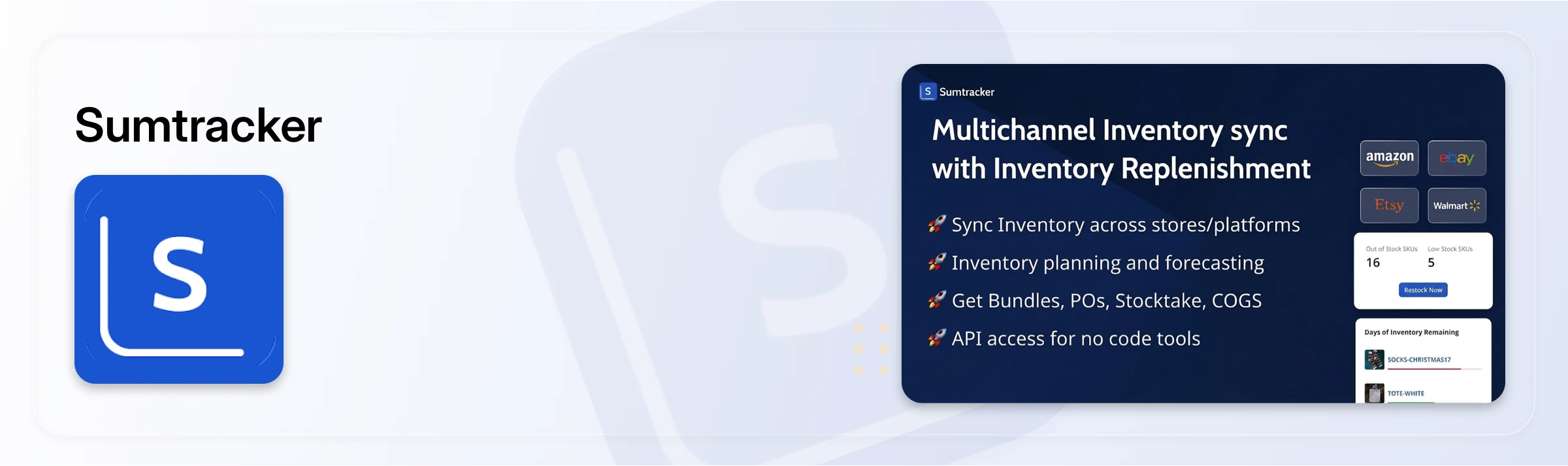
Best for: Shopify and multichannel eCommerce businesses that want demand forecasting connected directly to replenishment, reorder planning, and purchase orders.
Core forecasting capability: Sumtracker forecasts demand from sales history combined with sales velocity, seasonality, supplier lead time, safety stock, and days of cover. It projects stockout dates, recommends when and how much to reorder, and converts recommendations into purchase orders.
Where it falls short: The system is built around replenishment and purchasing rather than broader demand-planning scenarios. Seasonality is based on a product's own sales history, so new products with limited history get weaker forecasts, and historical sales sync fully only for Shopify locations; other connected channels start forecasting from their connection date.
Pricing: The Manage plan starts at $59/month, but forecasting and replenishment require the Replenish plan, starting at $119/month.
Prediko
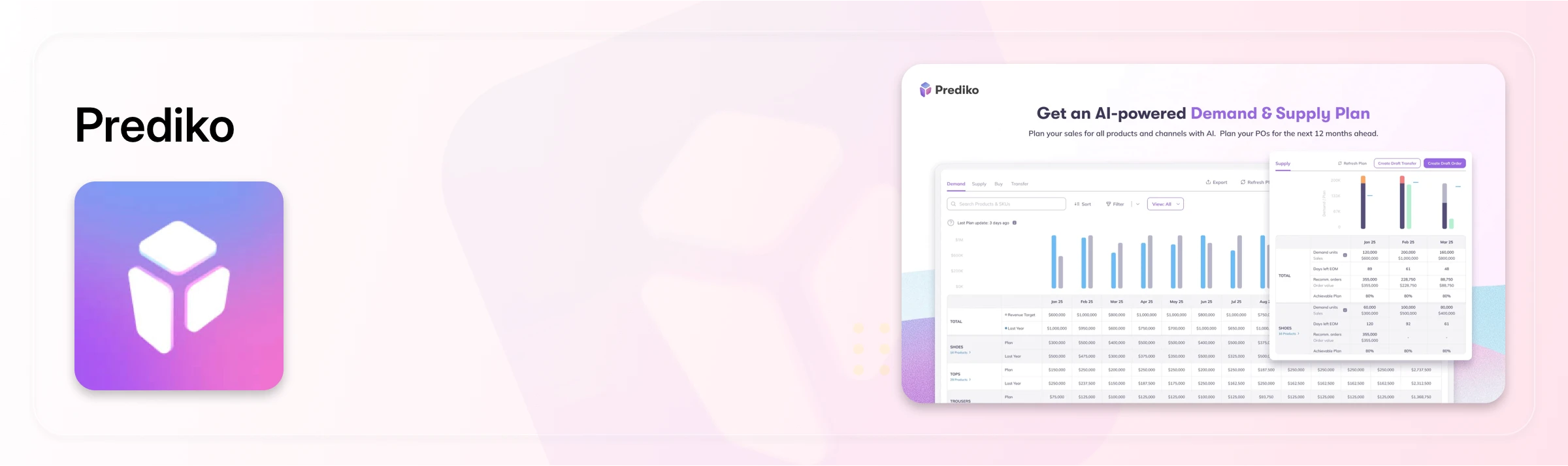
Best for: D2C Shopify brands that want AI-driven demand forecasting tightly connected to supply planning, multi-location inventory management, and streamlined purchasing.
Core forecasting capability: Prediko forecasts SKU-level demand from historical sales, sales velocity, and Shopify trend data, offering both mathematical and AI models that account for seasonality and growth targets. Forecasts combine with lead times, safety stock, and incoming inventory to suggest purchase quantities, and the platform supports raw-material and BOM forecasting for manufacturers.
Where it falls short: Demand planning is monthly rather than weekly, which limits merchants who need granular week-by-week forecasts. Forecasts can be adjusted for promotions and launches, but they still depend heavily on historical sales data and merchant-entered assumptions.
Pricing: Starts at $49/month for stores under $100K in trailing revenue, scaling upward by GMV tier.
Fabrikatör
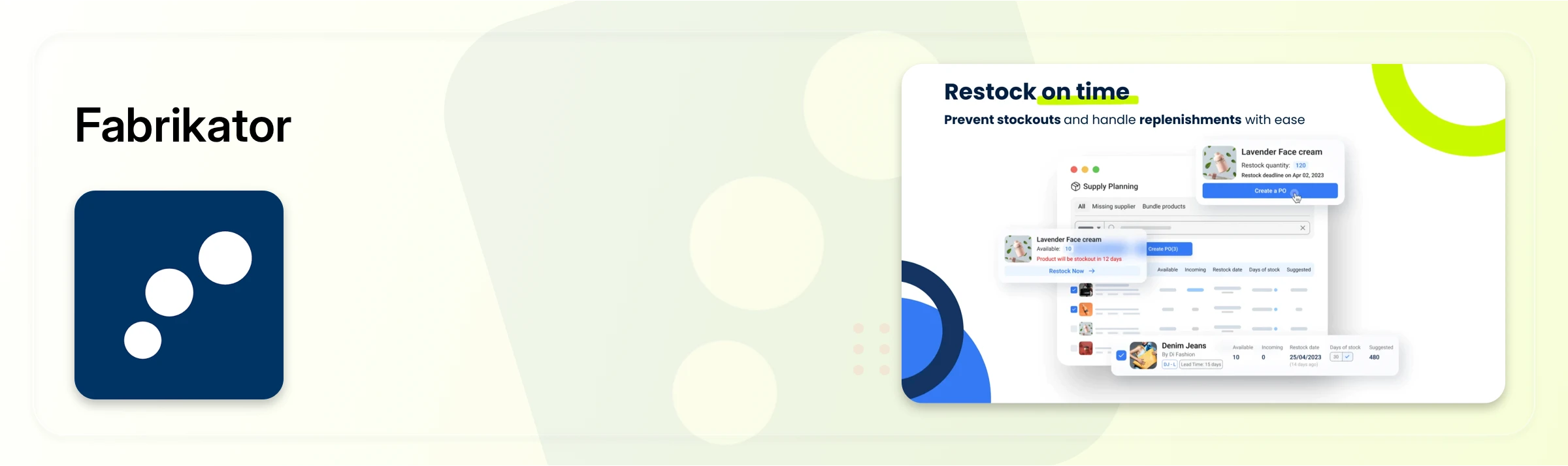
Best for: Growing Shopify brands that want demand forecasting connected to inventory planning, replenishment, purchasing, and supplier management.
Core forecasting capability: Fabrikatör forecasts future inventory needs using sales trends, seasonal changes, growth goals, stock levels, and supply information, then connects demand plans to purchase order recommendations, supplier data, restock frequency, and incoming inventory.
Where it falls short: The focus is Shopify inventory planning and purchasing rather than broad multichannel forecasting. Forecasts depend heavily on available sales data, so new products with limited history have less to work with, and some advanced planning features suit growing businesses more than very small stores.
Pricing: Starts at $99/month month-to-month, or $79/month billed annually, for businesses up to $500K in annual revenue. Includes demand forecasting, stock replenishment, bundle planning, and unlimited SKUs and users.
Rewize
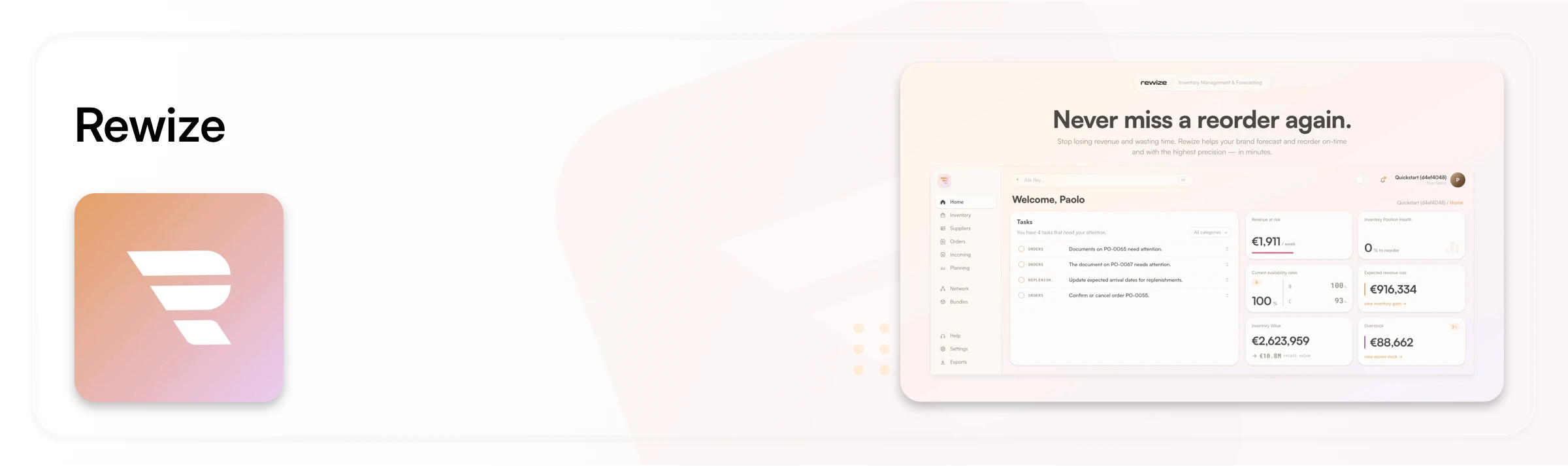
Best for: Fast-growing D2C brands managing multiple channels, locations, suppliers, and larger purchasing operations.
Core forecasting capability: Rewize uses AI to forecast demand at the SKU and sales-channel level, combining historical performance with seasonality, growth targets, upcoming marketing campaigns, supplier lead times, and current inventory. It maps out days of stock remaining, flags stockout risk early, calculates optimal purchase quantities, and generates purchase orders automatically.
Where it falls short: Because the algorithm relies on clear consumer velocity patterns, brand-new products with limited data get less reliable recommendations. Component-level tracking for brands doing their own manufacturing or assembly requires a paid upgrade rather than coming built in.
Pricing: The baseline plan starts at $79/month for businesses up to $1M in annual revenue. Raw Material / BOM Planning is a paid add-on at roughly 30% of the core tier's rate.
Monocle
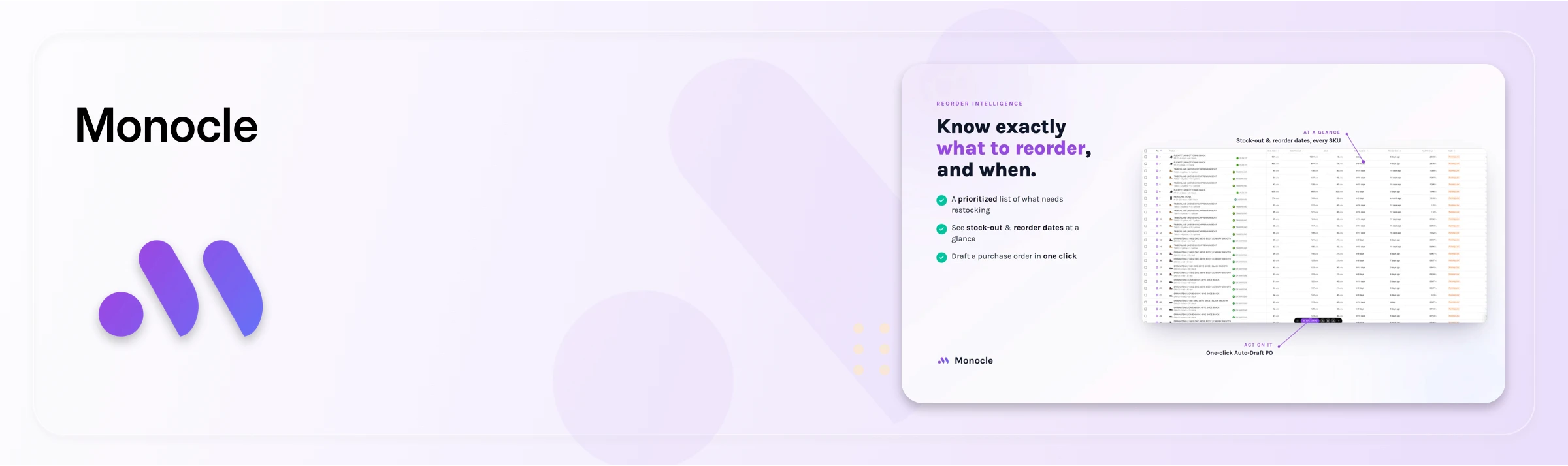
Best for: Shopify brands that want demand forecasting connected directly to replenishment and purchase order planning.
Core forecasting capability: Monocle uses AI to analyze sales history, trends, seasonality, and inventory patterns, with stockout-aware forecasting that prevents periods when a product was out of stock from being misread as low demand. Forecasts connect to purchase orders, replenishment recommendations, and inventory planning.
Where it falls short: The focus is Shopify inventory forecasting and replenishment rather than broader multichannel demand planning. Market basket analysis and ABC-XYZ analysis are useful for deeper product analysis, but they're analysis tools, not forecasting methods in themselves.
Pricing: Starts at $67/month, with Premium at $89/month, Elite at $129/month, and Ultimate at $169/month. Plans include a 14-day free trial.
Stockie
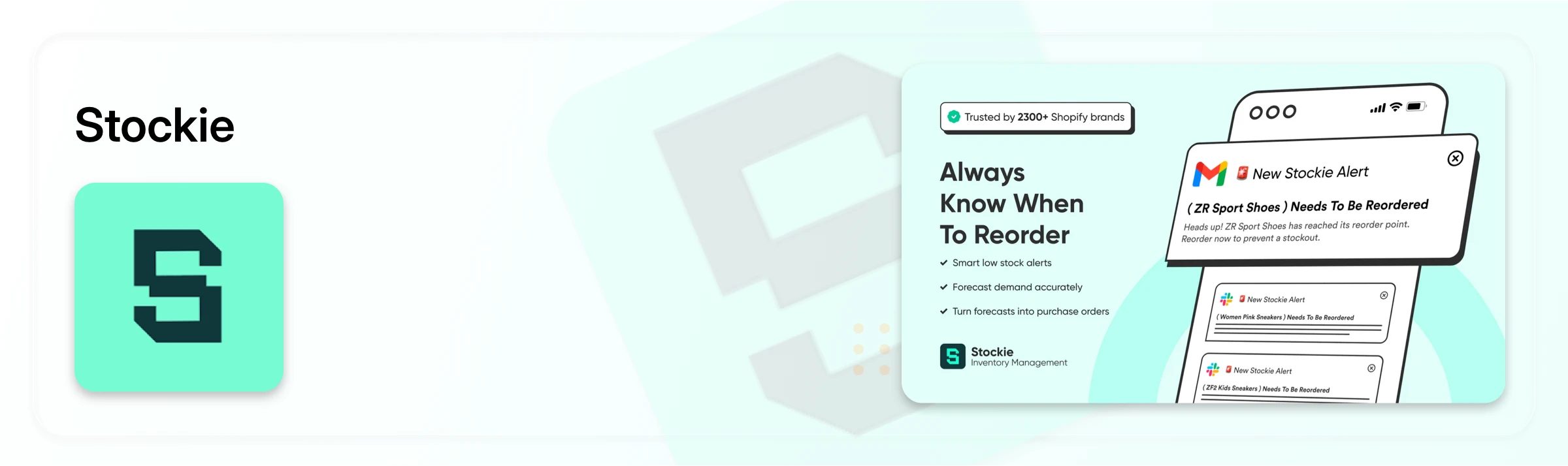
Best for: Shopify stores that want a simple, affordable way to forecast demand, monitor stock levels, and plan replenishment.
Core forecasting capability: Stockie's dashboard uses sales trends and velocity to estimate future inventory needs, automatically calculating inventory thresholds, predicting reorder dates, and suggesting reorder quantities. Merchants can configure supplier lead times and safety stock, and forecast-based notifications flag products that need attention.
Where it falls short: Stockie focuses on SKU-level velocity alerts and quick ordering rather than deep predictive modeling. It doesn't offer complex multi-layered forecasting, promotional trend simulation, or cross-channel logistics beyond Shopify's native setup, and purchase order creation is locked to its highest plan.
Pricing: Advanced forecasting analytics, safety stock calculations, and restock reminders are on the $29.99/month Pro plan; full purchase order management requires the $59.99/month Pro Plus plan.
Stockful
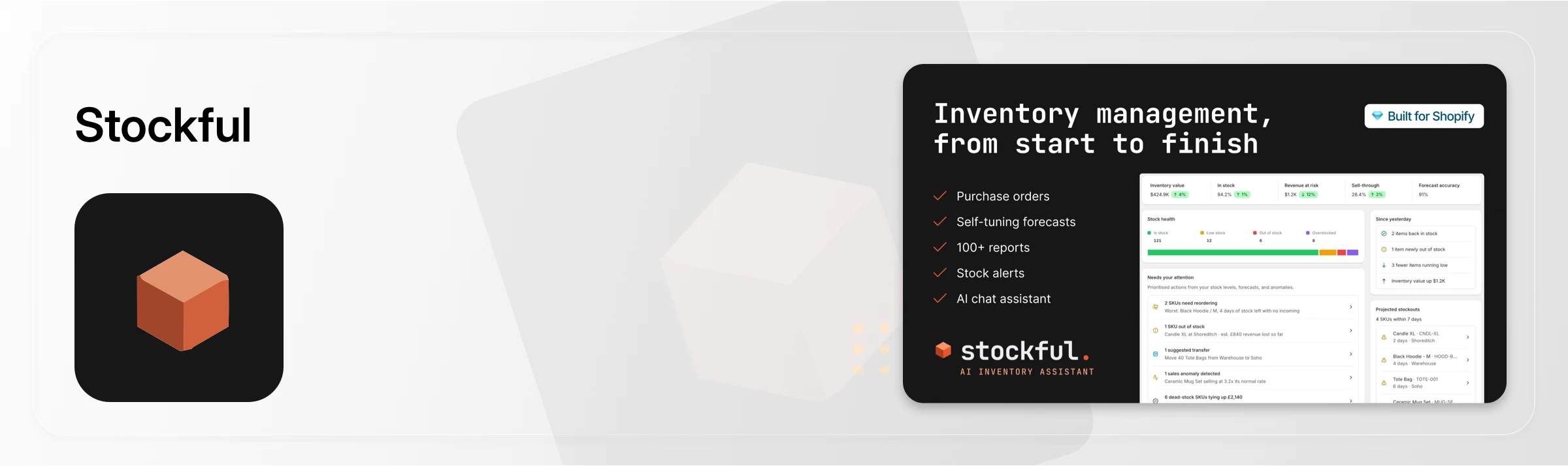
Best for: Shopify stores that want affordable forecasting combined with reorder points, purchase orders, stock alerts, and inventory planning.
Core forecasting capability: Stockful evaluates up to two years of sales history to run five candidate demand models per SKU and location, picking whichever best fits that item's seasonality and trend. Forecasts blend with incoming stock, transfers, and adjustments to trigger low-stock and stockout alerts, alongside automated ABC analysis and an AI assistant for spotting velocity anomalies.
Where it falls short: Stockful is Shopify-exclusive, with no native integrations for brands selling on Amazon, eBay, or TikTok Shop. It's strong at reading Shopify-native velocity but lacks the macro-promotional planning or simulation frameworks found in heavier enterprise ERPs.
Pricing: Starts at $19.99/month (Starter), scaling to $39.99/month (Growth), $79.99/month (Pro), and $199.99/month (Scale), with pricing also increasing by tracked SKUs and locations.
IFH (Inventory Forecasting Hero)
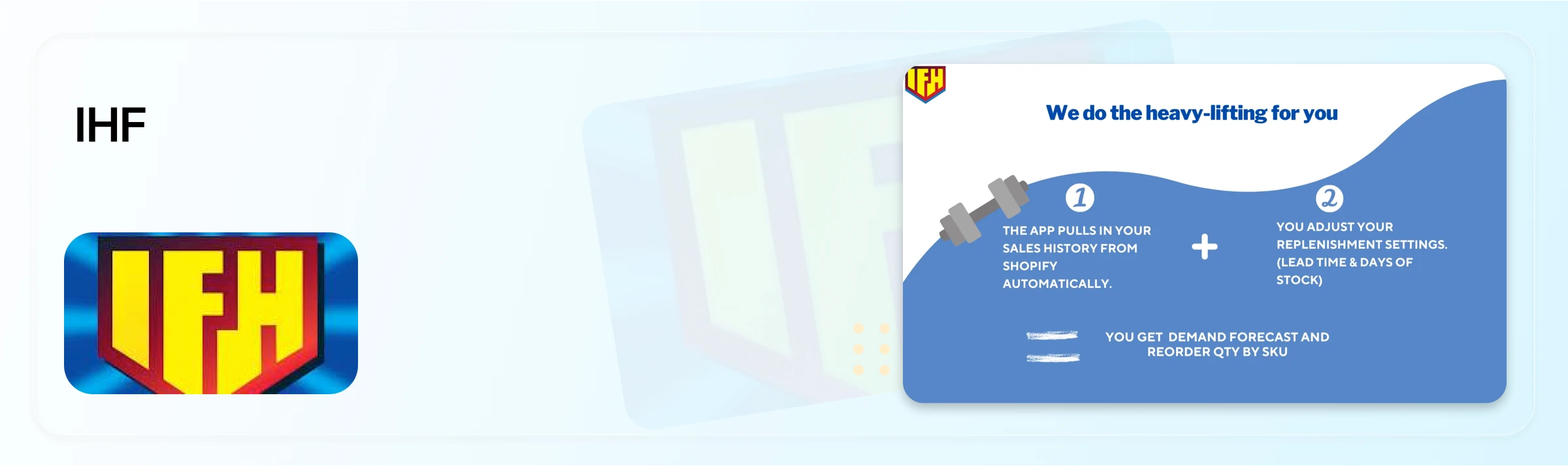
Best for: Small Shopify stores that have outgrown spreadsheets and need a simple tool for demand forecasting and reorder planning.
Core forecasting capability: IFH uses past sales data to estimate reorder quantity and timing, identifies bestsellers and overstock, and lets merchants simulate sales growth to plan for demand swings. Merchants can create Shopify purchase orders directly from the forecast and export data as CSV.
Where it falls short: IFH is intentionally simple, with fewer advanced forecasting and supply-planning features than larger platforms. It's built around sales history, reorder planning, bestsellers, overstock, and growth simulation rather than multichannel forecasting or complex supply-chain modeling.
Pricing: The Forecasting Plan is $25/month, including demand forecasting, reorder planning, one-click Shopify purchase orders, sales-growth simulation, SKU-level reorder settings, and daily reorder alerts, with a 30-day free trial.
How to select the best inventory forecasting system
Shopify inventory forecasting isn't one-size-fits-all, and the right choice depends on your operational requirements, store size, sales channels, and supply chain complexity. A good forecasting app doesn't just estimate future demand; it gives you information you can act on.
Predictive features
Start with how the system generates its predictions. Sales history and seasonality matter because past demand reveals recurring patterns, but check whether the tool also accounts for trends, growth targets, promotions, and stockouts, since these can all break a purely historical pattern.
If you sell across multiple channels, multichannel data aggregation matters: having all your sales data in one forecasting system gives a more complete demand picture than planning each channel in isolation. And a forecast showing rising demand is only useful if you also know your supplier lead time, since that determines when you actually need to place the order.
Operational and supply chain controls
Forecasting is most useful when it connects to your actual supply chain. Look for supplier lead-time tracking, reorder points, safety stock, incoming inventory awareness, purchase orders, and inventory transfers.
Minimum order quantities (MOQs) matter too. If your supplier requires a minimum, your recommended order needs to account for that constraint. Businesses that manufacture or bundle products may also need component-level forecasting or Bill of Materials (BOM) support so raw materials get planned alongside finished goods. And if you run frequent campaigns, launches, or influencer partnerships, the system should let you factor in expected demand changes rather than relying solely on historical sales.
Financial and workflow automation
A useful system turns forecasts into action. Automated purchase order recommendations cut manual work by connecting predicted inventory needs to purchasing, and cash flow planning helps you understand how much capital future purchases will tie up. Reporting by product, supplier, location, or category also makes it easier to spot slow-moving stock, upcoming shortages, and items due for replenishment.
Conclusion
Shopify inventory forecasting isn't about predicting the future with certainty. It's about using the sales and inventory data you already have to make better purchasing and stocking decisions.
The right Shopify inventory forecasting app depends on how you sell, how many products and locations you manage, how complex your supply chain is, and how much automation you need. Some tools focus narrowly on demand forecasting and reorder recommendations. Others, like Channel Bay, connect forecasting to purchase orders, suppliers, warehouses, and broader multi-channel inventory management.
Before choosing, look past the forecast itself and ask what the system helps you actually do with it: catch a future stockout, plan a purchase order, account for supplier lead time, or manage inventory across multiple locations.
Frequently Asked Questions
What is a Shopify inventory forecasting app?
It's software that predicts future product demand for a Shopify store using historical sales, seasonality, and trend data, then uses that prediction to guide reorder timing, quantities, and purchase orders.
What's the difference between Shopify inventory forecasting and generic demand forecasting?
Shopify-native tools pull sales and inventory data directly from Shopify's platform, so setup is faster and forecasts stay synced automatically. Generic or multichannel forecasting tools instead aggregate data from several sales channels, which matters more once you sell beyond Shopify.
Can these tools create purchase orders automatically?
Most of the apps compared here, including Channel Bay, Cin7, Sumtracker, Prediko, Fabrikatör, Rewize, Monocle, and IFH, can generate purchase order recommendations or purchase orders directly from forecast data.
How much sales history do I need before forecasts become accurate?
It varies by tool, but several platforms recommend at least six months of sales history for reliable results, and new products with little or no sales history will generally get weaker forecasts regardless of which tool you use.

