

Best Inventory Management Software for Shopify 2026
Compare the best Shopify inventory management apps for 2026. Free and paid tools for stock sync, purchase orders, low-stock alerts, and multi-location tracking.

The best inventory management software for Shopify in 2026 depends on your operation. Channel Bay can be strongest option, covering stock sync, purchase orders, and multi-location tracking at no cost. Prediko and Assisty lead on forecasting and demand planning. Cin7 and Katana serve manufacturers with complex warehouse and production needs. Sumtracker specializes in multi-channel inventory synchronization.
This guide compares all six based on features, pricing, and which business type each actually fits so you can stop trialing tools and pick one.
Why Shopify Merchants Need Inventory Management Software
Managing inventory across multiple stores, warehouses, and sales channels with spreadsheets creates compounding errors. When stock levels go out of sync even by a few units, you risk overselling, angry customers, and manual cleanup that takes hours. Inventory management software eliminates that by keeping every channel updated in real time.
The four things a good Shopify inventory app must do:
Sync stock in real time across Shopify, Amazon, and other active channels to prevent overselling
Automate purchase orders so reordering is triggered before stockouts happen, not after
Send low-stock alerts when inventory crosses thresholds you define
Track inventory movements transfers, returns, stocktakes with a full audit trail
Shopify's native inventory tools handle basics at single-store level. Once you add a second location, a second channel, or a second supplier, you need a dedicated app.
Comparison: Best Inventory Management Apps for Shopify in 2026
App | Best For | Key Features | Pricing |
Shopify merchants wanting an all-in-one IMS | Multi-channel sync, multi-location, purchase orders, stocktakes, returns, barcode scanning, low-stock alerts | $30 - $60/month | |
Sumtracker | Merchants focused on multi-channel oversell prevention | Inventory sync, bundles/kits, purchase orders, forecasting, replenishment | Free - $119/month |
Cin7 | Manufacturers with complex warehouse operations | Barcode scanning, warehouse mgmt, multi-channel integrations, production workflows | $349 - $1199/month |
Prediko | Merchants replacing spreadsheet-based demand planning | Demand forecasting, replenishment planning, purchase orders, stockout prevention | Free - $199/month |
Katana | Manufacturers needing production + inventory in one platform | Production planning, material tracking, purchase orders, Shopify integration | Free - $299/month |
Assisty | Merchants focused on inventory analytics and replenishment | Forecasting, replenishment planning, inventory reports, purchase order planning | Free - $199/month |
List of Multi-Channel Inventory Management App
There are numerous inventory management apps available on the Shopify App Store, each offering different features and capabilities. Below, you will find a detailed overview of the top multi-channel inventory management solutions, including their key features, strengths, ideal use cases, pricing considerations, and what sets them apart. You'll also learn which businesses they are best suited for and the factors to consider when choosing the right solution, such as sales channels, inventory complexity, warehouse operations, automation requirements, scalability, and budget.
Channel Bay
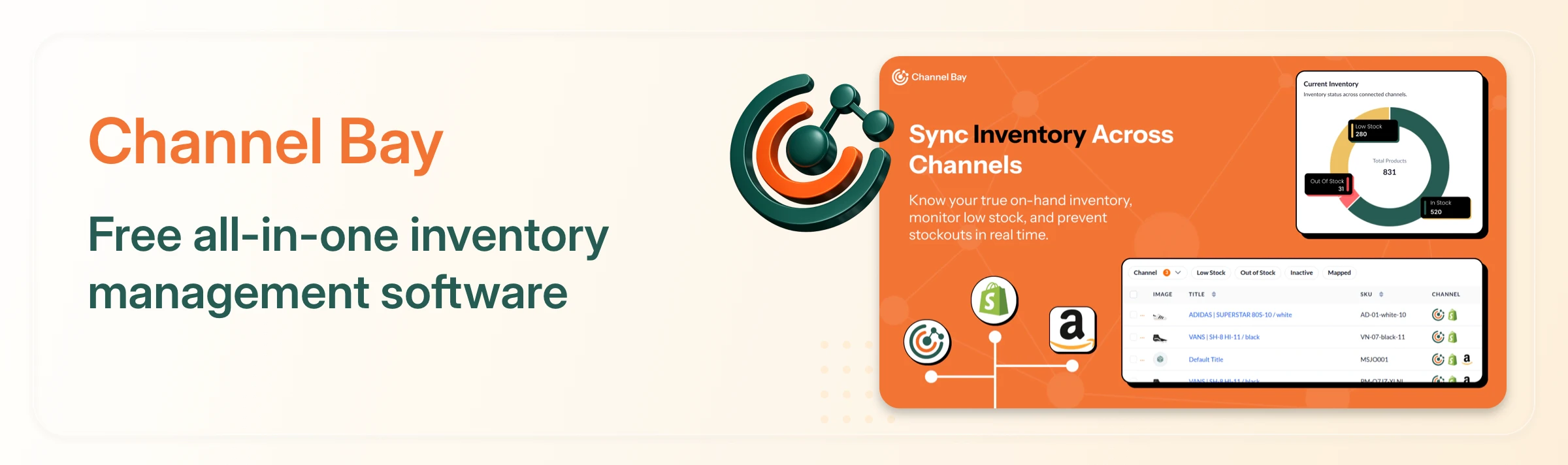
Channel Bay offers a complete inventory management solution for Shopify merchants. It covers multi-channel sync, multi-location tracking, purchase orders, stocktakes, returns, barcode scanning, low-stock alerts, and demand forecasting. All these essential operations can be managed from one centralized platform.
What it does well:
Multi-channel and multi-location sync- Keeps inventory accurate across Shopify stores, sales channels, and warehouse locations from a single dashboard. Stock updates propagate in real time, preventing the oversell scenarios that arise when channels fall out of sync.
Purchase order management- Create purchase orders directly within Shopify, assign multiple suppliers to a single product, and track incoming stock before it arrives.
Barcode scanning- Map physical products to their digital SKU, price, and inventory count instantly, particularly useful during stocktakes and goods receipt.
Return order tracking- Returned items are automatically reflected in inventory levels. No manual adjustment, no discrepancy.
Low-stock alerts- Set custom thresholds per product or location. Channel Bay triggers alerts before stockouts happen, not after.
The strongest stock management app for Shopify merchants who need real inventory management without a monthly subscription. Suitable for single-store merchants and multi-location operations alike.
Sumtracker
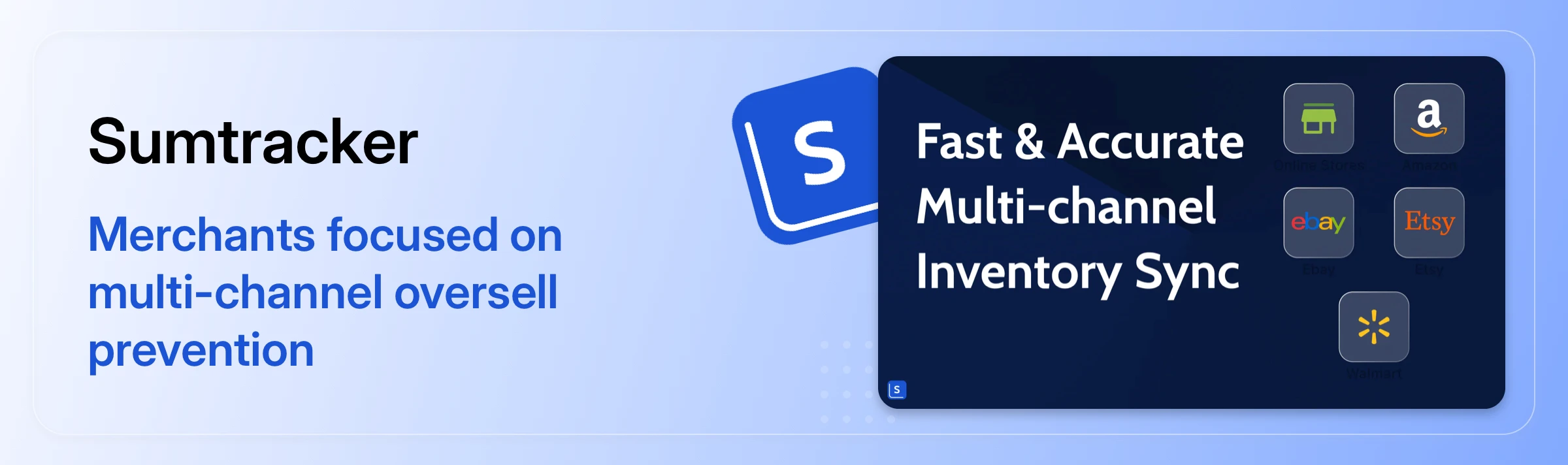
Sumtracker is built around one core problem: keeping inventory accurate when you sell across multiple platforms simultaneously. Merchants who sell on Shopify, Amazon, and other marketplaces often encounter stock discrepancies when one channel sells faster than expected. Sumtracker syncs all channels in near real time and adjusts available inventory to reflect actual sellable stock.
Pricing: Free, Manage ($59/month), Manage + Replenish ($119/month).
What it does well:
Bundle and kit inventory, complex product structures where one sale reduces multiple SKUs
Purchase order creation and replenishment planning built into the Manage + Replenish tier
Inventory forecasting at the mid tier
One thing to know- Getting the most out of Sumtracker requires careful configuration of inventory ownership and channel settings during setup. It's worth spending time on this before you go live, incorrect configuration is the most common source of sync errors on the platform.
Best for multi-channel merchants whose primary problem is overselling or inventory discrepancies between platforms.
Cin7
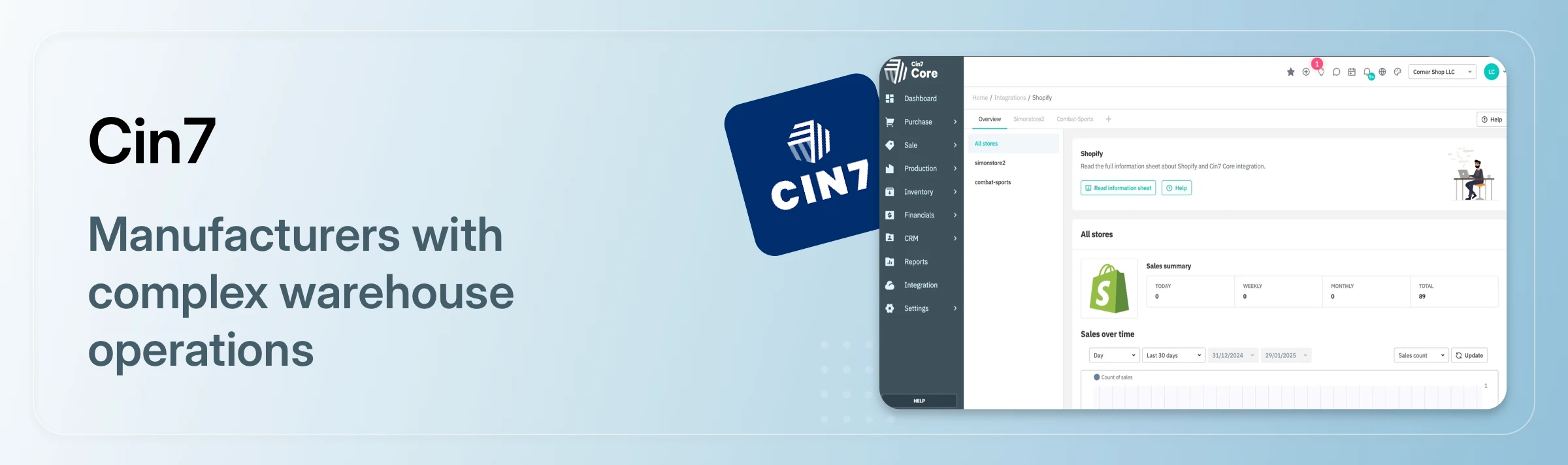
Cin7 is an enterprise-grade inventory and manufacturing platform. For businesses that manufacture products, manage multiple warehouses, and need barcoding built into receiving and picking workflows, it's one of the most complete options available.
Pricing: Standard ($349/month), Pro ($599/month), Advanced ($1199/month).
What it does well:
Barcode scanning integrated across warehouse workflows
Strong onboarding process, one of the better-reviewed implementations in its category
Over 700 integrations with sales, accounting, and logistics platforms
One thing to know: Cin7's feature depth means configuration takes time. Smaller Shopify merchants, those running fewer than 3 locations or without manufacturing workflows, will pay for capability they're unlikely to use. Its price floor is $349/month, which is meaningful for early-stage businesses.
Best for manufacturers and inventory-heavy businesses with multi-warehouse operations and $350+ monthly budget for their IMS.
Katana
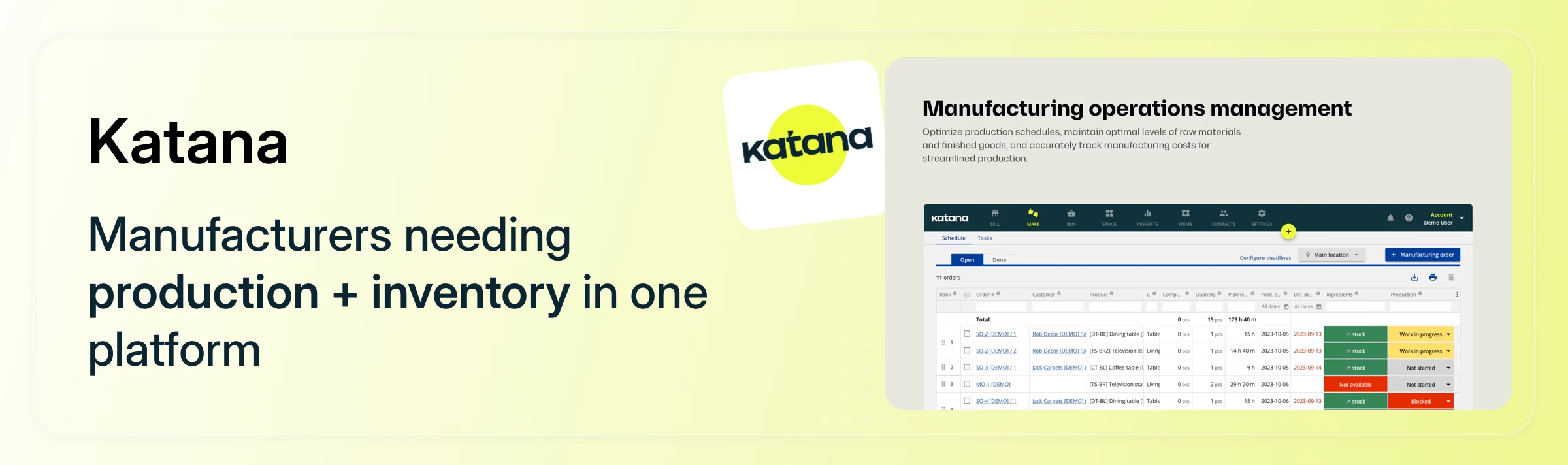
Katana is built specifically for manufacturers who sell through Shopify and need to manage production schedules, raw material stock, and finished goods inventory in one place. Unlike Cin7, it is more tightly scoped to production-first workflows.
Pricing: Free plan, Core from $299/month.
What it does well:
Production planning tied directly to Shopify demand
Material tracking, monitor raw material stock alongside finished product inventory
Reduces spreadsheet dependency for shops running both manufacturing and ecommerce
One thing to know: Katana is purpose-built for manufacturers. Merchants who don't run production workflows won't get full value from its feature set.
Best for small-to-mid manufacturers who sell direct-to-consumer through Shopify and need production and inventory tracked in the same platform.
Prediko
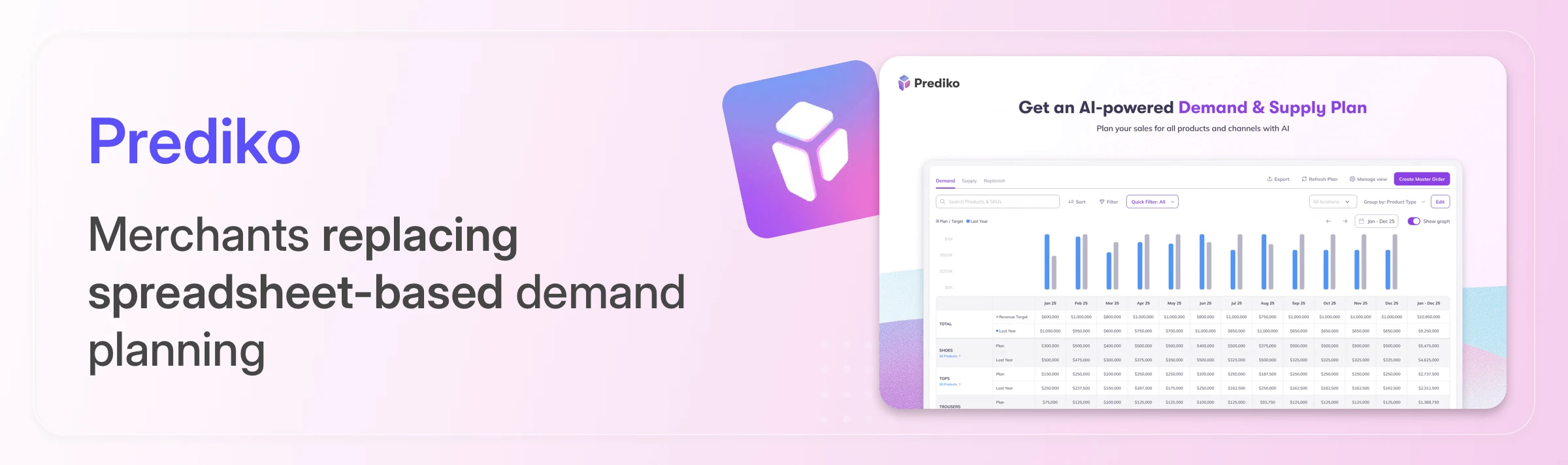
Prediko focuses on one problem: helping Shopify merchants predict when they'll run out of stock and order ahead of time. It replaces the ad hoc spreadsheet forecasting that most growing stores use, replacing gut-feel reorder timing with demand-driven planning.
Pricing: Free to install, Starter ($49/month), Scale-Up ($119/month), Growth ($199/month).
What it does well:
Demand forecasting using historical Shopify sales data
Replenishment planning that surfaces reorder recommendations with suggested quantities
Stockout prevention, alerts and plans before inventory runs out, not when it does
One thing to know: Prediko's focus is planning, not operations. It doesn't include warehouse workflows, barcode scanning, or stocktakes. Merchants who need those alongside forecasting
Best for merchants who've outgrown spreadsheet-based buying decisions and want data-driven purchasing. Particularly strong for seasonal businesses with irregular demand patterns.
Assisty
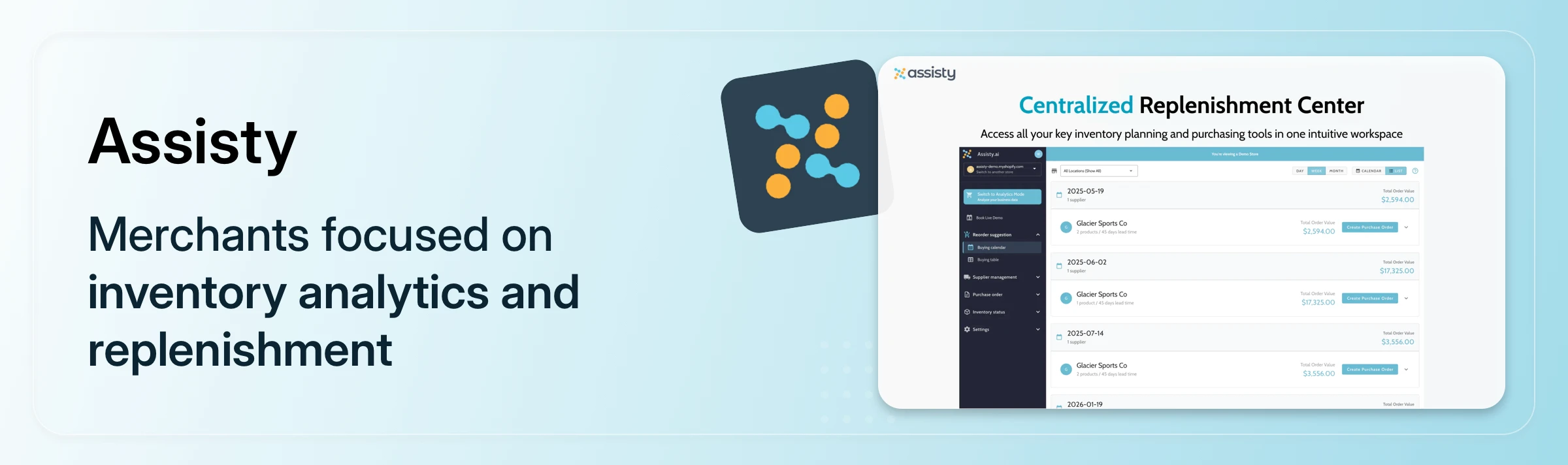
Assisty offers similar forecasting and replenishment capabilities to Prediko, with stronger native reporting and analytics. It's a cost-effective option for merchants who want inventory insights alongside replenishment planning, particularly useful for stores where understanding inventory performance by SKU, category, or channel matters as much as preventing stockouts.
Pricing: Free to install, Basic ($19/month), Advanced ($59/month), Shopify Plus ($199/month).
What it does well:
Forecasting and replenishment planning with actionable purchase order suggestions
Inventory performance analytics, strong visibility into which SKUs are underperforming, which are at risk, and where capital is tied up
Competitive pricing compared to enterprise alternatives
One thing to know: Like Prediko, Assisty is a planning layer, not a full operational IMS. Merchants running warehouses or high-volume receiving workflows should pair it with a dedicated warehouse tool. Some merchants find it useful to cross-check Assisty recommendations against Shopify directly, especially during high-volume periods.
Best for Shopify merchants who want to combine inventory analytics with replenishment planning at a lower price point than enterprise tools.
How to Choose the Right Shopify Inventory Management Software
Match the tool to your primary operational problem:
If your main problem is- | Consider |
You lost Stocky and need a perfect replacement | Channel Bay |
Overselling across Shopify + Amazon or other channels | Sumtracker |
You manufacture products and manage raw materials | Katana or Cin7 |
Your buying decisions rely on spreadsheets | Prediko |
You want inventory analytics alongside replenishment | Assisty |
You need enterprise warehouse management with 3+ locations | Cin7 |
Frequently Asked Questions
What is the best inventory management app for Shopify in 2026?
Channel Bay is the strongest option. It includes multi-channel inventory sync, multi-location tracking, purchase orders, stocktakes, return management, barcode scanning, and low-stock alerts at no cost.
Do I need inventory management software if Shopify has built-in inventory tracking?
Shopify's native tools are adequate for single-location, single-channel merchants. Once you add a second location, sell on additional platforms, or manage purchase orders with multiple suppliers, a dedicated inventory management app provides automation and accuracy that Shopify's built-in tools don't cover.
What features should I prioritize when choosing a Shopify inventory management app?
Prioritize the features that map to your actual operational gaps. For multi-channel merchants: real-time sync and oversell prevention. For growing stores: purchase orders and low-stock alerts. For data-driven buyers: demand forecasting and replenishment planning. For manufacturers: production planning and raw material tracking. Avoid paying for features (enterprise warehouse management, advanced manufacturing workflows) you won't use.
How much does Shopify inventory management software cost?
Pricing ranges from free to $1,199/month (Cin7 Advanced). Mid-tier options like Sumtracker ($59 - $199/month), Prediko ($49 - $199/month), and Assisty ($19 - $199/month) cover most growing Shopify merchants. Enterprise platforms like Cin7 start at $349/month and are best suited for manufacturing businesses.
Can inventory management software prevent stockouts on Shopify?
Yes, through two mechanisms. Low-stock alerts notify you when inventory falls below a threshold so you can reorder manually. Forecasting tools (Prediko, Assisty) predict future demand based on sales history and generate replenishment recommendations, letting you reorder before stockouts occur rather than reacting to them.
The Bottom Line
The best inventory management app for Shopify in 2026 is the one that solves your specific operational problem. For most Shopify merchants, Channel Bay is the obvious starting point, it covers the full operational surface. Merchants scaling into multi-channel need Sumtracker. Manufacturers need Cin7 or Katana. Data-driven buyers who want to stop reordering by gut feel should look at Prediko or Assisty.
The wrong move is choosing the most feature-rich tool rather than the most relevant one. Start with your biggest inventory pain point and pick the tool built to solve it.

