

Shopify Inventory Management: The Complete Guide
A complete guide to Shopify inventory management: tracking, transfers, purchase orders, plan limits, and the multi-channel gaps a third-party app fills.

Shopify inventory management is the set of built-in tools that let you track stock levels, manage SKUs and barcodes, transfer inventory between locations, create purchase orders, and update quantities in bulk, all from the Shopify admin. Ahead of Stocky's full shutdown on August 31, 2026, Shopify has folded most of Stocky's core operational features directly into the admin, so you can keep managing inventory without changing where you work. The catch is that Shopify handles inventory operations well but does not cover inventory planning or multi-channel sync, and that gap is where most growing stores get stuck.
In this guide we'll walk through every Shopify inventory management feature, show what each plan actually includes, spell out the real limitations (the ones Shopify docs quietly confirm), and explain how a third-party app like Channel Bay picks up where the native tools stop.
Key Takeaways |
Shopify moved most of Stocky's operational features (transfers, purchase orders, receiving, adjustments) into the admin before Stocky shuts down completely on August 31, 2026. |
Every Shopify plan includes inventory management, but active location limits differ: Starter gets 2, Basic through Advanced get 10, and Shopify Plus gets 200 |
Shopify handles inventory operations but not inventory planning: there's no native demand forecasting, ABC analysis, or min/max reorder points after Stocky. |
Shopify can't keep stock synced across marketplaces like Amazon on its own. A third-party app like Channel Bay closes that gap and centralizes multi-channel inventory in one dashboard. |
What is Shopify inventory management?
Shopify inventory management is how you track and control product stock across your store and locations from a single admin dashboard. It covers inventory tracking, SKU and barcode assignment, stock transfers, purchase order creation, and bulk quantity updates. Every Shopify plan includes some version of it, though what you can do scales with your subscription.
Here's the piece of context that matters right now. Shopify acquired Stocky in 2018 and bundled it with POS Pro as the go-to inventory app for years. That era is ending. Stocky stopped supporting inventory transfers and min/max forecasting on July 7, 2025, was pulled from the Shopify App Store on February 2, 2026, and stopped working entirely on August 31, 2026. Shopify's answer is to bring the operational parts of Stocky into the admin so you're not left without a workflow. In our experience helping stores through this shift, the migration is smooth for basic tracking but leaves a real hole in planning, which we'll get to.
What are Shopify's inventory management features?
The core Shopify inventory management features let you track stock in real time, manage SKUs and barcodes, move inventory between locations, create and receive purchase orders, and update quantities in bulk or by CSV. These tools live natively in the admin and, for most single-store merchants, cover day-to-day operations without any extra app.
How does inventory tracking work in Shopify?
Shopify tracks each product across five inventory states, which tells you exactly where every unit sits at any moment. Getting these five right is the foundation of accurate stock counts, so it's worth knowing what each one means.
Available: units ready to sell right now, not committed to any open order.
Committed: units in a placed order you haven't fulfilled or shipped yet.
On hand: the total physical count in your location, available plus committed.
Unavailable: units you can't sell yet, such as damaged stock or safety stock held back.
Incoming: units you've ordered from a supplier that haven't arrived.
How does multi-location inventory management work?
Multi-location inventory lets you track and move stock across warehouses, retail stores, and fulfillment locations, then rebalance based on demand. You create a transfer in the admin, set the destination, track quantities in transit, and confirm what arrives. This keeps the right products at the right location without double-counting the same units. Transfers moved into the Shopify admin as part of the Stocky migration, though the admin version doesn't yet support Stocky's min/max replenishment triggers.
How do you create purchase orders in Shopify?
You create a purchase order in the admin, assign it to a supplier, add products and quantities, and send it directly to the vendor. When stock arrives, you receive it against the PO and Shopify updates your inventory counts. Purchase orders can be tied to any active location, including online warehouses, fulfillment centers, home offices, and physical POS retail stores. One limit to know: native CSV upload for POs only adds product line items to a new draft. It can't import past PO statuses or supplier links.
How do bulk editing and CSV updates work?
You have two ways to update many products at once. The Bulk Editor is for manually changing quantities, SKUs, or pricing across a few dozen items without touching a file. CSV import and export is for larger jobs: hundreds of products, or a full warehouse count you've already got sitting in a spreadsheet. Pick the Bulk Editor for quick in-admin edits and CSV when your data is already prepared outside Shopify.
What automation and analytics does Shopify include?
Shopify offers low-stock automation through Shopify Flow and inventory reporting through its analytics, though both depend on your plan. With Flow, you can trigger a low-stock alert when a product hits a threshold you set. Shopify's professional reports (on higher plans) surface sell-through rates, days of inventory remaining, and ABC-style product analysis that flags fast movers versus dead or slow-moving stock. The depth of this reporting is one of the clearest reasons stores upgrade tiers.
How does Shopify manage inventory across its plans?
Shopify manages inventory on every plan, but the number of active locations, the reporting depth, and the automation you get all scale with your subscription. The single hard limit that trips people up is active locations. Deactivated locations don't count against it. Here's how the plans compare.
Plan | Active locations | Inventory capability |
Starter | 2 | Basic tracking only. No transfers, purchase orders, bulk editing, or CSV import/export. |
Basic | 10 | Full operational toolkit: statuses, POs and receiving, transfers, Bulk Editor, CSV, SKUs and barcodes. |
Grow | 10 | Everything in Basic, plus Shopify Flow automation and professional reports (sell-through, days of inventory, ABC analysis). |
Advanced | 10 | Everything in Grow, plus a custom report builder and deeper inventory analytics for purchasing decisions. |
Shopify Plus | 200 | Enterprise: smart order routing, native B2B inventory, and up to 9 expansion stores with centralized control. |
Beyond the table, a few plan details are worth calling out. Starter is a payment-and-buy-button tool, not a full store: it does basic tracking but no transfers, purchase orders, bulk management, or CSV import/export. Basic unlocks the full operational toolkit most merchants need. Grow adds Shopify Flow automation and professional reports. Advanced adds a custom report builder and deeper inventory analytics. Plus is the enterprise tier, with up to 200 locations, smart order routing, native B2B inventory, and expansion stores for regional storefronts.
How to manage inventory in Shopify (step by step)
Managing inventory in Shopify comes down to a repeatable loop: set up locations, enable tracking per product, keep counts accurate, and reorder before you run out. Inventory management in Shopify is only as reliable as the process behind it, so the goal is to run the same steps every cycle rather than reacting to stockouts. Here's the practical order we recommend.
Set up your locations. Add each warehouse, store, or fulfillment point under Settings, staying within your plan's active-location limit.
Turn on tracking per product. Enable "track quantity" and assign SKUs and barcodes to every product and variant so counts and scanning work.
Keep counts accurate. Adjust quantities manually, in bulk with the Bulk Editor, by CSV, or with barcode scanning in the admin and POS.
Move stock as demand shifts. Create transfers to rebalance inventory between locations, and confirm receipt at the destination.
Reorder on time. Create purchase orders for suppliers, send them, and receive stock against the PO so counts update automatically.
The tricky part, and the reason managing inventory in Shopify breaks down for growing stores, is step 5. Without Stocky's forecasting, deciding when and how much to reorder now falls on a person watching low-stock alerts and spreadsheets.
What are the challenges of Shopify inventory management?
The main Shopify inventory management challenges are the absence of multi-channel stock sync, no demand planning, and thin warehouse features. Shopify's native tools are strong for single-store, direct-to-consumer operations, but they were built for inventory operations, not inventory intelligence. From what we've seen, these are the gaps that push stores toward a third-party app:
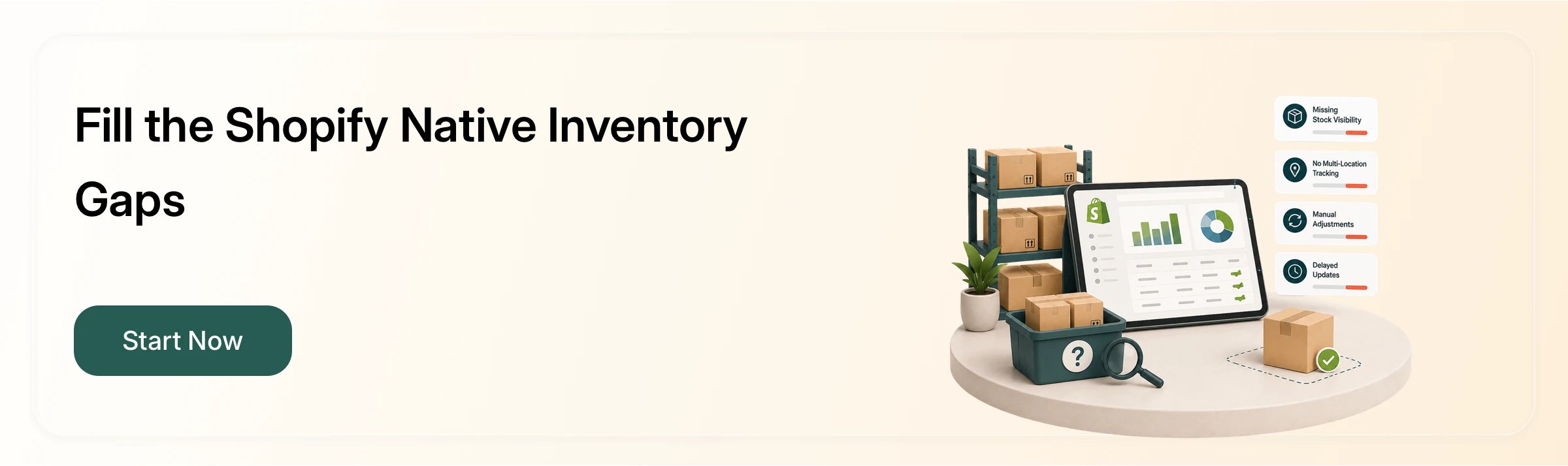
No real-time multi-channel sync. Shopify alone can't keep stock aligned across Amazon or any other, which risks overselling.
No demand planning. After Stocky, the admin has no native forecasting, ABC analysis, or min/max reorder points.
Basic warehouse management. No bin locations, pick paths, or cycle counting.
Limited supplier workflows. Suppliers can't even be exported from Stocky, and native supplier management is minimal.
Limited barcode workflows. No advanced scanning flows for receiving, returns, and stocktakes tied together.
How do third-party apps improve inventory management in Shopify?
Third-party inventory apps extend Shopify with the planning, multi-channel sync, and advanced warehouse features the native tools skip. They act as a bridge between Shopify and your other sales channels, keeping stock accurate everywhere from one dashboard. This matters most for stores selling on marketplaces, where a single sale on Amazon needs to decrement Shopify stock instantly to prevent overselling.
How does Channel Bay fill Shopify's inventory gaps?
Channel Bay is a Shopify inventory management app that centralizes stock, purchasing, and multi-channel sync in one dashboard. It's built to serve as a Stocky alternative while adding the cross-channel control Shopify lacks natively. Here's what it handles.
Purchase order creation: build POs, pick or add a supplier, set quantities and costs, send directly, then receive against the PO so stock updates automatically.
Multi-channel inventory: connect Shopify with Amazon and other marketplaces and manage every channel's stock from one place.
Real-time inventory sync: when stock changes on any connected channel, Channel Bay updates the rest automatically so you don't oversell.
Bulk editing and CSV: update many products at once and sync the changes across every connected channel.
Low-stock alerts: set minimum thresholds and get notified in time to reorder or transfer.
Supplier and PO management: keep suppliers, products, POs, and order history together and track status end to end.
Advanced barcode workflows: scan for receiving, transfers, returns, and stocktakes to cut data-entry errors.
The bottom line
Shopify gives you a solid inventory foundation: tracking, transfers, purchase orders, barcode management, and bulk updates, all native and included on every plan. For a single store, that's often enough. The limits show up when you sell across channels or need real planning, since Shopify covers operations but not forecasting or multi-channel sync. For growing merchants, an app like Channel Bay bridges that gap by syncing stock across every channel in real time and centralizing purchasing, suppliers, and barcode workflows in one dashboard.
FAQs
What are the limitations of Shopify inventory management?
The main limitations are no real-time multi-channel stock sync, no native demand forecasting or ABC analysis after Stocky's shutdown, basic warehouse features with no bin locations or cycle counting, and limited supplier and barcode workflows. Stores selling on marketplaces or needing reorder planning usually add a third-party app.
Can Shopify support multi-channel inventory management?
Not on its own. Shopify can't keep stock synced across marketplaces like Amazon, eBay, or Walmart natively, which risks overselling. To manage multi-channel inventory you need a third-party app such as Channel Bay that bridges Shopify and your other channels and syncs stock automatically from one dashboard.
Do Shopify's inventory features change with the plan?
Yes. Every plan includes inventory management, but capability scales. Active location limits run from 2 on Starter to 10 on Basic through Advanced and 200 on Shopify Plus. Higher plans add Flow automation, professional reports, and a custom report builder.
What is replacing Stocky for Shopify inventory management?
Shopify moved Stocky's operational features (transfers, purchase orders, receiving, adjustments) into the admin before Stocky shuts down on August 31, 2026. But planning features like forecasting and min/max reorder points weren't rebuilt, so many merchants pair the admin with a third-party app.
How do I manage inventory across multiple locations in Shopify?
Add each location in settings within your plan's limit, then create transfers in the admin to move stock between them. Set the destination, track quantities in transit, and confirm receipt. This keeps counts accurate across warehouses and stores without double-counting the same units.

