Landed Cost: What It Is and How to Calculate It
Landed cost is the supplier price plus freight, duty and fees to get stock sellable. The formula, what to include, and a worked example split three ways.
On this page
Key Takeaways
- Landed cost is everything it took to get stock ready to sell: the supplier price plus freight, insurance, duties and fees. Per unit, it's (line cost + the line's share of those costs) / units received.
- On a PO with mixed products, how you split the extra costs matters more than the formula. The same $1,650 of freight and duty put a skillet at $13.83, $15.30 or $19.64 a unit.
- Split freight by weight or volume, and duties and insurance by value. Split by quantity only when every unit is much the same.
- Divide by the units you received and can sell, not the units you ordered, and leave out recoverable taxes such as VAT, GST and import VAT you reclaim.
- Shopify keeps one cost per item for each variant, so every new delivery's cost replaces the last one. Record landed cost per delivery if you want to see when your margin moved.
Landed cost is the total cost of getting a product from your supplier to the point where you can sell it: the supplier price plus freight, insurance, import duties, brokerage, and payment or currency fees. To calculate landed cost per unit, split the costs that sit on the whole order across its lines, add each line's share to its product cost, then divide by the number of units you received.
The formula is the easy part. The hard part is the split. On a PO that mixes a light, cheap product with a heavy one, splitting freight by quantity, value or weight can move one product's unit cost by more than 40%, and its margin with it. This guide takes one purchase order through every step, shows all three ways to split the costs, and explains which one to use.
If you're new to purchase orders themselves, start with our guide to what a purchase order is and how it works.
What Is Landed Cost?
Landed cost is what a unit really cost you by the time it's on your shelf, and the price on the PO line is only the first part of it. The US tax code takes the same view of inventory: the cost of merchandise you buy is the invoice price minus discounts, "plus transportation or other charges incurred in acquiring the goods" (IRS Publication 538, Inventories).
Here's what belongs in landed cost and what doesn't.
| Include in landed cost | Leave out |
|---|---|
| Supplier price, after line and order discounts | Import VAT or GST you reclaim |
| International and inland freight to your warehouse | Shipping to your customers |
| Cargo insurance | Storage once the stock is on your shelf |
| Customs duties and tariffs | Marketing, packaging for orders, platform fees |
| Customs brokerage, port and handling fees | Sales tax on goods bought for resale (normally not charged) |
| Bank, payment and currency conversion fees | |
| Taxes you pay and can't recover |
Check your Incoterms before you add freight or duty. On an FOB or EXW order you pay the freight separately, so it's an extra cost. On CFR or CIF the supplier's price covers the main freight (and insurance on CIF), but not import duty or brokerage. On a DDP order the supplier's price already includes freight and duty, so adding them again counts them twice (Incoterms rules, International Chamber of Commerce).
The Landed Cost Formula
For a whole order:
Landed cost = product cost + freight + insurance + duties + fees + adjustments − discounts
For one product on that order:
Landed cost per unit = (line cost + line's share of extra costs) / units received
A line's share depends on the method you choose. Split by value, it is:
Line share = line value / order value x total extra costs
Split by weight or quantity, replace "value" with the line's kilograms or units.
How to Calculate Landed Cost: A Worked Example
A kitchenware brand orders three products from one overseas supplier on FOB terms. Here is the purchase order.
| Product | Units | Unit price | Line value | Weight per unit | Line weight |
|---|---|---|---|---|---|
| Ceramic mug | 600 | $3.00 | $1,800 | 0.4 kg | 240 kg |
| Cast-iron skillet | 100 | $12.00 | $1,200 | 2.5 kg | 250 kg |
| Chef's knife | 200 | $15.00 | $3,000 | 0.25 kg | 50 kg |
| Total | 900 | $6,000 | 540 kg |
The duty figure below is illustrative. Your real duty depends on each product's tariff code and where you import.
Step 1: Start From What You'll Actually Pay the Supplier
Take each line's value after any discounts the supplier gave you, in your own currency. If the supplier invoices in euros or yuan, convert at the rate you actually paid and add the bank's conversion fee to your extra costs. Here everything is in dollars and there are no discounts, so product cost is $6,000.
Step 2: Total the Extra Costs
Collect every invoice that belongs to this delivery:
| Extra cost | Amount |
|---|---|
| Ocean freight | $1,080 |
| Customs duty | $420 |
| Customs brokerage, insurance and port fees | $150 |
| Total extra costs | $1,650 |
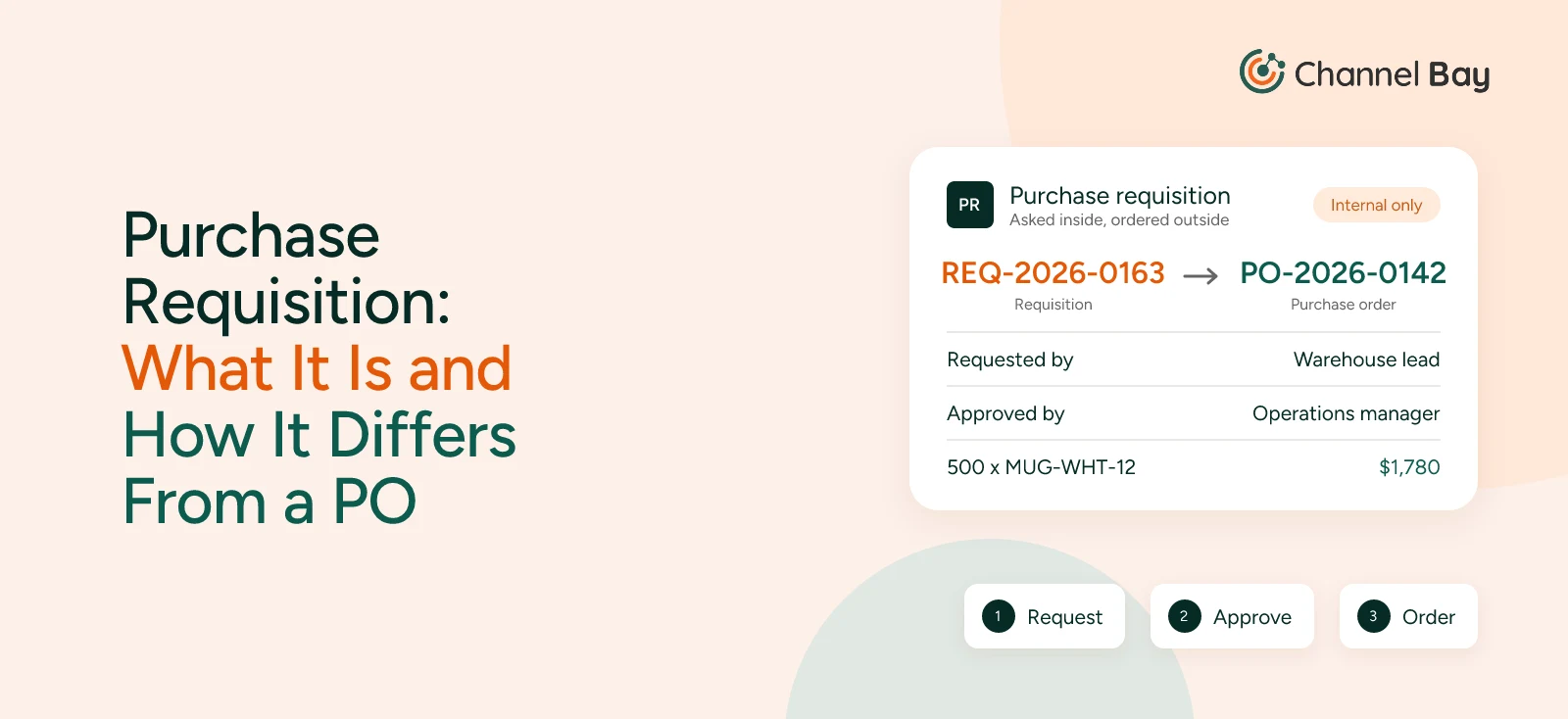
The order's landed cost is $6,000 + $1,650 = $7,650. Divided by 900 units, that's $8.50 a unit, which is true of no product on this order. A $3 mug and a $15 knife can't both cost $8.50. The $1,650 has to be split line by line.
Step 3: Split the Extra Costs Across the Lines
There are three common ways to split them.
By quantity: every unit carries the same share, $1,650 / 900 = $1.83.
By value: each line carries extra costs in proportion to its value. Extra costs are 27.5% of product cost ($1,650 / $6,000), so each unit's price goes up by 27.5%.
By weight: each line carries extra costs in proportion to its kilograms, $1,650 / 540 kg = $3.06 per kg.
| Product | Share by quantity | Share by value | Share by weight |
|---|---|---|---|
| Ceramic mug (600) | $1,100.00 | $495.00 | $733.33 |
| Cast-iron skillet (100) | $183.33 | $330.00 | $763.89 |
| Chef's knife (200) | $366.67 | $825.00 | $152.78 |
| Total | $1,650.00 | $1,650.00 | $1,650.00 |
Each column adds back to $1,650. That's the check that the split is complete: every dollar of freight and duty lands on exactly one line.
Step 4: Divide by the Units You Received
Add each line's share to its value, then divide by the units that arrived in sellable condition, not the units you ordered. Using the split by value:
- Mug: ($1,800 + $495) / 600 = $3.83
- Skillet: ($1,200 + $330) / 100 = $15.30
- Knife: ($3,000 + $825) / 200 = $19.13
Now suppose 4 knives arrived broken and the supplier won't credit them. You paid for 200 but can sell 196, so the knife's landed cost is $3,825 / 196 = $19.52. If the supplier credits them, take the $60 off the line value: ($2,940 + $825) / 196 = $19.21. The credit refunds the price, not the freight and duty you paid to ship the broken knives.
Step 5: Record the New Cost Against the Product
The number only helps if it reaches the place your margins are calculated. If you value stock at a rolling average, blend the new delivery with what's already on the shelf. With 150 knives in stock at $18.40 and 196 received at $19.52:
(150 x $18.40 + 196 x $19.52) / 346 = $19.03 per knife
If you use the last received cost instead, the knife simply becomes $19.52. Either way, keep the per-delivery figure somewhere you can find it, because it's the only record of what that shipment really cost.
Landed Cost Allocation: By Quantity, Value or Weight
Here are the per-unit landed costs from the same PO, side by side.
| Product | PO price | By quantity | By value | By weight | Freight by weight, duty and fees by value |
|---|---|---|---|---|---|
| Ceramic mug | $3.00 | $4.83 | $3.83 | $4.22 | $4.09 |
| Cast-iron skillet | $12.00 | $13.83 | $15.30 | $19.64 | $18.14 |
| Chef's knife | $15.00 | $16.83 | $19.13 | $15.76 | $16.93 |
Say the skillet sells for $45. On the PO price its gross margin looks like 73%. Split by value it's 66%. Split by weight it's 56%. Nothing about the product changed, only the arithmetic.
Each method suits a different cost:
- By value fits duties and insurance best, because both are charged as a percentage of the goods' value. It's also a common default in inventory software. Its weak spot is products that are heavy for their price: the skillet above carries less freight than it really caused.
- By weight or volume fits freight best, because carriers charge by weight or volume, whichever is greater. Use volume for bulky, light goods shipped by sea.
- By quantity fits only when every unit on the PO is much the same, such as one T-shirt in five colors. On mixed orders it overcosts the cheap items and undercosts the expensive ones.
When products on one PO differ a lot in weight, split the freight invoice by weight and split duties, insurance and fees by value. That's the last column in the table: here, $1,080 of freight at $2.00 per kg and $570 of duty and fees at 9.5% of value. It takes one more line in a spreadsheet and gives the most defensible number.
When the products are alike in weight and price, splitting everything by value is accurate enough, and much simpler to keep up.
Common Landed Cost Mistakes
Adding duty as a flat percentage of landed cost. Duty is worked out on the customs value, and countries define that differently. In the US, the cost of international freight and insurance is excluded from the transaction value duty is charged on (CBP, Proper Deductions). In the UK, transport costs up to the UK border are included (GOV.UK). Use the duty on your customs entry, and if it's shown per tariff line, give each product its own duty instead of splitting the total.
Forgetting the small fees. Brokerage, port handling, US merchandise processing fees (a percentage of value with a minimum and maximum, see CBP's user fee table) and bank charges are each small, but together they often add a few percent to an order.
Spreading one shipment's freight across the whole PO. If a PO arrives in two deliveries with two freight bills, cost each delivery on its own.
Counting recoverable tax. Import VAT or GST you reclaim is not a cost, so including it overstates landed cost and understates margin.
Doing it once and never again. Freight rates and tariffs move between orders. A landed cost worked out last spring is not this delivery's landed cost.
Landed Cost in Shopify
Shopify stores one cost per item for each variant. Whatever you enter replaces the previous value, so a mug that landed at $3.83 on this PO and $4.20 on the next shares a single number, and there's no record in the product of which delivery cost what. That's how margins drift without anyone noticing: the cost on the product is whatever was typed in last.
Shopify's native purchase orders let you add shipping, customs duties and other fees to each shipment on the linked inventory transfer as cost adjustments. The transfer's cost summary then compares the cost agreed on the PO with the actual cost of receiving it (Shopify Help Center). Shopify's docs don't describe spreading those adjustments into each product's cost per item, so the five steps above still happen in a spreadsheet, and the result is typed into each variant by hand.
Merchants who relied on Stocky's purchase order cost fields have run into this since it shut down. If you're still sorting out what happened to your Stocky data, see whether your Stocky app still works.
How Channel Bay Calculates Landed Cost
Channel Bay works out landed cost per unit as you receive a purchase order, so steps 1 to 5 happen without a spreadsheet:
- Currency: The supplier's price is converted to your shop currency at the rate on the day the PO was opened. If you paid at a noticeably different rate, override the line's landed cost.
- Freight per delivery: Each delivery you receive is its own batch, with its own freight and supplier invoice number, and is costed on its own.
- Adjustments, discounts and tax: Add adjustments for surcharges or supplier credits, line or order discounts, and tax on the PO.
- Spread by value: Freight, adjustments and order discounts are spread across the lines by value, using the formula above. If you'd rather split a PO by weight, you can override the landed cost on any line.
- Cost sync: With cost sync on, the new cost is saved on the supplier and the variant, then sent to Shopify. Stock is valued at the last received cost or a rolling average, whichever you choose.
See how Channel Bay handles purchase orders and landed cost, or read more about the full purchase order process, from raising the order to closing it.
Frequently Asked Questions
What is landed cost?
What is the formula for landed cost?
Should landed cost include VAT, GST or sales tax?
Is landed cost the same as COGS?
Does Shopify calculate landed cost per unit?
How do I calculate landed cost when a PO arrives in several shipments?

Guides from the team that builds and supports Channel Bay, the Shopify inventory app for purchase orders, stocktakes, stock transfers and multichannel stock sync. About Channel Bay