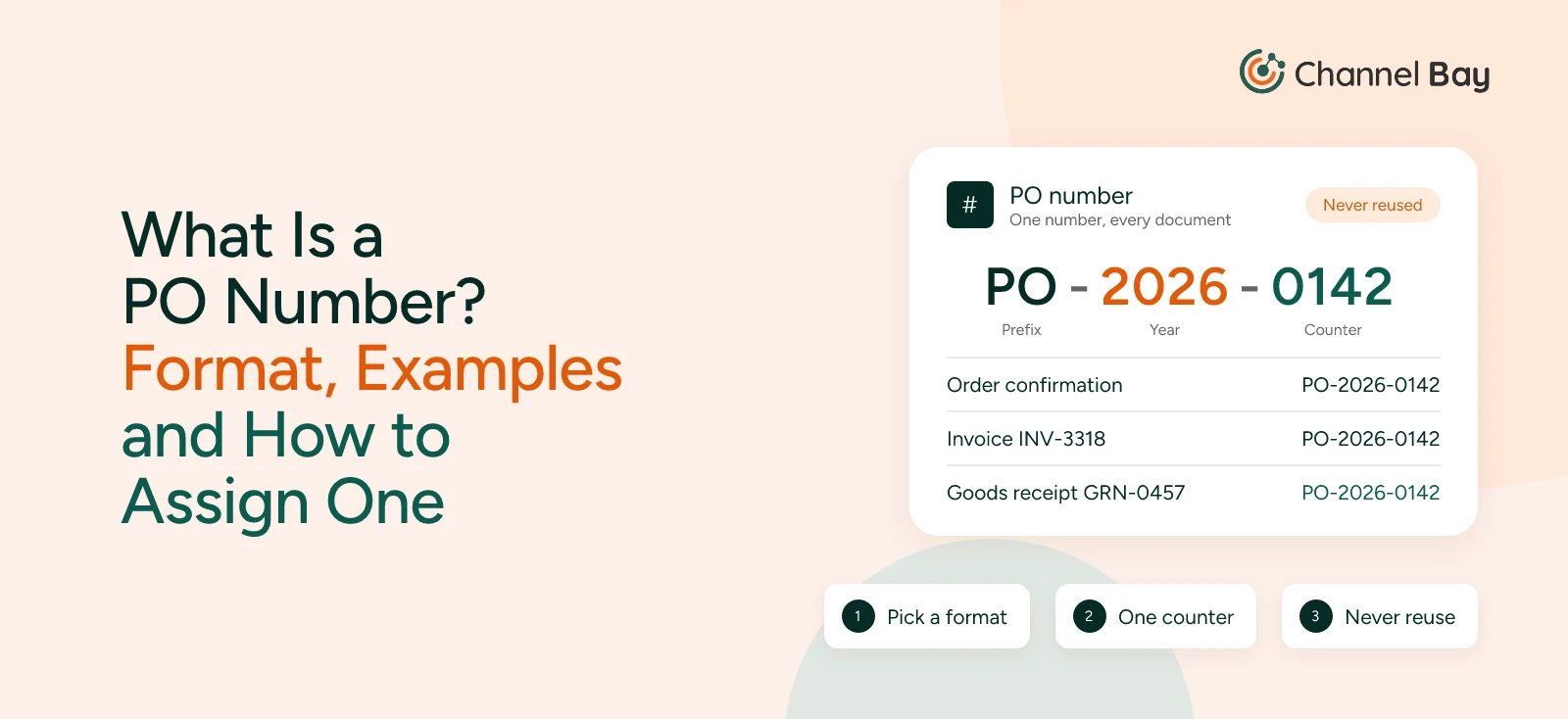
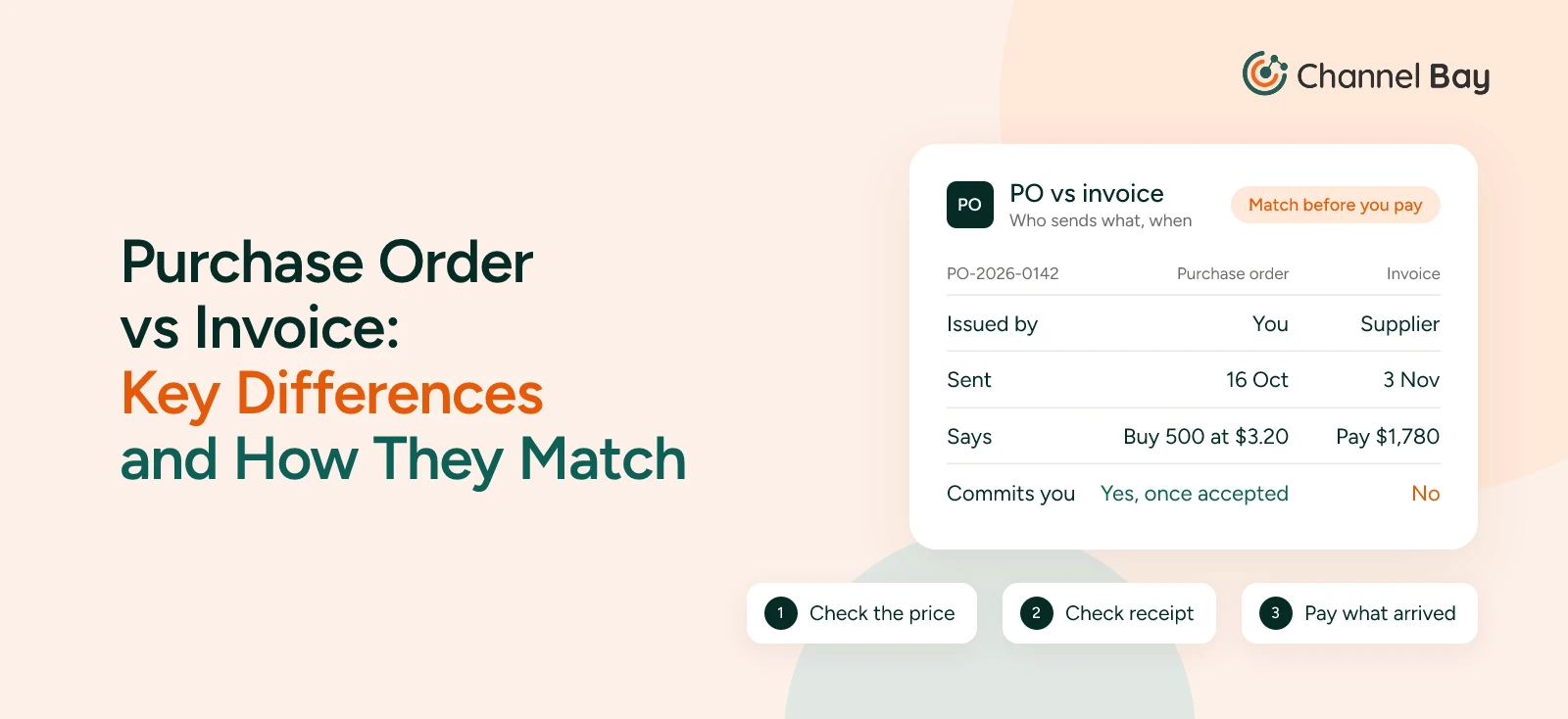
Purchase Order vs Invoice: Key Differences and How They Match
A purchase order is what you agree to buy; an invoice is what the supplier bills. The key differences, how to match them, and what to pay when they disagree.
On this page
- What is the difference between a purchase order and an invoice?
- Purchase order vs invoice: side-by-side comparison
- How a purchase order and an invoice are matched
- What to do when the purchase order and invoice don't match
- When do you pay against a purchase order or an invoice?
- How Channel Bay keeps invoices with the purchase order
Key Takeaways
- A purchase order is the buyer's document, sent before delivery, that commits you to buy at an agreed price. An invoice is the supplier's document, sent after shipment, that asks you to pay.
- The PO sets the price and terms. The invoice is the supplier's claim against them, and it doesn't change what you agreed on its own.
- Before you pay, match the invoice to the PO on price and to the goods receipt on quantity. Checking the PO and invoice alone doesn't tell you what arrived.
- When they disagree, pay for what you accepted at the PO price, and get a credit note or revised invoice for the difference. If you agreed to a change, amend the PO so all three documents show the same thing.
- You pay against the invoice, never the PO. The PO's payment terms decide when, and the goods receipt decides how much.
A purchase order (PO) is the document a buyer sends a supplier to order goods: what to supply, how many, at what price and on what terms. An invoice is the document the supplier sends back, after the goods ship, to ask for payment. The PO comes first and commits you to buy. The invoice comes later and tells you what the supplier thinks you owe.
Most guides to purchase order vs invoice stop there, because they're written for finance teams who match thousands of invoices. For an online seller, the useful part is what happens when the two don't agree: when a supplier bills for 500 mugs and only 480 of them could go on sale. This guide covers both. It uses the same example as our guide to what a purchase order is and how it works: a kitchenware brand orders 500 white mugs on PO-2026-0142.
What Is the Difference Between a Purchase Order and an Invoice?
The difference is who issues each document, when, and what it commits you to. You issue the purchase order before anything ships, and once the supplier accepts it, you're committed to buy on its terms. The supplier issues the invoice after shipping, and it asks you to pay. It records the supplier's side of the deal, but it doesn't change the terms you agreed.
What a Purchase Order Is
A purchase order is the buyer's written offer to buy. It lists the products, quantities, unit prices, any freight or other charges, the delivery date and location, and the payment terms, under a unique PO number. When the supplier accepts it, the PO becomes the agreement both sides work from.
For PO-2026-0142, that's:
| PO-2026-0142 | |
|---|---|
| Line | 500 x MUG-WHT-12 at $3.20 = $1,600 |
| Freight | $180 |
| PO total | $1,780 |
| Due | 10 November, payment Net 30 |
The PO creates no entry in your accounts. It's a commitment to spend, not money owed, so it shows up in your stock on order and your cash planning but not on your balance sheet.
What an Invoice Is
An invoice is the supplier's request for payment. What it has to show depends on the country. UK government guidance, for example, says an invoice must include (GOV.UK):
- A unique invoice number
- The supplier's and the customer's names and addresses
- A description of what's being charged for
- The supply date and the invoice date
- The amounts charged, any VAT, and the total owed
Other countries have similar rules, plus their own tax requirements. For a business buyer, the most useful field isn't on that list: the PO number. Without it, you have to work out which order the invoice belongs to.
When you approve a supplier's invoice, it becomes a bill in your accounts: money you owe, due on the PO's payment terms.
In the example, the supplier ships the mugs on 3 November and emails invoice INV-3318, dated the same day, for $1,780: 500 mugs at $3.20, plus $180 freight. It matches the PO exactly. That turns out to be the problem.
Purchase Order vs Invoice: Side-by-Side Comparison
Here are the invoice vs purchase order differences, row by row.
| Purchase order | Invoice | |
|---|---|---|
| Issued by | The buyer | The supplier |
| Sent to | The supplier | The buyer |
| When | Before delivery, when you place the order | After shipment or delivery. A deposit is billed earlier, on a proforma invoice |
| Purpose | Orders goods on agreed terms | Asks for payment |
| What it commits you to | Buying the goods at the PO price, once the supplier accepts | Nothing new. It's the supplier's claim under the PO |
| Reference number | PO number, chosen by you | Invoice number, chosen by the supplier, quoting your PO number |
| Quantities | What you ordered | What the supplier says it shipped |
| Prices | What you agreed | What the supplier is charging, which should be the PO price |
| Payment terms | Set here, for example Net 30 | Repeats them and gives a due date |
| In your accounts | No entry. Counts as stock on order | A bill you owe, once approved |
| What to check it against | The supplier's acceptance | The PO and the goods receipt |
The PO and the invoice also sit among other documents. On PO-2026-0142, they arrive in this order:
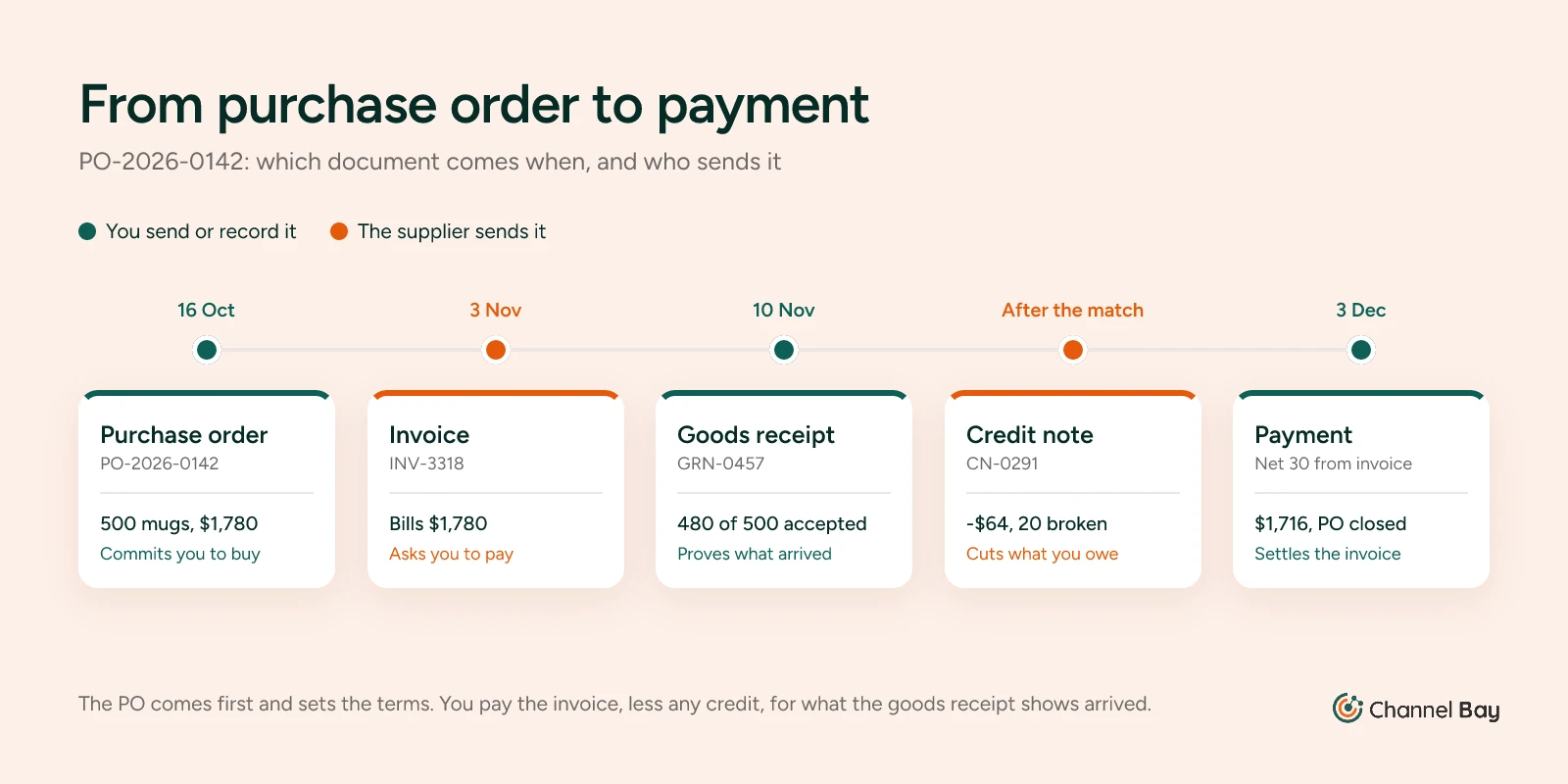
The purchase order guide has the full list, including the packing slip and the payment receipt, and who creates each one.
How a Purchase Order and an Invoice Are Matched
Matching a PO and an invoice means checking that the invoice bills for what you ordered, at the price you agreed. Line by line, the invoice should show the same products, the same unit prices and the same extra charges as the PO, and quote the PO number. This PO vs invoice check is what finance teams call a two-way match.
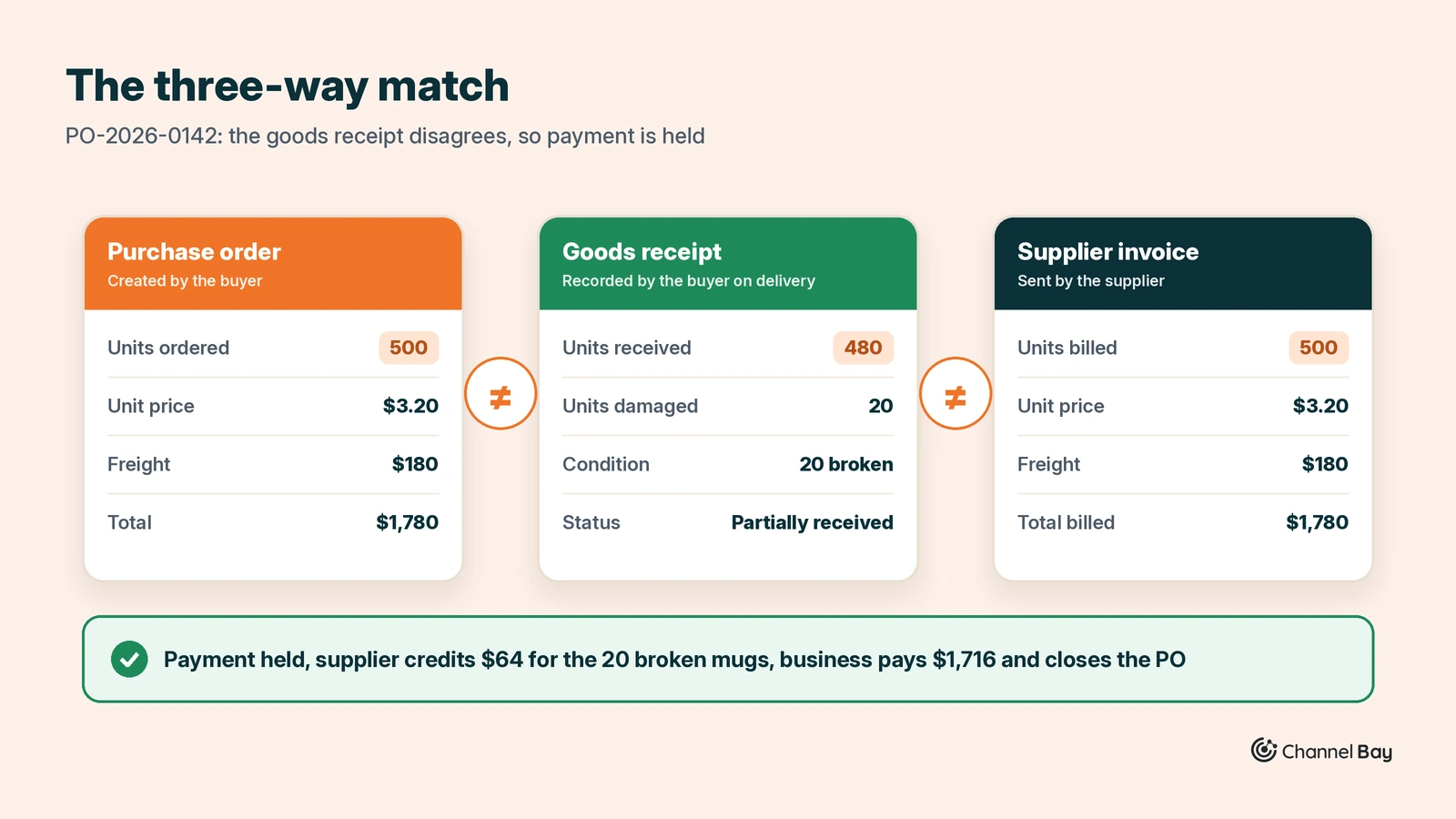
A two-way match checks the price, but not whether you got the goods. INV-3318 passes it: 500 mugs at $3.20 plus $180 freight, exactly as ordered. But when the delivery was counted, one carton had been packed without dividers, and all 20 mugs in it were broken.
That's why most businesses add a third document, the goods receipt: your record of what arrived, what you accepted into stock and what you rejected. Checking the PO, the goods receipt and the invoice together is called a three-way match. The PO sets the price, the goods receipt sets the quantity, and the invoice should agree with both.
| PO-2026-0142 | GRN-0457 | INV-3318 | What to pay | |
|---|---|---|---|---|
| MUG-WHT-12 quantity | 500 ordered | 480 accepted, 20 rejected | 500 billed | 480 |
| Unit price | $3.20 | $3.20 | $3.20 | |
| Mugs | $1,600 | $1,600 | $1,536 | |
| Freight | $180 | $180 | $180 | |
| Total | $1,780 | $1,780 | $1,716 |
The invoice bills $64 more than the delivery supports: 20 mugs at $3.20. The brand holds the payment and sends the supplier the goods receipt and photos of the broken carton. The supplier issues credit note CN-0291 for $64 against INV-3318, and the brand pays $1,716.
How to Check a Supplier Invoice
You don't need accounts payable software to do this. For each invoice:
- Find the PO. Use the PO number on the invoice. If there isn't one, ask the supplier to add it before you go further.
- Check the prices against the PO. Every unit price and extra charge should match. Anything new, like a surcharge or a higher price, needs a reason.
- Check the quantities against the goods receipt. Compare the billed quantity with the units you accepted, not the units the supplier says it shipped.
- Check it isn't a duplicate. Make sure the invoice number hasn't already been paid, and that another invoice hasn't already billed the same delivery.
- Record the invoice number with the delivery. Then anyone can trace a delivery to its bill, and a bill to its delivery.
- Approve, or hold and ask. If everything agrees, approve the invoice for payment. If not, hold it and send the supplier the difference.
If you track purchase orders in a spreadsheet, our purchase order template has a receiving sheet with a column for each delivery and a row for its packing slip or invoice number.
Decide in advance what counts as a match. A few cents of rounding on a long invoice isn't worth an email. A price that's 3% higher on every line is.
What to Do When the Purchase Order and Invoice Don't Match
When they disagree, the rule is the same every time: pay for what you accepted, at the price you agreed, and get the paperwork to say so. The supplier fixes the gap with a credit note (which reduces an invoice it has already sent) or a revised invoice (which replaces it). If you agreed to the change, amend the PO instead, so the PO, the goods receipt and the invoice all tell the same story.
Each case below starts from PO-2026-0142: 500 mugs at $3.20 plus $180 freight, $1,780 in total.
| What's wrong | On PO-2026-0142 | What to pay | How to settle it |
|---|---|---|---|
| Damaged units billed | 480 accepted, invoice bills 500 | $1,716 | Credit note for $64, or a replacement shipment |
| Short delivery, balance to follow | 400 arrived, invoice bills 500 | $1,460 now | Revised invoice or a $320 credit; the balance is invoiced when it ships |
| Price drift | Invoice at $3.30, PO at $3.20 | $1,780 | Credit note for $50, or amend the PO if you agreed the price |
| Extra units | 520 arrived and billed | $1,780 if you return 20, $1,844 if you keep them | Return the extras, or amend the PO to 520 |
| A charge that wasn't on the PO | $60 fuel surcharge added | $1,780 | Credit note for $60, or amend the PO if you agreed the charge |
Short Deliveries and Damaged Units
The supplier billed for the full order, and fewer sellable units arrived. Pay for the units you accepted. In the main example, that's 480 mugs: (480 x $3.20) + $180 freight = $1,716, after a $64 credit.
If the shortfall is still coming, the invoice should bill only what shipped. Say the supplier sends 400 mugs and confirms the other 100 for two weeks later. The first invoice should be (400 x $3.20) + $180 freight = $1,460, with the 100 mugs invoiced when they ship. If the supplier has already billed $1,780, ask for a revised invoice or a $320 credit, and keep the balance open on the PO. Don't pay for the 100 in advance unless that's what you agreed. If they never arrive, you're chasing a refund instead of cancelling a line. The goods receipt guide covers when to keep a balance open and when to close it.
Price Drift
The invoice price is higher than the PO price. Suppose all 500 mugs arrive in perfect condition, but INV-3318 bills them at $3.30: 500 x $3.30 + $180 = $1,830, or $50 more than the PO.
The PO price is the agreed price. Pay $1,780 and ask the supplier for a $50 credit, unless you accepted the increase, for example by agreeing to a new price list after the PO went out. In that case, amend the PO to $3.30 before you pay, so the order and the bill agree, and record the higher cost. Each mug then costs ($1,650 + $180) / 500 = $3.66 instead of $3.56. Either way, the price you pay and the cost you record should be the same. Paying $3.30 while your margins assume $3.20 makes every sale look $0.10 better than it is.
Under the US Uniform Commercial Code, a buyer "must pay at the contract rate for any goods accepted" (UCC § 2-607, Cornell Legal Information Institute). For an accepted PO, the contract rate is the PO price, not whatever turns up on the invoice. Other countries have their own rules, and your supplier agreement may set its own.
Extra Units
More units arrived than you ordered, and the invoice bills for all of them. Suppose 520 mugs arrive and INV-3318 bills 520 x $3.20 + $180 = $1,844.
You didn't agree to buy the extra 20, so you choose. Send them back, agree who pays the return freight (usually the supplier, if it was their mistake), and pay $1,780. Or keep them, amend the PO to 520 and pay $1,844. What doesn't work is paying $1,844 against a PO for 500: then the PO, the stock count and the invoice all show different numbers.
Freight and Charges That Weren't on the PO
The invoice includes a charge the PO didn't: a fuel surcharge, a pallet fee or freight on an order you bought with free shipping. Suppose INV-3318 adds a $60 fuel surcharge on top of the $180 freight, for $1,840.
If the PO's freight was a fixed quote, the surcharge is the supplier's to absorb, so pay $1,780 and ask for a $60 credit. If your terms allowed for it, or you agree to it, amend the PO and count it in the cost of the mugs: ($1,600 + $240) / 500 = $3.68 each, instead of $3.56. Your shipping terms decide who pays for freight and duty in the first place. That's what the Incoterms rules published by the International Chamber of Commerce are for, so it's worth naming one on the PO.
Freight billed by someone else, like a freight forwarder or customs broker, comes on its own invoice. It isn't matched against the supplier's PO, but it still belongs in what each unit cost. In the purchase order guide, the brand's forwarder billed $96 in import duty and $24 in fees for the mugs, which brought each of the 480 sellable mugs to a landed cost of $3.83. The method is in how to calculate landed cost.
When Do You Pay Against a Purchase Order or an Invoice?
You pay against the invoice, never the purchase order. The PO decides when the invoice is due, through its payment terms, and the goods receipt decides how much of it you owe. On Net 30, the 30 days usually run from the invoice date, so INV-3318, dated 3 November, is due on 3 December. Check your terms: some run from delivery or from the end of the month.
Two situations change the order of things:
- Deposits. Overseas manufacturers often ask for a deposit, such as 30% when the order is placed and 70% before it ships. The deposit is billed on a proforma invoice: a preliminary invoice that the supplier sends after accepting your PO, before the goods exist. You pay it against the PO terms. The final invoice then bills the balance, often before the stock reaches you. Do the match when the goods arrive anyway, and settle any shortfall as a credit against the next order.
- Disputes. If part of an invoice is wrong, you don't have to hold all of it. Many businesses pay the part that matches by the due date and hold only the difference, which keeps the supplier relationship and any early-payment discount intact. Tell the supplier promptly. Under the UCC, a buyer who has accepted goods and finds a problem must notify the seller within a reasonable time or lose the right to a remedy (UCC § 2-607(3)(a)).
Once the invoice is paid, close the PO, so it stops counting as stock on order in your reorder calculations.
How Channel Bay Keeps Invoices With the Purchase Order
Channel Bay doesn't approve or pay supplier invoices. You still pay them in your accounting software. What it does is keep each supplier invoice next to the delivery it bills for, so the check before you pay takes a few minutes:
- One batch per delivery, with its own invoice number: Every delivery you receive against a PO is a batch with its own supplier invoice number and freight. If accounting gets the invoice after the stock is received, add or edit the invoice number on the batch later.
- Received and outstanding on every line: Each line shows what's received and what's still due, so you can compare an invoice's quantities with what you accepted.
- The invoice price, when it's the right one: If you agreed to a price change, change the line's unit cost as you receive it. Freight is spread across the lines by value to give each unit a landed cost, and with cost sync on, the new cost goes to Shopify.
- A clear end to the PO: The PO stays partially received until the rest arrives or you close it, so a short delivery you've been credited for doesn't sit as stock on order.
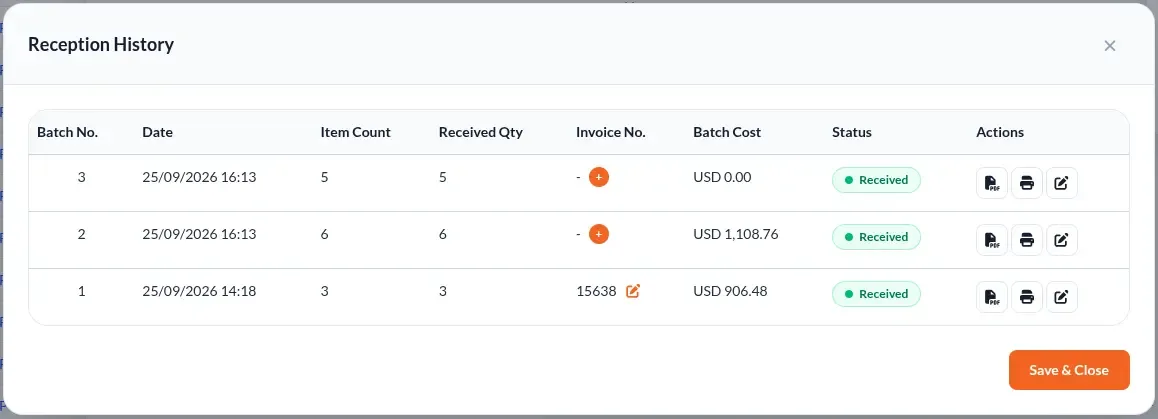
See how Channel Bay handles purchase orders, or follow the same PO through receiving in our goods receipt guide.
Frequently Asked Questions
What is the difference between a purchase order and an invoice?
Who issues a purchase order and who issues an invoice?
Does a purchase order come before an invoice?
Can you pay from a purchase order?
What should I do if the invoice is higher than the purchase order?
What is a credit note?
Is a purchase order an invoice?
What is the difference between an invoice and a bill?

Guides from the team that builds and supports Channel Bay, the Shopify inventory app for purchase orders, stocktakes, stock transfers and multichannel stock sync. About Channel Bay