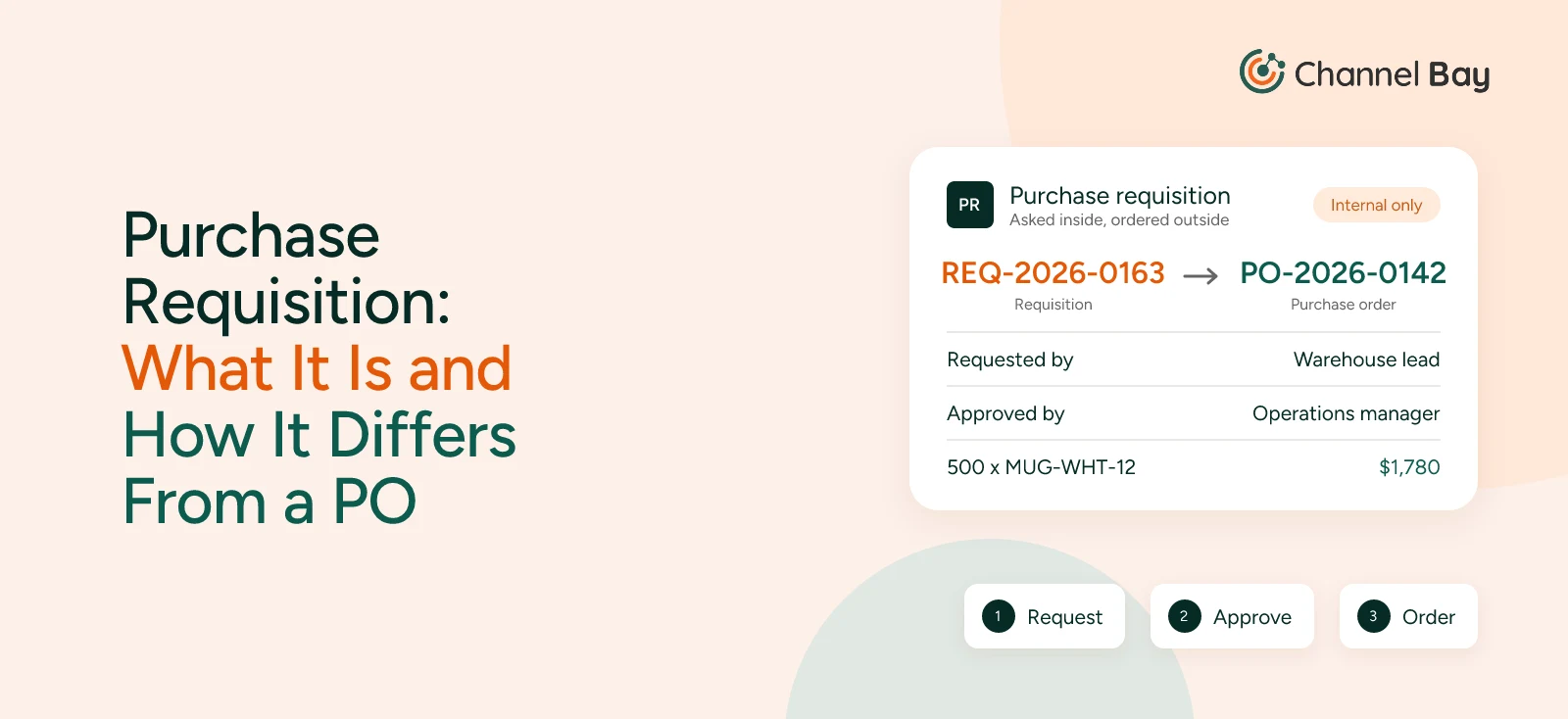
Purchase Requisition: What It Is and How It Differs From a PO
A purchase requisition is an internal request to buy, approved before a PO is raised. What it holds, how it differs from a PO, and when a small team needs one.
On this page
Key Takeaways
- A purchase requisition is an internal request to buy something. Someone on your team raises it, a manager or budget owner approves it, and only then does a buyer turn it into a purchase order. It never goes to the supplier.
- A requisition commits you to nothing outside the business. The purchase order is the document the supplier sees, and once the supplier accepts it, it's a commitment to buy.
- Give requisitions their own number sequence, such as REQ-2026-0163, separate from your PO numbers. Not every requisition becomes a PO, and one requisition can become several.
- If the founder still places every order, you don't need requisitions yet. You need them when someone who doesn't control the money starts deciding what to order, or when two people could order the same stock.
- Keep approval rules short: routine reorders at their reorder point need no sign-off, while new products, new suppliers and orders over a set amount do. Check other locations before buying, because a request for stock you already hold is a transfer.
A purchase requisition is an internal request to buy something. An employee who needs the goods raises it, and a manager or budget owner approves it. Only then does a buyer turn it into a purchase order and send that to the supplier. The requisition itself never leaves the business, and it commits you to nothing until the purchase order is accepted.
Most guides to purchase requisitions are written for procurement teams in large companies, with cost centers, budget codes and long approval chains. Most online sellers never need any of that. But a point comes, usually when the founder stops placing every order, where a simple requisition saves money and confusion. This guide covers what a requisition contains, how it differs from a PO, and the requisition-to-PO process. It also helps you tell whether your team has reached that point. It uses the same example as our guide to what a purchase order is and how it works: a kitchenware brand that orders 500 white mugs on PO-2026-0142.
What Is a Purchase Requisition?
A purchase requisition (often shortened to PR, and also called a purchase request or requisition form) is the document someone uses to ask for permission to buy. It says what's needed, how many, by when and why, with an estimate of what it will cost.
Three people are usually involved, even in a small team:
- The requester is the person who sees the need: a warehouse lead watching stock run down, a store manager, or someone planning a launch.
- The approver is the person who controls the money: the owner, an operations manager or a budget holder. Their job is to say yes, no, or "yes, but fewer".
- The buyer is the person who deals with suppliers. They turn the approved requisition into a purchase order, with the supplier's prices, delivery date and payment terms.
Larger organizations formalize the same split. Montclair State University's procurement office, for example, describes a requisition as a request submitted by a department. Once it's fully approved, it "is converted into a Purchase Order and issued to the supplier" (Montclair State University, Requisitions and Purchase Orders).
In a two-person business, one person may play two of those roles. What matters is that the person who asks and the person who approves aren't the same, and that the supplier only ever sees the purchase order.
In the running example, the brand's white mugs (MUG-WHT-12) dropped to 80 units on 16 October, below their reorder point of 150. The warehouse lead raised a requisition for 500 mugs, the operations manager approved it, and the buyer created PO-2026-0142 the same day.
What a Purchase Requisition Contains
A requisition only needs enough for someone to approve it and for the buyer to act on it. Here is the mug requisition:
| Field | What it's for | On the mug requisition |
|---|---|---|
| Requisition number | Identifies the request, separately from any PO | REQ-2026-0163 |
| Date raised | Shows how long it has waited | 16 October 2026 |
| Requested by | Who to ask about it | Warehouse lead |
| Item and SKU | Exactly what's needed, including the variant | White ceramic mug, MUG-WHT-12 |
| Quantity | How many | 500 |
| Reason | Why it's needed now | 80 on hand, below the reorder point of 150. Supplier minimum is 500 |
| Needed by | When the stock has to arrive | As soon as possible. 80 mugs last about 20 days at 4 a day, and the supplier's lead time is 25 |
| Deliver to | Which location receives it | Main warehouse |
| Suggested supplier | Where it usually comes from | The brand's usual mug supplier |
| Estimated cost | What the approver is saying yes to | About $1,780: 500 x $3.20 on the current price list, plus $180 freight |
| Approved by | Who signed off, and when | Operations manager, 16 October |
| Status | Where the request stands | Converted to PO-2026-0142 |
Notice what the requisition leaves out. It has no payment terms, shipping terms or confirmed delivery date, because those are agreed with the supplier, and they belong on the PO. The requester doesn't need to know them, and in a growing team often shouldn't be negotiating them.
The reason field does more work than it looks. "Below reorder point" tells the approver this is routine. "Supplier minimum is 500" explains why the request is for 500 rather than the 260 that would cover the lead time plus 60 days of sales. A requisition without a reason gets sent back with a question, which costs a day the mugs didn't have.
Why Requisitions Get Their Own Numbers
REQ-2026-0163 and PO-2026-0142 come from separate counters, and that's deliberate. If requisitions and POs shared one sequence, your PO numbers would be full of gaps, because:
- Not every requisition becomes a PO. Some are rejected, some are cut, and some are filled from stock at another location.
- One requisition can become several POs, when its items come from different suppliers.
- Several requisitions can become one PO, when they're for the same supplier.
A gap in your PO sequence should always have a reason you can find, as our guide to PO numbers explains, and suppliers should only ever see PO numbers. So give requisitions their own prefix and counter, such as REQ-YYYY-NNNN. The requisition counter usually runs ahead of the PO counter, which is why this brand's requisition is number 163 while its PO is number 142. Record the PO number on the requisition when it's converted, and the requisition number in the PO's internal notes, so you can trace either one back to the other.
Purchase Requisition vs Purchase Order
The short version: a requisition asks permission inside the business, and a purchase order makes the commitment outside it. Side by side:
| Purchase requisition | Purchase order | |
|---|---|---|
| Who creates it | The person who needs the goods: a warehouse lead, store manager or planner | The buyer, or whoever deals with suppliers |
| Who sees it | Your team only | Your team and the supplier |
| When | First, when the need is spotted | Second, once the requisition is approved |
| What it commits you to | Nothing outside the business. It can be cut or rejected at no cost | A purchase, once the supplier accepts it |
| Price | An estimate | The agreed price, with freight, terms and delivery date |
| Number | Its own sequence: REQ-2026-0163 | The PO sequence: PO-2026-0142 |
| Approved by | A manager or budget owner | A quick check against the approved requisition. A fresh approval only if something changed |
| What happens next | It's approved, changed or rejected, then converted to one or more POs | The supplier accepts it, ships, invoices and gets paid against it |
Procurement teams draw the same line. Colorado State University's procurement office says plainly that "a purchase requisition is not a purchase order." The department submits the requisition, and procurement prepares the PO and issues it to the vendor (Colorado State University Procurement Services).
The difference in commitment is the one that matters most. A requisition can be cut or cancelled without anyone outside the business knowing. A purchase order is an offer to the supplier, and it becomes a binding contract once the supplier accepts it, by confirming the order or by shipping the goods. In the US, the Uniform Commercial Code says an order for prompt shipment can be accepted either way (UCC § 2-206, Cornell Legal Information Institute). Other countries have their own rules, so check how acceptance works where you and your supplier are based.
The purchase order is also the document that matters later. It's what the supplier quotes on the invoice, what the goods receipt is recorded against, and what you check before you pay. The requisition's job ends when the PO is raised: it's the record of who asked for the purchase, why, and who said yes.
The Requisition-to-PO Process Step by Step
This is the front end of the purchase order process, from the moment someone notices a need to the moment the supplier has the order. Here's how it ran for the mugs on 16 October.
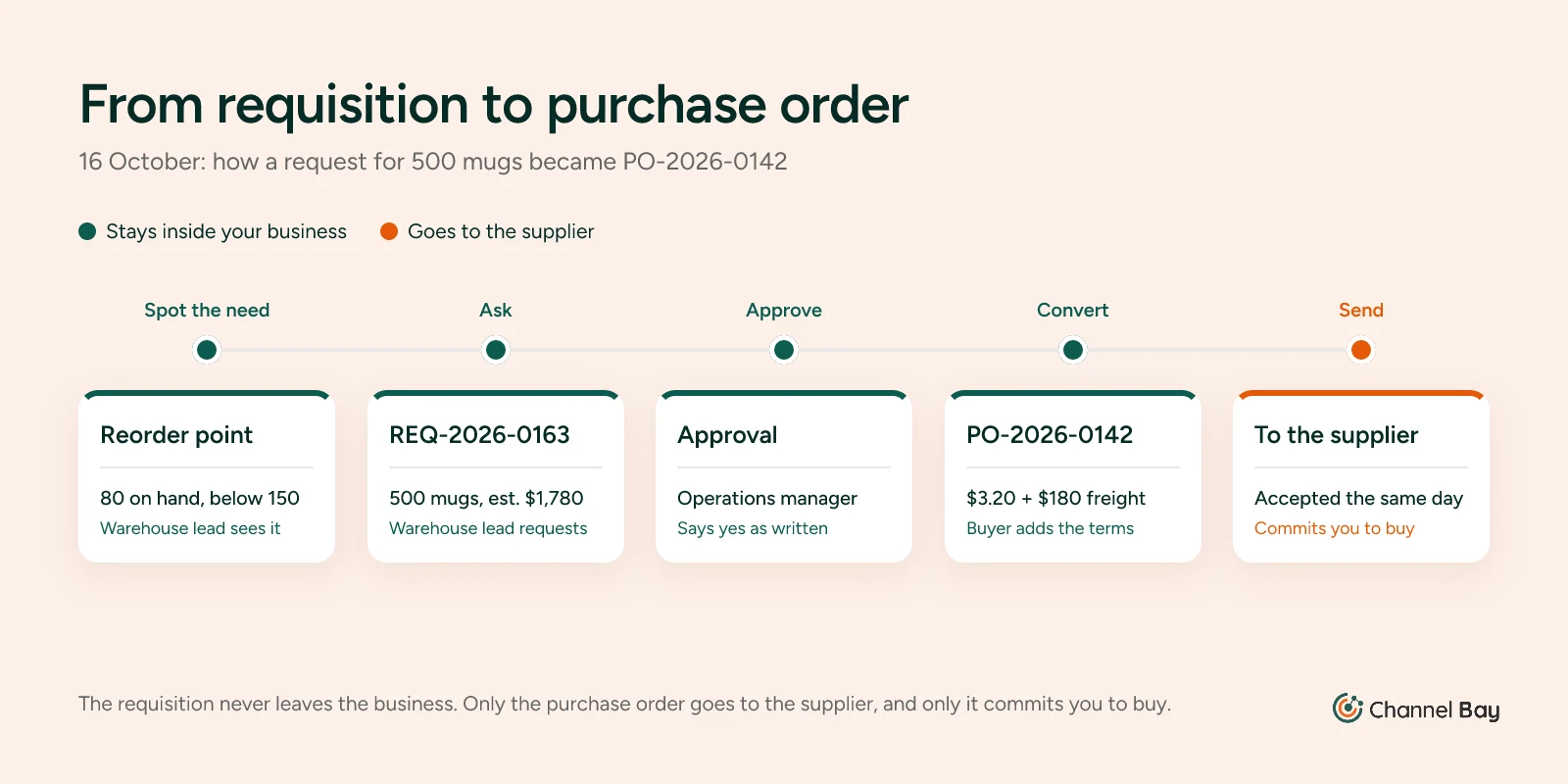
- Spot the need. Stock falls below its reorder point, a launch is coming, or a store runs short. The warehouse lead saw 80 mugs against a reorder point of 150.
- Check before asking. Is the stock already on order, or sitting at another location? Compare the reorder point with stock on hand plus stock on order, not shelf stock alone. Here there was no open PO for the mugs and no other location to draw from.
- Raise the requisition. Fill in the item, quantity, reason, needed-by date and an estimated cost. REQ-2026-0163 asked for 500 mugs at an estimated $1,780.
- Approve, change or reject. The approver checks that the request makes sense and fits the budget, and can approve it as it is, cut the quantity or send it back. The operations manager approved it as written.
- Convert it to a purchase order. The buyer picks the supplier, confirms the price and adds delivery and payment terms. If items come from two suppliers, that's two POs. The buyer created PO-2026-0142: 500 x MUG-WHT-12 at $3.20, plus $180 freight, $1,780 in total, delivery by 10 November, Net 30.
- Check the PO against the requisition. If the PO matches what was approved, the check is quick and it goes out. If the price, quantity or supplier changed, it goes back to the approver for a fresh decision. PO-2026-0142 matched REQ-2026-0163 to the dollar. In the brand's PO log, it sat in Pending approval between Draft and Ordered until the operations manager signed it off. That sign-off was a quick check against the requisition, not a fresh review of the purchase.
- Send the PO and close the requisition. The PO went to the supplier on 16 October, and the supplier accepted it the same day. The requisition was marked "Converted to PO-2026-0142", so nobody raised a second request for the same mugs.
What Happens After the PO Is Sent
From there, the PO takes over: the delivery on 10 November with 480 good mugs and 20 broken ones, goods receipt GRN-0457, invoice INV-3318 for $1,780, credit note CN-0291 for $64, and payment of $1,716. The requisition plays no part in matching the invoice. That check runs on the PO, the receipt and the invoice.
One thing this example shows: the mugs were already late. At 4 a day, 80 mugs last 20 days, and the supplier needs 25. A requisition that waits a day for approval makes that worse. If you add requisitions, make routine reorders fast, or raise them earlier, at a reorder point that leaves time for the approval as well as the lead time.
When a Small Seller Needs Purchase Requisitions
You don't need requisitions while the person who places orders is the person who pays for them. A founder who checks stock, picks the supplier and sends the PO is requester, approver and buyer at once, and a requisition would only add a form to fill in for themselves.
The need starts when ordering and paying split apart. Common signs:
| Your team looks like this | Do you need requisitions? |
|---|---|
| The founder places every order, from one location | No. Use reorder points and a PO log |
| A warehouse lead or store manager tells the founder what's running low, by message or in person | Not a formal one yet. A shared list of requests stops things from being forgotten |
| Someone other than the owner decides what to order and how much | Yes. They raise requests, and the owner approves anything outside routine reorders |
| Two or more people can place orders | Yes. Without a request on record, two people can order the same stock from the same supplier |
| Several stores or warehouses, each asking for stock | Yes, with a check for stock at other locations before anything is bought |
| Spend has grown past what the owner wants to approve order by order | Yes, with a threshold so the owner only sees the large or unusual ones |
Skip requisitions at that stage and the cost shows up as duplicates and surprises. Two buyers each reorder the same SKU because neither knew the other had. A store manager orders straight from a supplier at last year's price. The owner finds out about a $9,000 order when the invoice arrives.
One common setup for multi-store retailers: head office creates, approves and sends POs, and store managers work only with the open orders for their own store, receiving them without placing orders themselves. It's a rule the team agrees on and follows, whatever software it uses.
The cost of adding requisitions too early is speed. Every approval is a wait, and a reorder that's already late, like the mugs, can't afford one. So start small.
Simple Approval Rules for a Small Team
A small team needs a few rules, not a procurement policy. A set like this covers most online sellers:
- Routine reorders are pre-approved. If a SKU is below its reorder point, the buyer can raise the PO without anyone signing off. That holds as long as the order is at the usual quantity, from the usual supplier, at the price on file. The reorder point is the approval.
- Some requests always need a yes. New products, new suppliers, price increases, and any order over a set amount go to the owner. Pick an amount that catches the orders you'd want to see, such as $5,000, or $2,000 for a smaller brand.
- The person who asks doesn't approve. Even in a team of three, the warehouse lead requests and the owner or operations manager approves.
- Approve once. If the PO matches the approved requisition, the sign-off is a quick check against it, not a fresh approval. It goes back to the approver only if the price, quantity or supplier changed.
- Answer within one working day. A request that waits longer than that gets chased, or escalated to whoever is covering. Slow approvals cause the stockouts requisitions were meant to prevent.
- Keep the approval with the order. An email, a chat message or a comment on the draft PO is enough, as long as it can be found later. Our purchase order template has an Authorized by field for the approver's name.
The requisition itself can be as light as a row in a shared spreadsheet with the fields above, or a draft PO marked as a request. What matters is one place everyone uses, with a number on every request and a status that says whether it was approved, converted or rejected.
Other Ways a Requisition Starts
A requisition doesn't always begin with someone noticing an empty shelf. The common starting points for an online seller:
- A reorder point alert. Inventory software flags a SKU that has fallen below its reorder point and suggests a quantity. That alert does the requester's job: it says what's needed and why. Many teams treat the alert, or the list of suggested reorders, as the requisition, and the buyer reviews it before raising POs. See how low stock alerts differ from reorder point alerts.
- A store asking the warehouse. A shop runs low and asks for more. If the warehouse has the stock, this isn't a purchase at all. It's an internal stock request, filled with a stock transfer from the warehouse to the store, and nothing is bought. It becomes a purchase requisition only if no location has enough to spare. Checking that first stops you from buying stock you already own.
- A planned launch or season. A new product, a gift season or a promotion needs stock that sales history doesn't predict. These requests deserve approval every time, because the quantity is a judgment call, and new products often mean a new supplier.
- A stocktake. A count that finds less stock than the system showed can push a SKU below its reorder point overnight. The shortfall becomes a request, and the reason field should say it came from the count.
- Supplies the business uses. Packaging, labels and shipping materials are bought too. They usually need the same kind of request, even though they never go on sale.
How Channel Bay Fits a Requisition Workflow
Channel Bay doesn't have a purchase requisition document or a PO approval step: a PO is either a draft or open with the supplier. What it does have covers the parts of a requisition workflow a small team uses most:
- Reorder alerts and suggested quantities: Each product shows days of stock left, a stock status and a suggested order quantity that counts stock already on open POs. You can set a reorder point on any variant, and low-stock alerts and a daily digest flag products that drop below it. For routine reorders, that list does the requester's job.
- Draft POs as requests: A PO can be saved as a draft and stays one until someone opens it with the supplier. The warehouse lead can build a draft from the reorder list, and the buyer or owner reviews the quantities and sends it. Channel Bay doesn't enforce that review: anyone with full access to the supply chain area can send a PO.
- Who created each PO: Purchase orders record who created them, so you know who to ask about a draft.
- Stock transfers for internal requests: When a store needs stock the warehouse already has, a transfer moves it, with stock tracked in transit, so you don't buy stock you already own.
- Access by area: Staff get view or full access to each area, so a store team can view purchase orders without creating them. Access applies to all locations and can't yet be limited to one.
If you need a formal approval before every PO, keep the requisition and sign-off outside Channel Bay, in a shared sheet or your chat tool, and record the requisition number in the PO's notes.
See how Channel Bay handles purchase orders, or read the full purchase order process, from raising the order to closing it.
Frequently Asked Questions
What is a purchase requisition?
What is the difference between a purchase requisition and a purchase order?
Who approves a purchase requisition?
Is a purchase requisition sent to the supplier?
Is a purchase request the same as a purchase requisition?
Do small businesses need purchase requisitions?
Can one purchase requisition become several purchase orders?
Is a request for stock from another store a purchase requisition?

Guides from the team that builds and supports Channel Bay, the Shopify inventory app for purchase orders, stocktakes, stock transfers and multichannel stock sync. About Channel Bay