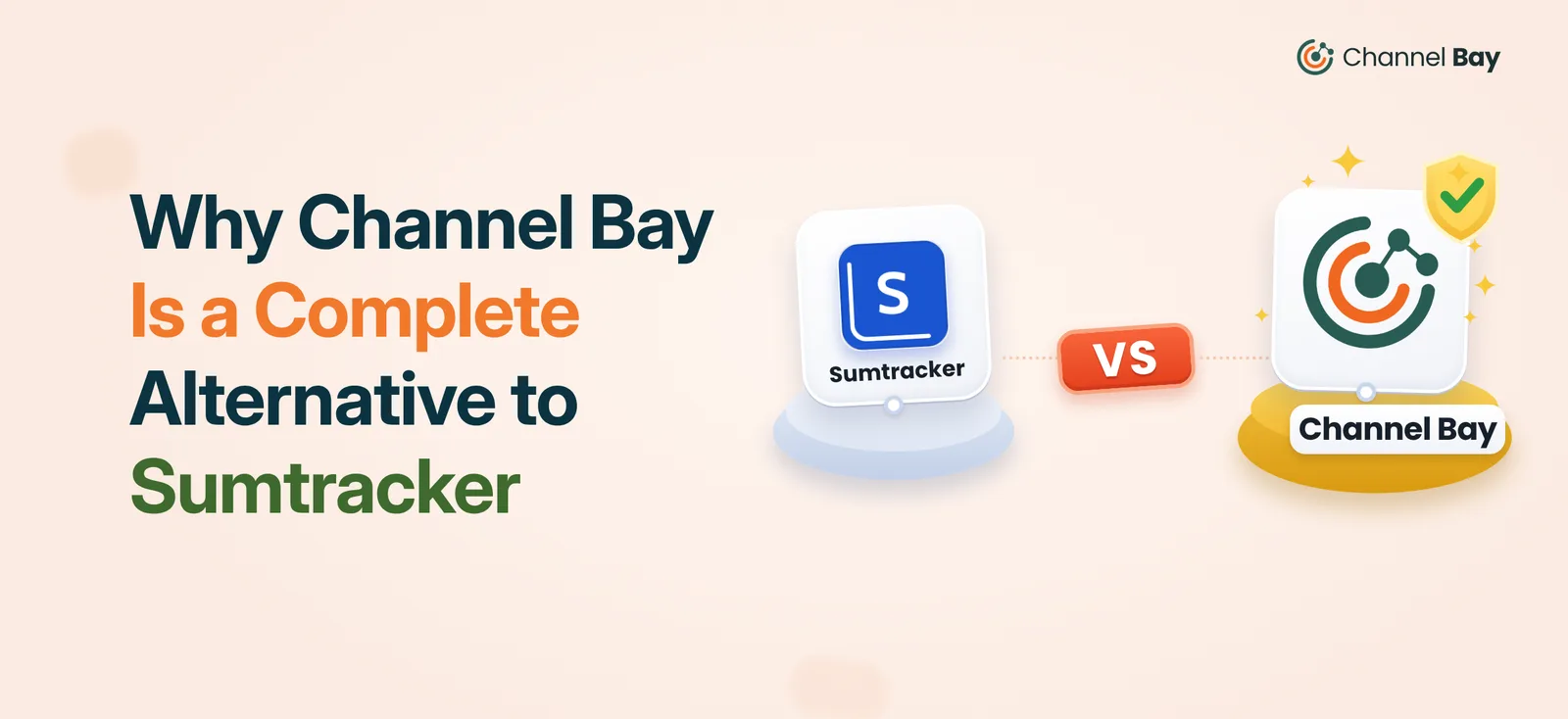
Why Channel Bay Is a Complete Alternative to Sumtracker
Compare Channel Bay and Sumtracker on pricing, channels, purchase orders, stocktakes, and forecasting to find the right Shopify inventory app for your store.
On this page
- What Does Channel Bay Offer as a Sumtracker Alternative?
- Sumtracker Shopify: What Does the App Offer?
- Channel Bay vs Sumtracker: How Do the Inventory Workflows Compare?
- Channel Bay Pricing vs Sumtracker Pricing: Which Costs More as Orders Grow?
- Which Inventory App Fits Your Shopify Store?
- Final Verdict: Channel Bay vs Sumtracker
Key Takeaways
- Connected workflow: Channel Bay puts purchase orders, receiving, transfers, barcode stocktakes, forecasting, and pick lists in one app alongside Shopify and Amazon sync.
- Price: at 10,000 annual orders Channel Bay Pro works out to about $95 a month. Sumtracker Replenish costs $179 monthly, or $150 on annual billing.
- Entry point: Channel Bay includes purchase orders on its free plan for stores under 1,000 orders. Sumtracker's purchase orders start on Replenish at $119 a month.
- Lead times: Channel Bay learns supplier lead times from your own purchase orders and subtracts units already on open orders.
- Where Sumtracker leads: it syncs eBay, Etsy, and Walmart as well as Shopify and Amazon, and predicts 12 months from 365 days of sales with seasonality.
Channel Bay and Sumtracker are two Shopify inventory apps that sync stock across sales channels, but they suit different stores. Channel Bay brings purchase orders, receiving, transfers, barcode stocktakes, and pick lists into the same app as stock sync, at a lower monthly price than Sumtracker. Sumtracker adds eBay, Etsy, and Walmart sync and a seasonal 12 month forecast. If you sell on Shopify and Amazon, Channel Bay is the Sumtracker alternative to start with.
Channel Bay syncs Shopify and Amazon stock every minute and builds purchasing, receiving, transfers, stocktakes, forecasting, and reporting into one workflow. Its plans run from free to $60 a month on Pro, plus $0.005 per order above 3,000, capped at $200. Purchase orders are free for stores under 1,000 orders.
Sumtracker syncs stock across Shopify, Amazon, eBay, Etsy, and Walmart and forecasts demand 12 months ahead. Sumtracker pricing starts at $59 a month for 2,500 annual orders on Manage, and $119 on Replenish, which adds purchase orders, transfers, and forecasting.
This comparison explores their features, pricing, and practical differences to help Shopify merchants determine which solution better fits their inventory requirements.
What Does Channel Bay Offer as a Sumtracker Alternative?
Channel Bay treats stock sync as the starting point. The same app that pushes quantities to your channels also builds purchase orders, receives deliveries, moves stock between locations, counts it, and tells you what to reorder. According to Channel Bay's site, stock changes reach connected channels about every minute, and each change is logged with its before, change, after, and cause.
- Multichannel sync: one quantity per product at every location, shared across multiple Shopify stores, Amazon, and retail. Amazon listings match by seller SKU, and you link any that don't match by hand.
- Purchase orders and suppliers: build a purchase order from low stock, a supplier, or a past order, then email it. Each supplier records the store's cost, SKU, pack size, and minimum order. Freight, discounts, and currency spread across lines to give each unit a landed cost.
- Receiving and transfers: receive deliveries in batches. A transfer takes stock off the source location and its channels while in transit, and returns it to sale when received.
- Stocktakes: count by scanning barcodes or typing SKUs. Variances show at cost and export to CSV, and adjustments are logged against the stocktake that caused them.
- Forecasting and reorder suggestions: the app shows days of stock left and a suggested order quantity per product. It learns supplier lead times from your own purchase orders and subtracts units already on open orders, so you do not order the same stock twice.
- Bundles and pick lists: bundles track component stock. Pick lists group the orders waiting at a location so staff collect every item in one walk.
- Reports and costing: 50+ built-in reports filter by date and channel. Costing offers FIFO or LIFO cost layers by location, and a separate rolling average cost.
The trade-off is channel breadth. Channel Bay's published channel list covers Shopify and Amazon, so merchants who sell on eBay, Etsy, or Walmart should check that fit before anything else.
Sumtracker Shopify: What Does the App Offer?
Sumtracker is a Shopify inventory app launched on July 13, 2020. Its Shopify App Store listing shows a 4.8 rating from 127 reviews. It pulls products from your store, calculates available quantity as physical stock minus booked stock, and pushes that number to your channels. One Sumtracker inventory pool can serve up to 10 connected stores on standard plans, according to sumtracker’s product summary.
- Supported sales channels: Shopify, Shopify Plus, Shopify POS, Amazon FBA and FBM, eBay, Etsy, and Walmart. Order edits, refunds, returns, and cancellations adjust stock automatically.
- Inventory management: bundles built from component stock, adjustments with audit logs, stocktakes and cycle counts, low-stock alerts, CSV bulk updates, and min and max levels.
- Purchase orders and replenishment: the Replenish plan adds purchase orders with supplier price lists, emailed POs, partial receiving, attachments, multi-currency support, and weighted average landed costs.
- Forecasting: Sumtracker reads the last 365 days of sales, counts only days a product was in stock, and predicts the next 12 months with seasonality adjustments. Reorder dates account for lead time, safety days, and incoming purchase orders and transfers.
- Multi-location inventory: Shopify locations are created in Sumtracker automatically. You set a fulfillment priority per location, and standard plans allow up to 10 warehouses.
- Integrations: QuickBooks Online (Replenish only), a public REST API, and an MCP connector.
Before you choose Sumtracker, check three things. Purchase orders, transfers, and forecasting sit on Replenish, which starts at $119 a month for 2,500 annual orders. Standard plans cap at 10 warehouses, 10 channels, and 100,000 orders a year. And Sumtracker says it is built for direct-to-consumer brands, not for pure B2B wholesalers or manufacturers that need bills of material. Most of these figures come from Sumtracker's own pages, so confirm them during the 14-day free trial.
Channel Bay vs Sumtracker: How Do the Inventory Workflows Compare?
Channel Bay leads on the purchasing and counting tools it includes at low plan prices, and on pick lists. Sumtracker leads on channel coverage and forecast depth. The six comparisons below follow the order inventory work usually happens in.
Multichannel Inventory Synchronization
| Capability | Channel Bay | Sumtracker |
|---|---|---|
| Channels | Shopify (multiple stores), Amazon, retail locations | Shopify, Shopify Plus, Shopify POS, Amazon FBA and FBM, eBay, Etsy, Walmart |
| Update speed | Stock pushed every minute | Real-time sync (vendor claim) |
| Listing matching | Amazon matches by seller SKU, the rest linked by hand | Listings sharing a SKU track as one inventory pool |
| Plan required | Basic ($30 a month) | Manage or Replenish |
Purchase Orders and Supplier Management
| Capability | Channel Bay | Sumtracker |
|---|---|---|
| Creating a PO | From low stock, a supplier, or a past order, then email | Manually, from replenishment suggestions, or from low-stock alerts, then email |
| Supplier data | Cost, SKU, pack size, minimum order per supplier | Supplier price lists and terms, multiple suppliers per SKU |
| Receiving | Batched receiving | Partial receiving through receive notes, attachments |
| Landed cost | Freight, discounts, and currency spread across lines into a landed cost per unit. Costing is separate: FIFO or LIFO layers by location, or a rolling average cost | Weighted average landed cost; multi-currency |
| Plan required | Free | Replenish ($119 a month at 2,500 orders) |
The Sumtracker purchase order workflow goes deeper on multi-supplier pricing and ties into QuickBooks Online. Channel Bay offers purchase orders on its free plan for stores under 1,000 orders, plus FIFO and LIFO costing by location, which Sumtracker does not list.
Multi-Location Inventory and Stock Transfers
| Capability | Channel Bay | Sumtracker |
|---|---|---|
| Locations | One quantity per product at every location; no location cap published | Up to 10 warehouses on standard plans; Shopify locations sync automatically |
| Order routing | Each Shopify location sells from its matching shelf | Fulfillment priority set per location |
| Transfers | Stock leaves source and channels while in transit; partial receiving by barcode scan | Manual transfers plus suggestions from min and max levels |
| Low-stock rules | Low-stock alerts | Location-based low-stock thresholds |
| Plan required | Basic ($30 a month) | Replenish |
Sumtracker's min and max transfer suggestions suit merchants who rebalance stock between warehouses often. Channel Bay's in transit handling of stock transfers matters when units sit on trucks for days: it keeps them off sale until received and blocks dispatch of any line without stock at the source.
Stocktakes and Inventory Accuracy
| Capability | Channel Bay | Sumtracker |
|---|---|---|
| Counting | Scan barcodes or type SKUs; each scan adds one unit | Full and partial counts on phones, tablets, and barcode scanners |
| Variance handling | Variances valued at cost, exported as CSV; only the difference is applied on submit | Adjustments with audit logs |
| Concurrency | Separate stocktakes, one per warehouse, can run at the same time | No |
| Reports | 50+ built-in reports, stock now or at month-end | Inventory valuation, ABC analysis, 12-month historical logs |
| Plan required | Basic ($30 a month), per Channel Bay's pricing page | Manage ($59 a month) |
Both apps support barcode based stocktakes. Channel Bay's pricing page lists guided stocktakes on Basic, while its Shopify App Store listing places them on the free plan, so confirm in the app before you decide.
Forecasting and Replenishment
| Capability | Channel Bay | Sumtracker |
|---|---|---|
| Forecast basis | Recent Shopify sales, supplier lead times, open purchase orders | Last 365 days of sales, counting only days the product was in stock |
| Output | Sales per day, days of stock left, suggested order quantity | Predicted sales for each of the next 12 months, with seasonality adjustments |
| Lead times | Learned from your own purchase orders for each supplier, or set by hand; 14 days until there is enough history | Set per supplier (1 to 180 days), plus safety days (0 to 60) |
| Order quantity | Suggested quantity turns into a PO in one click | Quantity covers 7 to 180 days of predicted sales after the stock-out date |
| Plan required | Pro ($60 a month) | Replenish |
Channel Bay's strength is that lead times come from your own purchase history, so you do not need to enter them by hand. Sumtracker plans further ahead and adjusts for seasonality, up to a 50% lift or 30% drop against the yearly pace.
Bundles and Pick Lists
| Capability | Channel Bay | Sumtracker |
|---|---|---|
| Bundles | Bundles and raw materials track component stock | Bundles built from component SKUs and a quantity per bundle; stock is limited by the scarcest component |
| Pick lists | Group the orders waiting at a location so staff collect every item in one walk | No |
| Plan required (bundles) | Pro ($60 a month) | Manage ($59 a month) |
Both apps deduct component stock when a bundle sells and updates every connected channel. Channel Bay adds pick lists for warehouse staff. Sumtracker's own guide describes limited warehouse execution features, so merchants who pick and pack from the app should weigh that.
Channel Bay Pricing vs Sumtracker Pricing: Which Costs More as Orders Grow?
Channel Bay costs less at every order volume the two vendors publish, but the plans scale differently. Channel Bay pricing adds $0.005 per order above 3,000 and stops at a monthly cap. Sumtracker pricing rises in order tiers from 2,500 to 100,000 annual orders.
Channel Bay Plans
Channel Bay bills every 30 days and offers a 14-day trial on paid plans. Paid plans include 3,000 orders over the trailing 365 days, then charge $0.005 per extra order up to the monthly cap.
| Plan | Price | Monthly cap | Includes |
|---|---|---|---|
| Free | $0 | - | Multi-location inventory, purchase orders, automated PO emails, batched receiving (stores under 1,000 orders) |
| Lite | $10 | $75 | Everything in Free |
| Basic | $30 | $100 | Multichannel sync, stock transfers, guided stocktakes, order dashboard, returns, reporting |
| Pro | $60 | $200 | Demand forecasting, reorder suggestions, bundles and raw materials, team permissions, Report Pundit API reporting, label printing, multi-currency POs |
Channel Bay does not publish limits on locations or users. It claims unlimited staff seats.
Sumtracker Plans
Both plans bill in USD, include a 14-day free trial, and save 16% on annual billing. Prices below are for the 2,500 annual-order tier.
| Plan | Monthly | Annual billing (per month) | Includes |
|---|---|---|---|
| Manage | $59 | $50 | Multichannel sync, bundles, stocktakes and cycle counts, barcode scanner support, adjustments with audit logs, ABC analysis, reports, public API |
| Replenish | $119 | $100 | Everything in Manage, plus purchase orders, stock transfers, supplier lists, landed costs, 12-month forecasting, reorder suggestions, QuickBooks |
Standard plans cover up to 10 warehouses, 10 channels, and 100,000 orders a year. Larger setups need custom pricing. Sumtracker lists no add-ons or overage fees.
How the Full-Featured Plans Compare as You Grow
Channel Bay Pro and Sumtracker Replenish are the closest match, since both add forecasting and reorder suggestions. The Channel Bay figures use the published rate of $60 plus $0.005 per order above 3,000, capped at $200. This is our calculation from published prices, not a quote.
| Annual orders | Channel Bay Pro (monthly) | Sumtracker Replenish (monthly) |
|---|---|---|
| 2,500 | $60 | $119 |
| 10,000 | $95 | $179 |
| 25,000 | $170 | $269 |
| 50,000 | $200 | $379 |
| 100,000 | $200 | $599 |
Which Plan Fits Which Requirement
- Under 1,000 orders and running purchase orders: Channel Bay Free covers purchase orders and receiving at no cost.
- Shopify and Amazon with multiple locations: Channel Bay Basic adds sync, transfers, and stocktakes for $30 a month.
- Forecasting on Shopify and Amazon: Channel Bay Pro at $60 a month, or Sumtracker Replenish for a 12-month horizon.
- eBay, Etsy, or Walmart in the mix: Sumtracker Manage or Replenish, since Channel Bay does not list those channels.
- Barcode stocktakes without purchase orders: Sumtracker Manage at $59 a month, or Channel Bay Basic at $30.
Price by the features you will use weekly. A plan that lacks purchase orders or forecasting pushes that work back into spreadsheets.
Which Inventory App Fits Your Shopify Store?
Choose by your channel list first, then by the workflows you run every week. A channel mismatch cannot be fixed with a higher plan.
When Channel Bay Is the Better Choice
Choose Channel Bay if you sell on Shopify and Amazon and your week includes raising purchase orders, receiving deliveries in batches, transferring stock between locations, and counting stock with a barcode scanner. It also fits if you want that workflow at a low entry price: purchase orders are free for stores under 1,000 orders, and Pro is $60 a month at 3,000 orders. Pick lists help if your team packs from the same app. Channel Bay says Stocky migration is free and not tied to a plan, which matters if you are replacing that app.
When Sumtracker Is the Better Choice
Choose Sumtracker if you sell on eBay, Etsy, or Walmart, need a 12-month forecast with seasonality, or want QuickBooks Online sync. It also fits if you connect up to 10 stores and 10 warehouses in one account. Its entry plan already includes barcode stocktakes and bundles, so a store that does not need purchase orders can stay on Manage. Sumtracker has the longer track record: it launched in July 2020 and has 127 Shopify App Store reviews, against Channel Bay's August 2025 launch and 7 reviews.
What to Check Before You Switch
Switching changes the system that writes stock quantities to your store, so plan it as a cutover.
- Integrations: list every channel, accounting tool, and shipping tool you use, then confirm each appears on the new app's published list. Channel Bay lists Shopify, Amazon, and ShipStation. Sumtracker lists its marketplaces plus QuickBooks Online.
- Inventory migration: export SKUs, on-hand quantities, costs, supplier terms, and open purchase orders before you start. Rebuild open purchase orders in the new app so incoming stock is not lost.
- Pricing: price the plan on your trailing 12 months of orders, not this month's count. Both vendors bill on annual order volume.
- Data accuracy: run a full count of one location during the free trial and compare it with what the app reports. Do not let two apps write stock to the same store at once.
- Operations: decide who counts, who receives, and who sets up barcode scanners and permissions. Both vendors offer a 14-day trial, so test those roles before you pay.
Final Verdict: Channel Bay vs Sumtracker
Channel Bay offers purchasing, receiving, transfers, barcode stocktakes, pick lists, and forecasting in one workflow, at a lower price at every published order volume, with purchase orders on its free plan. Sumtracker offers broader channel coverage (eBay, Etsy, Walmart) and a longer, seasonal forecast. If you sell on Shopify and Amazon and want inventory and purchasing handled together, Channel Bay is the Sumtracker alternative to trial first. If you need eBay, Etsy, or Walmart sync or 12-month seasonal forecasting, start with Sumtracker. Run a full count of one location during the 14-day trial to confirm the numbers hold.
Frequently Asked Questions
Is Channel Bay a good Sumtracker alternative?
How does Sumtracker pricing compare with Channel Bay?
Does Channel Bay have a free plan?
Does Sumtracker have a free plan?
Does Sumtracker support purchase orders?
Can I run barcode stocktakes in Channel Bay and Sumtracker?
Which channels does Channel Bay support compared with Sumtracker?

Guides from the team that builds and supports Channel Bay, the Shopify inventory app for purchase orders, stocktakes, stock transfers and multichannel stock sync. About Channel Bay