Three-Way Match: How It Works, With a Worked Example and Tolerance Rules
The three-way match checks the PO, the receipt and the invoice before you pay. See how it works, how to set tolerances and how to run it without an AP team.
On this page
- What is a three-way match?
- Two-way, three-way and four-way match compared
- How the three-way match works, line by line
- Match tolerances: how much of a mismatch to ignore
- A worked three-way match: PO-2026-0150 across two deliveries
- How to run a three-way match without an AP department
- When a three-way match is worth it
- What software can automate
- Three-way matching for online sellers
- Where Channel Bay fits
Key Takeaways
- A three-way match compares the purchase order, the goods receipt and the supplier invoice before you pay. The rule: pay for the lowest of the ordered, received and billed quantities, at the PO price.
- Match each line, and match each delivery to its own invoice. A PO that arrives in parts has several receipts and often several invoices, and the totals only agree at the end.
- A tolerance is the size of mismatch you accept without chasing the supplier. Set it by what a dispute costs you, accept under-billing, and allow no over-billing of quantity or price beyond rounding.
- A small team can run the match in a weekly slot with no AP department. Keep receiving and paying with different people where you can.
- Match everything above a value you choose, and spot-check the rest. A two-way match is enough for low-value invoices from suppliers you trust.
A three-way match (also written 3-way match) is the check you run before paying a supplier: compare the purchase order, the goods receipt and the invoice, and pay only where they agree. The rule that makes it practical is short. Pay for the lowest of the ordered, received and billed quantities, at the price on the PO.
The top results for this term are mostly accounts payable and procurement software vendors writing for finance teams. This guide is for a small team that buys stock, receives it itself and pays the bills from the same inbox. It shows how to run the match on a PO that arrives in pieces, how to set tolerances, and when to skip it. The short version of the match is in our purchase order guide, and the mismatch cases and the six-step invoice check are in purchase order vs invoice. The worked example here uses a new PO, because the interesting cases start when one order has several lines, several deliveries and several invoices.
What Is a Three-Way Match?
The three documents each answer a different question, and the match works because no single document can answer all three.
- The purchase order says what you agreed to buy and at what price. It sets the maximum quantity and the unit price.
- The goods receipt says what actually arrived and what you accepted into stock. It is the only document made by your side after the goods were counted. See our guide to the goods receipt for how to record one.
- The invoice is the supplier's claim for payment. It is the document you are checking.
For each line, the quantity you owe for is the lowest of what you ordered, what you received and what the supplier billed. If the invoice bills more than arrived, you pay for what arrived. If it bills less than arrived, you pay what is billed and note that the supplier still owes you an invoice for the rest. If more arrived than you ordered, you pay for the PO quantity unless you agree to amend the PO. The price is the PO price, unless you agreed a change before paying.
On PO-2026-0142 in the other guides, 500 mugs were billed and 480 arrived, so the match said pay for 480. That is the whole idea. The rest of this guide is about running it when the real world is less tidy.
Two-Way, Three-Way and Four-Way Match Compared
The names count the documents you compare. More documents catch more problems and take more time, so the right one depends on what a mistake costs.
| Match | Compares | Catches | Misses | Worth it when |
|---|---|---|---|---|
| Two-way | PO and invoice | Wrong price, quantity above what you ordered, charges the PO did not include | Goods that never arrived, or arrived damaged | Low-value invoices, services, suppliers you trust who invoice after delivery |
| Three-way | PO, goods receipt and invoice | Everything above, plus invoices billing for stock that was short, damaged or rejected | Poor quality that passes the count; wrong goods that look right | Stock purchases, orders that arrive in parts, suppliers who invoice on dispatch |
| Four-way | Adds an inspection or acceptance report | Everything above, plus quality failures the count would not show | Whatever the inspection did not test | High-value, fragile, regulated or made-to-spec goods |
Definitions of the four-way match vary. The usual one adds a quality inspection. If you use the term with a supplier or an accountant, say which documents you mean. For most online sellers the inspection is already part of receiving, so the damaged and rejected units are on the goods receipt and the three-way match covers them.
How the Three-Way Match Works, Line by Line
Match Each Line, Not the Total
An invoice total can be right while two lines are wrong. If the supplier bills 20 extra small items and 20 fewer large ones at a similar price, the total looks fine and the stock count is out on both lines. Match every line on three things:
- Quantity. Billed quantity should not be above received quantity, and received should not be above ordered.
- Price. Billed unit price should equal the PO unit price, within your tolerance.
- Charges. Freight, fees and tax should be on the PO or agreed with the supplier, again within tolerance.
Match Each Delivery to Its Own Invoice
A PO that arrives in parts is one order with several receipts, and suppliers often send one invoice per shipment. Keep a running count per line: ordered, received so far, billed so far, paid so far. Each new invoice is checked against the cumulative figures, not against the original PO alone.
The test for each invoice is that billed so far never exceeds received so far, and received so far never exceeds ordered. If an invoice breaks that, it is billing ahead of the goods. The totals agree only at the end, when the last delivery is in and the last invoice is paid or credited.
When the Invoice Comes Before the Goods
Many suppliers raise the invoice when they dispatch, which can be days or weeks before the delivery. You cannot finish the match yet, because there is no receipt to match against. Do three things: log the invoice against the PO, note the due date from the payment terms, and mark it held. When the goods arrive and are counted, finish the match and approve it. If the due date arrives first and you have no receipt, ask the supplier for tracking or a proof of delivery before you pay, not after.
Our free purchase order tracker flags an invoice that arrived before the delivery was complete, for a PO with a single invoice. That makes it a weekly check rather than something you remember.
Match Tolerances: How Much of a Mismatch to Ignore
A tolerance is the size of difference you accept without holding the invoice. Without one, you chase a 4 cent rounding difference as hard as a $400 overbilling. With a badly set one, you pay for things you should have questioned.
Three principles:
- Set it by the cost of chasing. An email to a supplier and a wait for a credit note costs you time. A difference smaller than that is not worth raising.
- Favor yourself. Accept being billed less than you received, and note what is still owed. Do not accept being billed for more units than you received, or at a higher price, beyond rounding.
- Use an amount and a percentage. A percentage alone is too tight on a $20 line and too loose on a $20,000 one. A cap in dollars stops a large invoice hiding a large error behind a small percentage.
Here is a rule set you can adjust. The figures are examples for a small seller whose POs run from about $1,000 to $5,000, not a standard. Scale them to your own order size and your own margins.
| Check | Example tolerance | Why |
|---|---|---|
| Billed quantity above received | None | You should never pay for goods you did not receive |
| Billed quantity below received | Accept; note the balance owed | The supplier will bill the rest, and you owe it |
| Unit price above the PO price | None beyond $0.01 of rounding | The PO price is the agreed price |
| Freight and other charges | Up to 10% of the PO estimate or $15, whichever is lower | Freight is often quoted before the weight is known |
| Variance you accept on one invoice | Over $25 needs a second person to sign off | Many small accepted differences add up |
Our purchase order guide gives one example of the same idea, a flag on any line that differs by more than 2% or $50. The table above splits it by what is being checked, because quantity and price deserve a tighter rule than freight.
Write the rules down and keep them with your PO process. Some AP and procurement tools apply tolerances automatically. In a spreadsheet or in your head, they work the same way, but only if they are written down and the same every week.
A Worked Three-Way Match: PO-2026-0150 Across Two Deliveries
A pet-supplies brand orders three products on PO-2026-0150. The supplier will ship in two deliveries and invoice each one. Freight is estimated at $240 across the order. Days are counted from the day the PO is sent.
| Line | Ordered | Unit price | Line value |
|---|---|---|---|
| DOG-BWL-S (small ceramic bowl) | 300 | $4.10 | $1,230.00 |
| DOG-BWL-L (large ceramic bowl) | 200 | $5.60 | $1,120.00 |
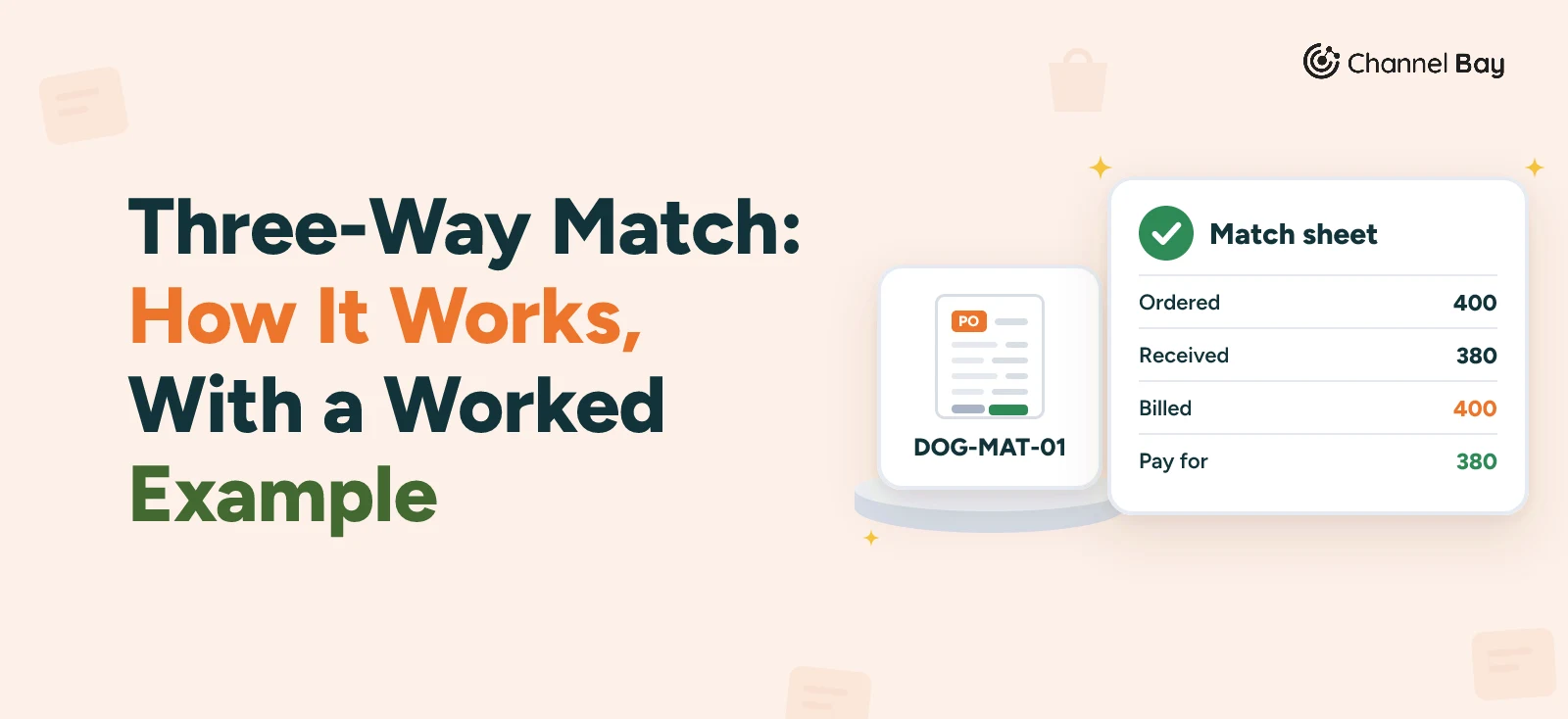
| DOG-MAT-01 (feeding mat) | 400 | $2.25 | $900.00 |
| Goods | $3,250.00 | ||
| Freight (estimate) | $240.00 | ||
| PO total | $3,490.00 |
Delivery 1: the Invoice Arrives First
On day 4 the supplier dispatches the small bowls and part of the large bowls and sends INV-5207 for $2,052.00: 300 small bowls ($1,230.00), 120 large bowls ($672.00) and $150.00 freight. The goods are not here yet, so the invoice is logged against the PO, the due date is noted and the invoice is held.
On day 9 the delivery is counted: 300 small bowls and 120 large bowls, all accepted.
| Line | Ordered | Received | Billed | Pay for |
|---|---|---|---|---|
| DOG-BWL-S | 300 | 300 | 300 | 300 x $4.10 = $1,230.00 |
| DOG-BWL-L | 200 | 120 | 120 | 120 x $5.60 = $672.00 |
| DOG-MAT-01 | 400 | 0 | 0 | Nothing yet |
| Freight | $240.00 estimate | $150.00 | $150.00 | |
| Total | $2,052.00 | $2,052.00 |
Every line agrees, prices equal the PO and freight is inside the estimate. The invoice is approved and paid on its terms. Billing ahead of delivery did no harm because the invoice was held until the receipt arrived.
Delivery 2: One Line Is Billed Ahead, One Charge Is Over
On day 16 the second delivery arrives: 80 large bowls and 380 mats. The packing slip says 400 mats, but the count is 380, and the 20 missing are not in the carton. INV-5231 bills $1,452.00: 80 large bowls ($448.00), 400 mats ($900.00) and $104.00 freight.
This time the check runs on the cumulative figures.
| Line | Ordered | Received so far | Billed so far | Pay for on this invoice |
|---|---|---|---|---|
| DOG-BWL-S | 300 | 300 | 300 | Nothing, paid on INV-5207 |
| DOG-BWL-L | 200 | 200 | 200 | 80 x $5.60 = $448.00 |
| DOG-MAT-01 | 400 | 380 | 400 | 380 x $2.25 = $855.00 |
| Freight | $240.00 estimate | $254.00 | $104.00 |
Applying the tolerance rules from the table above:
- Mats. Billed is 400 and received is 380, so the invoice bills 20 mats, or $45.00, ahead of the goods. The rule for billed above received is none, so the 20 extra mats are held and the other 380 are paid. The supplier issues credit note CN-0312 for $45.00. The other 20 mats are not coming, so the balance is cancelled. How to settle each kind of mismatch and when to keep a balance open are covered in the other guides.
- Freight. The order's freight is now $150 + $104 = $254, which is $14.00 over the $240 estimate, or 5.8%. The tolerance is 10% of $240 ($24) or $15, whichever is lower, so $15. $14 is inside it, so it passes without a call to the supplier.
- Accepted variance. The only difference accepted on this invoice is the $14 of freight, under the $25 sign-off line, so no second approval is needed.
Pay $1,452.00 - $45.00 = $1,407.00.
The end of the PO reconciles from three directions:
| Line | Ordered | Received | Billed | Credited | Paid |
|---|---|---|---|---|---|
| DOG-BWL-S | 300 | 300 | 300 | $1,230.00 | |
| DOG-BWL-L | 200 | 200 | 200 | $1,120.00 | |
| DOG-MAT-01 | 400 | 380 | 400 | 20 ($45.00) | $855.00 |
| Freight | $240.00 estimate | $254.00 | $254.00 | ||
| Total | $3,490.00 | $3,504.00 | $45.00 | $3,459.00 |
The two invoices total $2,052.00 + $1,452.00 = $3,504.00. Less the $45.00 credit, the brand paid $3,459.00, which is exactly the goods it received ($1,230.00 + $1,120.00 + $855.00 = $3,205.00) plus the freight it was billed ($254.00). Had it paid each invoice on sight, it would have paid $45.00 for mats it never received, and nobody would have noticed on a total that looked close to the PO.
How to Run a Three-Way Match Without an AP Department
There is no AP team here to hand it to. These habits do the work of one.
- Keep receiving and paying with different people where you can. The person who counts the delivery is the best witness to what arrived, and is the worst person to be the one approving the bill. With two people, the receiver records the count and the person who pays does the match. If you are one person, write "matched [date]" and your initials on the invoice, with the receipt it was matched to.
- Put the invoice number on the receipt. Without it the match depends on someone's memory, as the invoice check in purchase order vs invoice also shows.
- Match in a weekly slot. Once a week, go through the invoices received and the deliveries received, and match what you can. Our guide to purchase order management has a weekly review that fits this.
- Write down the tolerance rules. Put them in the same place as your PO process, so a new person uses the same ones you do.
- Decide who can accept a variance. In a small business, a rule such as "anything over $25 goes to the owner" is an approval workflow, even though it lives in a note and not in software.
When a Three-Way Match Is Worth It
You do not need to match every invoice. The check costs time, and the time is justified where a mistake costs more.
Match every invoice when:
- the order is large for your business, or the supplier is new
- the supplier invoices on dispatch, before you have the goods
- the PO arrives in parts, so billing can run ahead of delivery
- the goods are fragile, high-value, or often arrive short
A two-way match, with a spot check of a few invoices a month, is enough when the invoice is small and routine, the supplier has a clean record with you, and the receipt is a simple count of one delivery.
Pick a value below which you will not match every invoice, and apply it consistently. The point is to spend the effort where it recovers money.
What Software Can Automate
AP and procurement software can compare the documents for you and apply tolerances automatically, flagging only the exceptions. At small volumes the comparison itself is quick, and the slow part is that the PO, the receipt and the invoice sit in three different places. Approval workflows, which route a held invoice to the right person, and choosing purchase order software are separate topics.
Three-Way Matching for Online Sellers
For an online seller, the goods receipt does two jobs. It is the document the match relies on, and it is also what puts the stock into your store. A receipt that counts 400 when 380 arrived overstates your stock and overpays the supplier at once. Count first, then match.
The price you matched is also the cost you should record. If you pay $2.25 a mat, your product cost should start from $2.25 plus its share of freight, not from an older figure. Our guide to landed cost shows how to work that out once the invoice is matched.
Where Channel Bay Fits
Channel Bay is our app, so we're not neutral here. It does not match invoices for you. The match is done by a person, against the receiving record. Channel Bay keeps that record in a form that makes the match quick:
- One batch per delivery. Each delivery you receive against a PO is its own batch, with its own supplier invoice number and freight, so two deliveries and two invoices stay separate.
- Invoice numbers after the fact. If accounting gets the invoice after the stock is received, the invoice number can be added or edited on the batch later. The PO also has its own supplier invoice number, which the PO list shows next to the location.
- Received and outstanding on every line. Each line shows what has been received and what is still due, and the received quantity is printed on the PO document, so what you counted sits next to what you ordered.
- Cost at receiving. If you agreed a price change with the supplier, you can change the line's unit cost as you receive it.
It doesn't match invoices, set tolerances or route approvals, and it has no QuickBooks or Xero connection. You approve and pay invoices in your accounting software. Channel Bay is free for stores with fewer than 1,000 orders in the last 365 days, and the prices are on the pricing page. See how Channel Bay handles purchase orders.
Frequently Asked Questions
What is a three-way match?
What is the difference between a two-way and a three-way match?
What is a four-way match?
What is a tolerance in a three-way match?
Which documents do you need for a three-way match?
What happens if the three-way match fails?
Can an invoice arrive before the goods?
Do small businesses need a three-way match?

Guides from the team that builds and supports Channel Bay, the Shopify inventory app for purchase orders, stocktakes, stock transfers and multichannel stock sync. About Channel Bay