Inventory Write-Off: When to Do It And How to Record It For Shopify Sellers
An inventory write-off removes the cost of stock you can no longer sell. See when to do it, the journal entry, the records to keep and the Shopify steps.
On this page
- What is an inventory write-off, and how does it differ from a write-down?
- When should you write off inventory?
- What is the journal entry for an inventory write-off?
- Is an inventory write-off tax deductible in the US?
- Records to keep for every write-off
- Writing off inventory in Shopify
- Donating or returning the stock instead
- Writing off inventory in Channel Bay
- Where to start
Key Takeaways
- A write-off takes the whole cost off your books, and a separate inventory adjustment takes the quantity off in your store. A write-down lowers only the carrying value, and the units stay in stock. Both need proof of why.
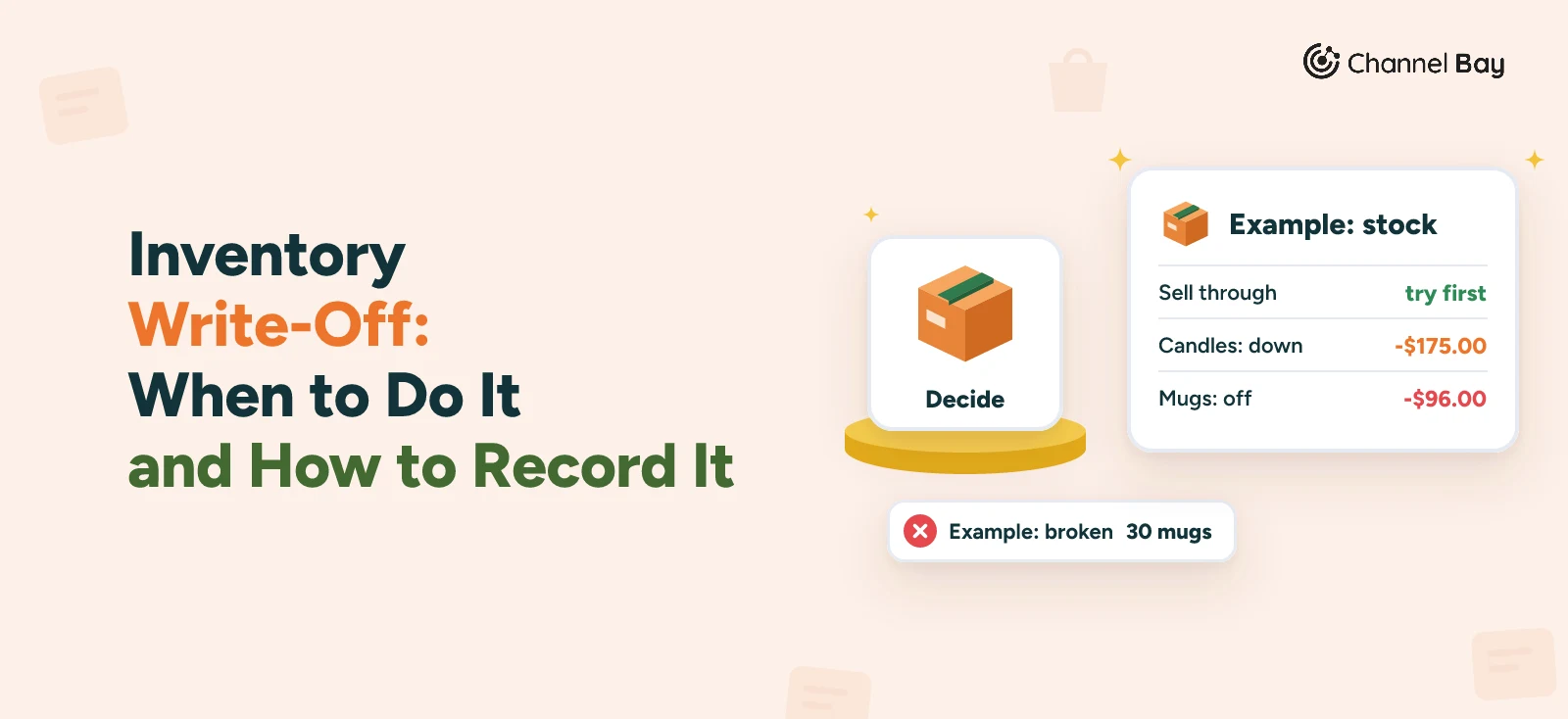
- In our invented example, 30 broken mugs at $3.20 are a $96.00 write-off: a debit to an expense account (cost of goods sold in AccountingTools' description) and a credit to inventory. The account name in our table is an illustration, and your accountant decides the account.
- Sections of three IRS publications cover how to value goods that can't be sold, how to deduct a theft or casualty loss of inventory and how donated inventory is treated. None of the sections we read says an ordinary write-off is deductible, or that it isn't, so ask your accountant.
- Shopify's help pages we read don't describe a write-off function. You adjust the quantity down with a reason, and keep the proof elsewhere.
- Channel Bay has no write-off reason. Use Damaged or Theft / Loss in the single adjustment, or Damaged, Lost or stolen or Other in the bulk update, and check the Inventory Adjustment Report's cost value against your own figures.
An inventory write-off removes the cost of stock that has no value left from your books. A write-down removes only the part you can't recover. In Shopify you take the units off with an inventory adjustment, and the write-off itself is an entry in your accounts. A write-down changes only the recorded value, so the units stay. Either way, keep proof of why.
The pages we read for this guide mostly cover the entry. This one also covers the decision before it (is this stock worth selling through first?), the records to keep, what sections of three IRS publications say, and the steps in Shopify and Channel Bay. We read every source cited here on 12 November 2026, mark direct quotes with quotation marks and say where we didn't read something. It is part of our inventory valuation guide. If you only have a minute, count the stock before you write anything off, and keep a photo and a note for every line.
What Is an Inventory Write-Off, and How Does It Differ From a Write-Down?
A write-off removes the whole recorded cost of stock because nothing of value remains. AccountingTools puts the difference this way: a write-down reduces the carrying value of inventory to net realizable value when it remains partially recoverable, and a write-off eliminates the inventory balance entirely (AccountingTools, how to write down inventory, read 12 November 2026). One accounting textbook defines net realizable value as the "estimated selling price in the normal course of business, less reasonably predictable costs of completion, disposal, and transportation" (Principles of Accounting, lower of cost or net realizable value, read 12 November 2026).
Three neighboring terms get mixed up with it:
- An adjustment changes the recorded quantity. A cracked mug you bin needs both an adjustment to the quantity and a write-off of its cost, and you record them as two separate things, unless your accounting software posts the entry from the adjustment. See the inventory adjustment guide for the reasons and the steps.
- Shrinkage is the measure of stock that went missing, whatever the cause. The inventory shrinkage guide shows how to calculate it, and a write-off is one way a shrinkage loss reaches the books.
- A write-down is the partial version. Stock you can still sell for less than it cost is written down, not written off.
On the books, IAS 2, the IFRS standard for inventories, says inventories are measured at the lower of cost and net realizable value, and that the amount of any write-down of inventories to net realizable value and "all losses of inventories" are recognized as an expense in the period the write-down or loss occurs (IFRS Foundation, IAS 2 Inventories, read 12 November 2026). The entries below follow that idea. If you report under US GAAP, ask your accountant how it treats the same loss. When and how you write off stock is for your accountant to say.
When Should You Write off Inventory?
Our rule of thumb, not a standard: write stock off when you have decided it can't be sold or used, not when you suspect it can't. A write-down is different and shouldn't wait for the stock to sell: under IFRS, the lower-of-cost-and-net-realizable-value rule in IAS 2 means stock you expect to net less than cost is carried at the lower figure. Before you write anything off, ask what else could recover some value, because every unit you sell through or return is a write-off you don't have to record.
| Situation | Write-off or write-down | Try this first | Proof to keep |
|---|---|---|---|
| Broken or damaged beyond sale | Write-off | A carrier claim or a supplier credit | Photos, the packer's note, the claim |
| Expired or spoiled | Write-off | Returning a short-dated batch, if the supplier takes it | Batch and date, how it was disposed of |
| Out of season or slow to sell | Write-down if you expect to net less than cost but more than nothing, write-off if nobody will take it | A markdown, a bundle or a clearance sale | The new price and how long it was offered |
| Missing after a recount | Write-off | Searching, then reconciling against receipts and orders | Both count sheets and the reconciliation |
| Given away | Can be treated differently from a write-off (see the tax section) | Not applicable | The recipient and what was agreed |
| Destroyed on instruction, such as a recall | Write-off | Not applicable | The instruction in writing and the disposal record |
Two rules keep the list honest. First, claim what a supplier or carrier owes you before you write off the loss, because a credit offsets it. The return to vendor guide covers the paperwork. Second, don't write off stock nobody has counted. A blank row in a stocktake is a product nobody looked at, and the uncounted items guide shows how setting those rows to zero removes units from your records that may still be on the shelf.
What Is the Journal Entry for an Inventory Write-Off?
The simplest approach writes the loss off in one step instead of through a reserve. AccountingTools describes a write-off as a debit to cost of goods sold and a credit to inventory (AccountingTools, how to write off inventory, read 12 November 2026). For a write-down it describes a credit to inventory and a debit to a loss account, and says a large write-down should be shown in a separately itemized account so readers can see it (AccountingTools, how to report an inventory write down, read 12 November 2026).
Your accountant picks the account, and the account names in the tables below are illustrations. Our inventory adjustment guide debits cost of goods sold for a count shortage, and a write-off expense account is another possible choice. AccountingTools is a single accounting reference, so treat these entries as the general pattern.
A Write-off Entry
Take the sage mug from our reconciliation guide, which costs $3.20. The figures are invented. A pallet corner is crushed in storage and 30 sage mugs are broken.
| Account | Debit | Credit |
|---|---|---|
| Inventory write-off expense | $96.00 | |
| Inventory | $96.00 |
That is 30 mugs at $3.20, written off in full. In Shopify the matching change is minus 30 on the sage mug with the closest reason in the menu. The help pages we read don't list the labels.
A Write-Down Entry
A write-down splits the loss. Suppose 50 seasonal candles cost $6.00 each, $300.00 in all, and after the season you expect to sell them for $2.50 each after selling costs. The carrying value falls from $300.00 to $125.00, so $175.00 is written down. Another invented example:
| Account | Debit | Credit |
|---|---|---|
| Loss on write-down of inventory | $175.00 | |
| Inventory | $175.00 |
The $125.00 stays on the books until the candles sell or you decide they won't. The same pattern appears in the textbook cited above, which says a write-down credits the Inventory account and debits a loss for the decline in net realizable value, reported in the income statement as a charge against income.
Perpetual and Reserve Notes
- Perpetual or periodic. AccountingTools says a periodic system credits the inventory asset by the amount written down and debits a loss account, and that in a perpetual system the inventory software creates the entry from a transaction that lists the reduction as a write-down. Which system you use is your accountant's call.
- The reserve method. Instead of writing stock down in one step, a business can set aside a reserve for stock it expects to lose and draw it down as items are disposed of. AccountingTools' example has $100,000 of excess coffee roasters that can only be sold for $20,000, so an $80,000 reserve is recognized. When the roasters sold for $19,000, a further $1,000 of expense followed (AccountingTools, accounting for obsolete inventory, read 12 November 2026). The account names come from your accountant.
Is an Inventory Write-off Tax Deductible in the US?
We can't tell you. The answer depends on your country, your business structure and your accounting method. What follows is what three IRS publications say, for readers in the United States. We haven't read the Australian or UK tax guidance, and the rules differ, so check your own tax authority's.
- Goods that can't be sold. IRS Publication 538 (January 2022 revision) describes these as "goods you cannot sell at normal prices or they are unusable in the usual way because of damage", and among the causes it lists imperfections, shop wear, changes of style and odd or broken lots. It says to value them "at their bona fide selling price minus direct cost of disposition" (IRS Publication 538, Accounting Periods and Methods, read 12 November 2026). That is a valuation rule. Your accountant works out what it means for your return.
- Theft and casualty losses of inventory. IRS Publication 547 says there are "two ways you can deduct a casualty or theft loss of inventory": through the increase in the cost of goods sold, or separately, with a downward adjustment to opening inventory or purchases. If you use the first way, it adds: "Don't claim this loss again as a casualty or theft loss" (IRS Publication 547, Casualties, Disasters, and Thefts, 2025, read 12 November 2026). Publication 538, in its section on loss of inventory, adds, in the part about taking the loss through the cost of goods sold: "Any insurance or other reimbursement you receive for the loss is taxable."
- Donated inventory. IRS Publication 526 says that if donated stock was in opening inventory, "the amount you can deduct is the smaller of its FMV on the day you contributed it or its basis" (FMV is fair market value) (IRS Publication 526, Charitable Contributions, 2025, read 12 November 2026). It also says: "You must remove the amount of your charitable contribution deduction from your opening inventory." The donated amount "isn't part of the cost of goods sold". That publication says it explains how individuals claim charitable deductions, and we didn't read the rules for corporations.
None of the sections we read says outright that an ordinary write-off of unsellable stock is deductible, and none says it isn't. They describe valuation, a theft or casualty route and a donation route, each with conditions. Your accountant decides which applies, which is why this guide stops here. Keep the records in the next section so you can answer your accountant's questions.
Records to Keep for Every Write-off
Keep enough that someone who wasn't there could see what happened, to which units and who agreed. For each write-off, keep:
- The discovery. The count sheet, the stocktake or the incident that showed the loss, with the date.
- The units and their cost. The SKU, the quantity and the unit cost, so the value can be rebuilt. If landed cost applies, our landed cost guide explains what goes into it. Which cost leaves your books when a unit sells depends on your costing method, covered in our FIFO vs LIFO vs weighted average guide.
- The reason. A specific one, such as damaged in storage, not a general correction.
- The evidence. Photos, a supplier or carrier reply, an insurance claim or an incident note.
- The disposal. How the stock left: binned, destroyed, donated or returned, and who handled it.
- The approval. Who agreed to write it off, and when.
The inventory audit guide shows how an auditor tests a sample of adjustments against these documents. A short folder per write-off, named by date and SKU, is one workable way to keep them. Ask your accountant how long to keep them.
Writing off Inventory in Shopify
Shopify's help pages we read don't describe a write-off function. You take the units off with an inventory adjustment and a reason, and the entry in your books is a separate step. Our inventory adjustment guide has the full steps: Products, then Inventory, click the quantity, switch Set to to Adjust by, enter the quantity, choose an origin and destination, click Add reason and save.
Three points matter for a write-off:
- Use the standard adjustment, not the bulk editor, when you need a trail. Shopify's help says "When you use the bulk editor, you set absolute inventory quantities without specifying origin and destination, so this method doesn't create an audit trail of inventory movements" (Shopify Help Center, adjusting inventory quantities in bulk, read 12 November 2026).
- Keep the evidence outside Shopify. The help pages we read describe a reason, not a note or reference field, so put the photos and the damage note in your own folder and name the folder in your entry.
- Keep the history before you archive. Save a copy of a product's adjustment history before you archive the product.
Donating or Returning the Stock Instead
A supplier credit offsets the cost, so the loss is smaller or gone, and the return to vendor guide covers how to track the credit. A donation takes a different route, described in the Publication 526 bullet above. Record the recipient and what they received.
Writing off Inventory in Channel Bay
Channel Bay is our app, so we're not neutral here. What follows is how it works as of November 2026.
Which Reason to Pick
Channel Bay has no write-off reason, so use the nearest one. The single adjustment and the bulk update have different reason lists, so the closest fit depends on which you use:
| Situation | Single adjustment | Bulk update |
|---|---|---|
| Broken or damaged | Damaged | Damaged |
| Missing | Theft / Loss | Lost or stolen |
| Held back for inspection | Not in the list | Quality control hold |
| Given away | Promotion / Donation | Promotion, sample or giveaway |
| Expired, obsolete or anything else | Not in the list | Other, with your own text of up to 100 characters |
The single adjustment's list also has Correction, Count, Received, Return Restock and PO Restock, which don't describe a write-off. Channel Bay's bulk update is a different tool from Shopify's bulk editor. It requires a reason and writes a History row.
Making the Change
To make the change, open Inventory, open the variant and click the quantity for the location. In Adjust By, enter a negative whole number, pick the Reason and save. For many variants, use Bulk Action, then Update Inventory. Either way, a row appears on the variant's History tab with the reason and the user.
Reporting on Write-Offs
To total a period's write-offs, open Reports and the Inventory Adjustment Report. Filter by location and date, read the reason, quantity change and cost value columns, and use Export CSV. Cost value is the unit cost times the units changed, so check a row against your own figures. The report catalogue also lists Adjustments by Reason and Location and Write-offs and Shrinkage by Month as Coming soon, so for now the export is the way to group losses. Our Cost Tracking page explains how Channel Bay values stock.
What it doesn't have: an entry posting or accounting export, an approval step, or a way to choose Damaged or Theft / Loss when a stocktake posts its gaps. Record the approval and the entry outside the app.
Where to Start
Pick the one pile of stock you already know won't sell. Count it, photograph it and decide whether a markdown, a bundle or a supplier credit could recover anything first. If nothing can, adjust it down with a specific reason, save the evidence in a folder and give your accountant the quantity, the cost and the reason. Then check how your accountant wants it booked before you post the entry.
For the counting routine that finds these piles in the first place, see our stocktake guide.
Frequently Asked Questions
What is the journal entry for an inventory write-off?
What is the difference between an inventory write-off and a write-down?
Can I write off inventory in Shopify?
Is a write-off of inventory tax deductible?
What if I donate the stock instead of throwing it away?

Guides from the team that builds and supports Channel Bay, the Shopify inventory app for purchase orders, stocktakes, stock transfers and multichannel stock sync. About Channel Bay