Inventory Shrinkage: How to Calculate It, What Causes It And How to Reduce It
Inventory shrinkage is stock your records show but a count can't find. See the formula, a worked example, the causes by where they enter and the cheapest fixes.
On this page
Key Takeaways
- Inventory shrinkage is the gap between the stock your records show and the stock a count finds. The rate is (recorded minus counted) divided by recorded, times 100. Work it out at cost, because cost is what you lost.
- A count shows that stock is missing, not why. In the worked example, a $124.00 net shrinkage splits into $62.40 to claim back from the supplier, $42.80 of damage and $18.80 unexplained, with no theft found.
- The NRF's 1.6% shrink average comes from store retailers, 65% of it theft, and the NRF has stopped publishing it. A seller with no shop floor should set its own baseline from its last three counts.
- Shrinkage enters in a few places: delivery, storage, orders and returns, the records, and people. The cheapest fixes sit at delivery and returns.
- Record the net figure and the gross figure. A surplus on one line offsets a shortfall on another, so the net number can hide a pick error.
Inventory shrinkage is the loss of stock between buying it and selling it, shown as the gap between the quantity your records say you hold and the quantity a count finds. Shopify describes it as "the percentage difference between your actual physical inventory and your recorded inventory" (Shopify, Retail Math, Michael Keenan, updated 23 October 2026). A count tells you that stock is missing. It does not tell you why, and the why decides whether you claim a credit from a supplier, fix a process or tighten security. This guide gives the formula, a worked example, the causes sorted by where they enter your business, what a stocktake can and cannot show, and the cheapest fixes. It sits beside the stocktake guide, which covers how to run the count, and the inventory reconciliation guide, which covers tracing one line's gap to its cause.
What Is Inventory Shrinkage?
Shrinkage is stock your records show that you cannot find. It comes in two kinds:
- Physical loss. The stock is gone: stolen, broken, expired, lost in transit or given away without a record.
- Paper shrink. The stock is on the shelf, but the record is wrong. Shopify uses the term for administrative errors such as count mistakes and accounting discrepancies (Shopify, Retail Shrink, Michael Keenan, 15 November 2024). A recount clears it.
Two terms get mixed up with it. A variance is the difference on one line in one count, and it can be over or under. Inventory accuracy counts every miss, over or under, as a miss. Shrinkage nets the lines into one shortfall, as a value or a percentage, so it answers "how much did we lose?" rather than "how many lines were wrong?"
How to Calculate Inventory Shrinkage
Take the recorded quantity at the moment of the count, subtract what you counted, and divide by the recorded quantity. Shopify's formula is [(recorded inventory - actual inventory) / recorded inventory] × 100, and its example is 1,000 items on record with 950 found, which is 5% (Shopify, Retail Math).
| Measure | Formula | Use it for |
|---|---|---|
| Shrinkage in units | Recorded units minus counted units | Spotting which lines are short |
| Shrinkage at cost | For each line, (recorded minus counted) × unit cost, added up | What the gap cost you |
| Shrinkage rate | (Recorded minus counted) ÷ recorded × 100, in units or at cost | Comparing one count with the next |
Work the money out at cost, not at selling price. Cost is what you paid for the stock that is gone, and retail value overstates the loss. Some benchmarks divide by sales instead of by recorded stock, so check the denominator before you compare your rate with anyone else's.
A Worked Example
Here is a made-up count for a kitchenware shop, the same shop as in our reconciliation and audit guides.
| Product | Unit cost | Recorded | Counted | Variance | Variance at cost |
|---|---|---|---|---|---|
| White mug, 12 oz | $3.20 | 410 | 410 | 0 | $0.00 |
| Sage mug, 12 oz | $3.20 | 100 | 92 | -8 | -$25.60 |
| Cream mug, 12 oz | $3.20 | 80 | 83 | +3 | +$9.60 |
| Glass jar, large | $2.60 | 260 | 240 | -20 | -$52.00 |
| Tote bag | $4.10 | 120 | 120 | 0 | $0.00 |
| Oak chopping board | $14.00 | 40 | 36 | -4 | -$56.00 |
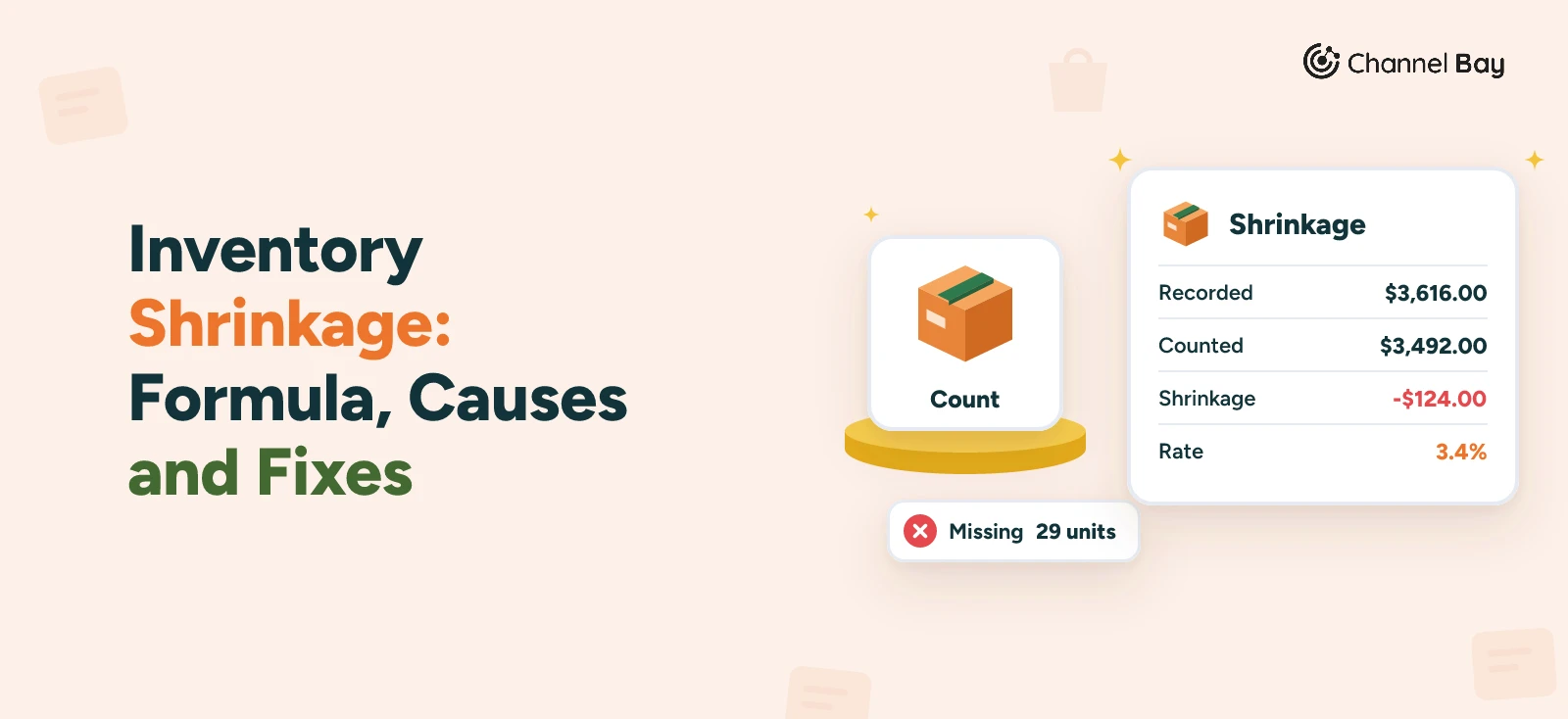
| Total | 1,010 units, $3,616.00 | 981 units, $3,492.00 | -29 units | -$124.00 |
- Net shrinkage at cost: $3,616.00 - $3,492.00 = $124.00, a rate of 124 ÷ 3,616 = 3.4%.
- Net shrinkage in units: 29 of 1,010, or 2.9%.
- Gross shortfall at cost: $25.60 + $52.00 + $56.00 = $133.60, or 3.7%. The cream mugs are $9.60 over, and that offsets part of the sage mug shortfall.
Record both the net and the gross figure. The net figure is the financial hit. The gross figure is how much stock actually went missing, and it is the better one for spotting a problem, because a surplus on one line can be a shortfall on another that went to the wrong place.
Where the Missing Stock Went
The 3.4% is a headline, and it is the wrong number to act on. Here is what a cause hunt finds on the same four lines, using the method in the reconciliation guide. The causes are made up.
| Line | Gap | What the hunt found | At cost | Class |
|---|---|---|---|---|
| Sage mug | -8 | 3 went out in cream orders | $9.60 | Swap, offsets the cream line |
| Sage mug | 2 short on the last delivery (packing slip 46, booked 48) | $6.40 | Supplier credit | |
| Sage mug | 2 broken in storage | $6.40 | Damage | |
| Sage mug | 1 unexplained | $3.20 | Unexplained | |
| Cream mug | +3 | 3 sage mugs shipped in cream orders | -$9.60 | Swap, offsets the sage line |
| Glass jar | -20 | 14 broken in a returns carton | $36.40 | Damage |
| Glass jar | 6 unexplained | $15.60 | Unexplained | |
| Oak chopping board | -4 | 4 damaged on arrival, booked in as sellable | $56.00 | Supplier credit |
| Class | At cost | Share of the $124.00 |
|---|---|---|
| Supplier credit to claim | $62.40 | 50% |
| Damage | $42.80 | 35% |
| Unexplained | $18.80 | 15% |
| Theft | $0.00 | 0% |
| Swap between lines | $0.00 net | 0% |
Half of the headline shrinkage is the supplier's to cover, so the true write-off is $61.60, or 1.7%. Nothing points to theft, and the unexplained $18.80 is the part to watch. If the same lines are unexplained again next count, look harder. If you had posted -$124.00 as a loss and moved on, you would have written off $62.40 you could have claimed.
What Causes Inventory Shrinkage?
The useful way to sort the causes is by where they enter, because the fix sits at the same place.
| Where it enters | Typical causes | What a count shows | Cheapest fix |
|---|---|---|---|
| Delivery | Short shipment, damaged on arrival, wrong item, a receipt keyed at the ordered quantity | A line short soon after a delivery | Check the delivery against the packing slip and PO before booking it (goods receipt), then claim the credit (return to vendor) |
| Storage and packing | Breakage, expiry, damaged stock left on the sellable shelf, samples and giveaways not recorded | Short lines with no matching order | Keep damaged stock apart and adjust it out as Damaged |
| Orders | A wrong variant picked, so one line is short and another over | A short line and an over line at the same cost | Scan at the pick |
| Returns | A return never booked back in, booked into the wrong variant, or damaged stock put back on the shelf | Short lines after a busy returns period | Inspect each return and book it into the right variant |
| Records | Counting errors, a missed or duplicate receipt, a pack size keyed as single units | A line that a recount puts right | Recount before you adjust |
| People | Shoplifting, employee theft, supplier fraud | The same lines short count after count | Limit who handles high-value stock and look at the pattern |
How Much of It Is Theft?
For a store, most of it. In the National Retail Federation's 2023 survey of 177 retail brands, the average shrink rate was 1.6% in FY2022, and internal and external theft made up nearly two-thirds (65%) of it (NRF, 2023). The NRF has since stopped publishing the annual shrink report (Retail Dive, Daphne Howland, 29 January 2025).
That figure comes from retailers with shop floors. A seller that ships from a stockroom has far fewer chances of shoplifting, so the 65% will not carry over, and we found no published benchmark for small online sellers. Treat 1.6% as context, not a target. Your own last three counts are a better baseline, and the direction matters more than the level. Shopify gives an example of a retailer whose quarterly counts showed shrinkage rising from 2% to 5% to 8%, which led to an investigation (Shopify, Retail Math).
Deliveries are where supplier errors enter your records. Auburn University's RFID Lab audited shipments from brands to retailers and found that audits with legacy systems recorded an order inaccuracy 69% of the time, against under 0.01% with RFID (Retail Dive, Edwin Lopez, 12 October 2018). That is a study of large supply chains, not small sellers, but the lesson carries: a delivery booked in as ordered, without checking it, puts any supplier error straight into your records.
What a Stocktake Shows and What It Can't
A stocktake is the only way to find shrinkage, because the system cannot see stock it believes is there. It has limits:
- It shows the gap, not the cause. The same $124.00 could be theft, a supplier error or a keying mistake. The cause hunt in the reconciliation guide is what tells them apart.
- It shows the gap since the last count. A line short by 20 could have lost 20 units last week or 2 a month for ten months. Cycle counting the lines that keep missing narrows the window.
- It cannot tell lost stock from a wrong record. Recount a miss before you call it shrinkage. If a second person gets the same number, the stock is gone or was never received.
- It is only as fair as the comparison. Count while picking is paused and against the same stock state, or the shrinkage includes stock that was in a box on the pack bench.
On the books, inventory is carried at cost and the loss has to go somewhere. IAS 2, the international inventory standard, says that "all losses of inventories are recognised as an expense in the period the write-down or loss occurs" (IFRS Foundation, IAS 2 Inventories). When and how you write it off is for your accountant to say. Our inventory write-off guide shows the entry for a write-off and a write-down on invented figures.
How to Reduce Inventory Shrinkage
These are in order of cost, cheapest first.
- Check every delivery before you book it in. Count against the packing slip and the PO, and book what arrived, not what was ordered. Our three-way match guide covers the paperwork.
- Claim what the supplier owes. A short shipment or a damaged carton is the supplier's loss until you let the claim lapse. Return to vendor covers the credit.
- Keep damaged, returned and unchecked stock in its own marked area. Sellable stock should be only sellable stock.
- Inspect returns and book them into the right variant. A return restocked as the wrong variant is a short line and an over line.
- Give every adjustment a specific reason and a reference. Damaged, Theft / Loss and Promotion / Donation say more than Correction, and they make shrinkage by cause measurable later.
- Count the lines that keep missing more often. The repeat misses are where the cause is still active.
- Fix the process behind each miss, and recount that line next time. Posting the adjustment fixes the number. It does not stop the next loss.
Tracking Shrinkage in Shopify, on Amazon and in Channel Bay
In Shopify
Shopify's stock counts record the counted and expected quantity for each variant, and each change is logged in adjustment history (Shopify Help Center, stock counts). Work the shrinkage rate out from those counts in a spreadsheet, as in the worked example. How to do a stocktake in Shopify walks through each counting tool.
On Amazon
Stock at Amazon fulfillment centers is yours but not on your shelves, so you cannot count it. Amazon's reimbursement policy points to the Inventory Ledger report to confirm the date and adjustment code of a loss or damage, and says a fulfillment center claim must be submitted no later than 60 days after the item was reported lost or damaged (Amazon, Reimbursements). Policies change, so check the current page. Review the report on a schedule, so a loss is found inside the claim window.
In Channel Bay
Channel Bay gives you the numbers to calculate shrinkage. It does not calculate it.
- The variance report. After you save and review a stocktake, the report shows the value of the stock difference, and each line shows expected, counted and variance. Each line has a notes field, which is where the cause goes. The report exports as CSV with cost price beside each line, so you can total the net and the gross shortfall at cost.
- The count log. Export the logs to see who added, counted or removed each product, the previous count and when it was scanned.
- One generic reason on submit. Submit posts the whole gap on every line under one generic reason, and you cannot choose Damaged or Theft / Loss there. Put the cause in the line's note, or post the reasoned adjustments from Inventory while the stocktake is still open.
- The Inventory Adjustment Report. In Reports, on the Basic plan and above, it lists changes by date, location, product, reason, user and reference, with the cost value of each change, and exports as CSV. The reasons are Correction, Count, Received, Damaged, Return Restock, PO Restock, Theft / Loss and Promotion / Donation. Filter on Damaged and Theft / Loss and add up the cost value to see the losses you recorded between counts.
- Supplier returns. A return records an expected credit from unit cost times quantity, then moves through Returned and Credited, so supplier-caused shrinkage can be claimed and tracked. There is no report that totals credits owed by supplier.
Channel Bay has no shrinkage report, no shrinkage rate, no cause field on a variance beyond notes, and no theft detection. The cause comes from your cause hunt, and the rate from the export.
Common Inventory Shrinkage Mistakes
| Mistake | What goes wrong | How to avoid it |
|---|---|---|
| Writing off the net number without a cause hunt | You pay for a supplier's error and repeat the process fault | Reconcile each line before you adjust |
| Working it out at selling price | The loss looks bigger than it was | Use unit cost |
| Reporting only the net figure | A surplus hides a pick error | Record the net and the gross |
| Comparing your rate with a store benchmark | A store's theft-driven rate says little about a stockroom | Use your own last three counts |
| Treating every gap as theft | The cause may be a receipt, a pick or a return | Sort the gap by where it entered |
| Adjusting everything as Correction | You cannot split shrinkage by cause later | Pick the most specific reason |
| Counting while orders are being picked | Stock in a box on the bench shows up as shrinkage | Pause picking and count against the same stock state |
Frequently Asked Questions
What is inventory shrinkage?
How do you calculate inventory shrinkage?
What is a good inventory shrinkage rate?
What causes inventory shrinkage?
How do you reduce inventory shrinkage?
Is shrinkage the same as a stock variance?

Guides from the team that builds and supports Channel Bay, the Shopify inventory app for purchase orders, stocktakes, stock transfers and multichannel stock sync. About Channel Bay