Inventory Audit: What It Checks and How It Differs From a Stocktake
An inventory audit tests whether your stock records can be trusted, not only the count. See audit vs stocktake, how to run one and an audit trail checklist.
On this page
Key Takeaways
- A stocktake counts what you hold. An inventory audit tests whether your records, and the process behind them, can be trusted. A count is one part of an audit, along with cut-off, ownership, cost and the adjustment log.
- The word covers three things: an internal check you run, an external auditor testing the stock figure in your accounts, and the audit trail of every stock change. Search results mix them, so know which one you need.
- Test counts run both ways. Records to shelf checks that stock exists. Shelf to records checks that nothing is missing from the list.
- A manual adjustment with no source document or a vague reason is the first thing to query. Give every adjustment a specific reason and a reference.
- If an auditor attends your count, expect them to review your instructions, observe, test count, take your cut-off information and confirm stock held by third parties. Your accountant decides what they will accept.
An inventory audit is a check that your inventory records, and the stock figure in your books, can be relied on. A physical count is part of it, but an audit also asks whether anything is missing from the list, whether the stock is yours, whether it is worth what the books say and whether the process that changes quantities leaves a trail. The word is used for three different things: a check you run yourself, an external auditor testing the stock figure in your accounts, and the audit trail of every stock change. This guide separates the three, shows a small seller's version you can run in a day or two, explains what an external auditor does, and ends with a checklist of the records to keep. It sits beside the stocktake guide, which covers how to run a count, and the physical inventory count guide, which covers year end.
This is general information, not tax or accounting advice. The rules differ by country and by business, so take the sections on external audits to your accountant.
What Is an Inventory Audit?
Shopify defines an inventory audit as "the process of cross-checking your actual inventory levels against financial records," and notes that it can also review how a business counts and records stock (Shopify, Inventory audit, 2023). That second part is what separates it from a count. A count produces quantities. An audit tests whether the quantities, and the records they are compared with, deserve trust.
Four questions sit behind most inventory audits:
- Is it there? Does the stock the records show exist, and in what condition?
- Is it all on the list? Is there stock on the shelf that no record shows?
- Is it yours? Consignment stock is on your shelf but not yours. Stock at Amazon or a third-party warehouse is yours but not on your shelf.
- Is it worth what the books say? Unit cost has to be supported, and stock worth less than it cost is written down. IAS 2, the international inventory standard, measures inventory at the lower of cost and net realisable value (IFRS Foundation, IAS 2 Inventories).
A count answers the first question and, if you also count from the shelf back to the records, part of the second. The rest need documents.
Inventory Audit vs Stocktake vs Cycle Count
| Activity | Question it answers | Who runs it | What it covers | What you get |
|---|---|---|---|---|
| Stocktake (physical inventory count) | How many of each item do I hold? | You and your team | Every item in a location, or a chosen list | Counted quantities and a variance report |
| Cycle count | Is this slice of the catalog still right? | You and your team | A few items a day, on a rotating schedule | A steady stream of small variance reports |
| Internal inventory audit | Can I trust my records and the process behind them? | You, a colleague or your bookkeeper, ideally not the person who counts | A sample of lines, plus adjustments, receipts, cut-off, ownership and cost | Findings and a list of fixes |
| External audit of the accounts | Is the stock figure in the accounts supported by evidence? | An independent auditor | Inventory is one area of the audit, where it is material | Audit evidence, which feeds the auditor's opinion on the accounts |
The overlap is real. The APICS Dictionary describes cycle counting as an inventory accuracy audit technique, in which stock is counted on a cyclic schedule rather than once a year (APICS Dictionary, 14th edition, as quoted by the APICS San Antonio chapter, 2020). So a good cycle count schedule is part of your audit evidence. It is not a full audit, because it does not test cut-off, ownership or cost.
An audit also does not replace the count. It tests how reliable your counts and records are, and the count is what gives the audit something to test. Inventory accuracy is the number you can report from it.
How to Run an Internal Inventory Audit
Here is a version a small seller can run in a day or two. Nothing in it is a required standard. It borrows the shape of what external auditors do, scaled down.
- Set the scope and date. Pick one location or the whole business, and a date. Say what you are testing: quantities, adjustments, cut-off, ownership, cost.
- Pull the records. The stock list at that date, the adjustment history for the period, goods receipts, supplier invoices, transfers and returns.
- Run test counts in both directions. See below.
- Trace a sample of adjustments to their source documents.
- Check cut-off, ownership and cost on a few lines.
- Write up the findings and fix the cause of each. Count the lines that missed again, and change the process behind each miss. The inventory reconciliation guide shows how to trace a miss to its cause.
Have someone other than the usual counter do steps 3 to 5 where you can. A reviewer who did not count has no reason to explain a miss away.
Test Counts, in Both Directions
Auditing standards describe test counts as tracing items selected from management's count records to the physical inventory, and tracing items selected from the physical inventory to management's count records, which gives evidence about the completeness and the accuracy of those records (AUASB, ASA 501, paragraph A7, 2023). In plain terms:
- Records to shelf. Pick lines from your stock list, favouring high-value lines and any that missed before, and count them. This tests that the stock exists and the quantity is right.
- Shelf to records. Walk the shelves, including the returns area, the prep bench and overflow storage, pick items, and find each one in your records. This tests that nothing is missing from the list.
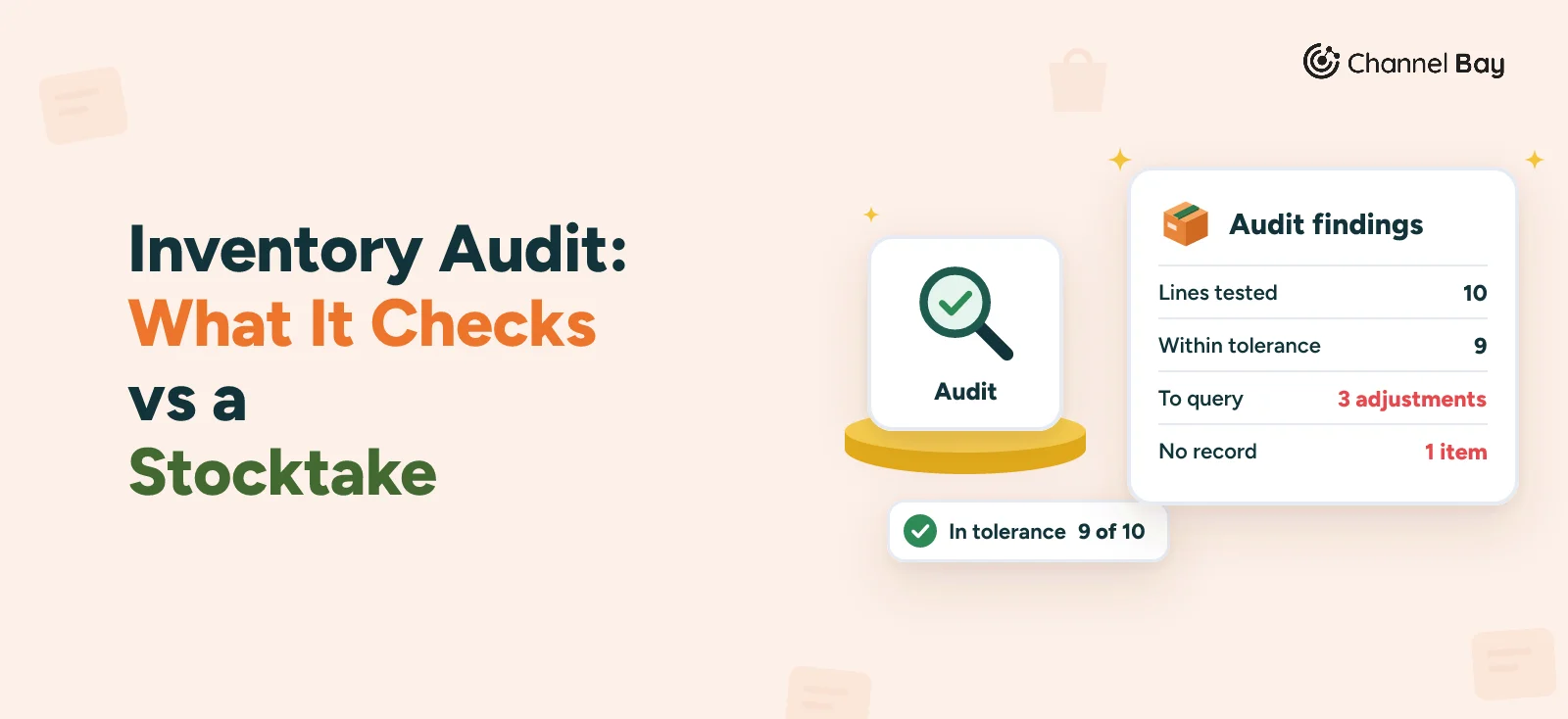
Say you test 10 lines each way on the kitchenware count from our inventory accuracy guide. From the list to the shelf, 9 of 10 lines are within your 5% and $50 tolerance, and the large glass jars are 20 units short of 260. From the shelf to the list, a carton of seasonal mugs in the returns area has no record at all. The second finding is the more serious one. A -20 on a known line is a count difference to investigate, but a whole product with no record is invisible to reorders, to channel sync and to the accounts.
Ten lines is a small sample. It catches large problems, not small ones. If you find any miss, widen the sample around it.
Trace a Sample of Adjustments
Counts are not the only way a quantity changes. Receipts, returns, transfers, channel orders and manual adjustments all move it. Auditing standards note that differences between perpetual records and physical quantities may indicate that the controls over changes in inventory are not operating effectively (ASA 501, paragraph A10). So pull the adjustment history for the quarter and look for changes that have no source document. For each sampled adjustment, ask whether it has a reason, a reference, a person and a size that makes sense.
Here is a made-up sample of five adjustments for the same brand. The rule is to query any adjustment with no reference, or over $50 at cost with no note.
| Date | Product | Change | Value at cost | Reason | Reference | Verdict |
|---|---|---|---|---|---|---|
| 3 Aug | White mug, 12 oz | +400 | +$1,280.00 | PO Restock | PO-0142 | Supported: matches the goods receipt |
| 19 Aug | Glass jar, large | -20 | -$52.00 | Count | Back room count | Supported: matches the count variance |
| 2 Sep | Tote bag | -35 | -$143.50 | Correction | None | Query: what happened to 35 bags? |
| 14 Sep | Oak chopping board | -4 | -$56.00 | Damaged | None | Query: no note or photo, over $50 |
| 30 Sep | Kettle | +10 | +$220.00 | Correction | None | Query: where did 10 kettles come from? An unrecorded delivery is a likely answer |
Three of five are queried, and all three share the same two weaknesses: a vague or missing reason, and no reference. The fix is not the numbers, which may well be right. It is the process: give every adjustment a specific reason and a reference, so the next audit can support it from the record alone. Adding up the Damaged and Theft / Loss adjustments gives the losses you recorded between counts, the starting point for inventory shrinkage.
Check Cut-Off, Ownership and Cost
Pick a few lines, ideally the highest-value ones, and check three things.
- Cut-off. Deliveries received just before and after the count date should be in the right period, and nothing should ship from the counted area during the count. The year-end version, with a cut-off note, is in our physical inventory count guide.
- Ownership. Match goods receipts to purchase orders and supplier invoices, as in a three-way match, so the stock on your list is stock you bought. Consignment stock should not be in your figure. Stock at Amazon or a third-party warehouse should be.
- Cost. Compare the unit cost on each sampled line with the latest supplier invoice, plus freight and duty if you use landed cost. Then ask whether any line is worth less than it cost, because damaged, expired or marked-down stock is written down.
What an External Auditor Does With Your Inventory
Many small online sellers are not audited. If you are, or a lender, buyer or investor wants a review, this is what to expect. The auditing standard for inventory is ASA 501 in Australia, which conforms with the international ISA 501. The US public-company standard, PCAOB AS 2510, treats observing inventory as a generally accepted auditing procedure (PCAOB AS 2510.01). Under ASA 501, if inventory is material to the financial report, the auditor must obtain evidence of its existence and condition by attending the count, unless that is impracticable, and by testing your final inventory records against the count results (ASA 501, paragraph 4). At the count, that means four things:
- Evaluate your instructions. The standard lists count and recount procedures, how slow-moving, obsolete, damaged and consignment items are identified, and control over movement, shipping and receiving before and after the cut-off date (paragraph A4).
- Observe the count. The auditor may take copies of cut-off information, such as details of stock movements, to test the accounting for them later (paragraph A5).
- Inspect the stock. This shows it exists and helps spot obsolete, damaged or ageing items, though not necessarily who owns it (paragraph A6).
- Perform test counts, in both directions, as described above (paragraph A7). The auditor also takes copies of your count records (paragraph A8).
Three more cases matter to an online seller.
- A count on another date. If the count is not on the financial report date, the auditor also tests the changes in inventory between the two dates (paragraph 5). Whether that is acceptable depends on the controls over changes in inventory (paragraph A9). This is why a clean adjustment log matters.
- Stock held by a third party. The auditor can ask the holder to confirm quantities and condition, or inspect the stock another way (paragraph 8). That covers a 3PL, and stock at Amazon, where Amazon's own report is your evidence.
- No attendance. If attending is impracticable, the auditor must use alternative procedures, and if they cannot get enough evidence the opinion is modified (paragraph 7).
An accounting reference lists further procedures for the same audit: testing cut-off by checking transactions just before and after the count, spending extra time on high-value items, retesting items with a history of errors, reviewing transfer documents for stock in transit, comparing recent supplier invoices with the costs in the valuation, applying the lower of cost or market rule, and confirming that the business owns the stock (AccountingTools, Inventory audit procedures, Steven Bragg, 15 May 2026). It suggests focusing cycle counts on high-value and error-prone items beforehand, which is a cheap way to prepare.
An Inventory Audit Trail Checklist
An audit trail is a record of every stock change that lets someone trace a quantity back to its source. Keep one folder per period, and check that each item below exists before anyone asks for it.
| Record | What it should let you show | Where it comes from |
|---|---|---|
| Count records | Who counted what and when, including recounts | Count log or signed count sheets |
| Variance report | Expected, counted and variance for each line, with a cause for each miss | Stocktake report with notes |
| Cut-off note | Last receipt, last shipment and transfers in transit on count day | Written on the day |
| Receipts | What arrived, matched to the purchase order and the supplier invoice | Goods receipt, purchase order, invoice |
| Adjustments | Every manual change, with date, person, reason and reference | Adjustment history or report |
| Transfers and returns | Transfers closed at both ends, supplier returns with credit | Shopify inventory transfers, return to vendor |
| Third-party and channel stock | Quantity at the cut-off date, from the holder | Amazon or 3PL inventory report |
| Costs and write-downs | Where each unit cost came from, and why anything was written down | Supplier invoices, landed cost workings |
How long to keep each one is for your accountant to say.
Auditing Inventory in Shopify, on Amazon and in Channel Bay
In Shopify
Shopify's stock counts record the counted and expected quantity for each variant, a manager approves the result before the difference is applied, and each change is logged in adjustment history (Shopify Help Center, stock counts). Use the adjustment history as the log in the sample above, and the stock count as the count record. The checks on cut-off, ownership and cost happen outside Shopify, in your purchase orders and invoices. How to do a stocktake in Shopify walks through each counting tool.
On Amazon
Stock at Amazon fulfillment centers is yours but not on your shelves, so your audit evidence is Amazon's reports. Amazon's reimbursement policy points to the Inventory Ledger report to confirm the date and adjustment code of a lost or damaged item, and says a claim for a fulfillment center loss must be submitted no later than 60 days after the item was reported lost or damaged (Amazon, Reimbursements). Policies change, so check the current page. Keep the report for each cut-off date next to your count records, and review it on the same schedule as your own counts, so a loss is found inside the claim window.
In Channel Bay
Channel Bay keeps the trail in four places.
- The stocktake. A stocktake is a session for one location. The variance report shows expected, counted and variance for each line, with a note field per line for the cause. It exports as CSV with the SKU, cost price, retail price, expected and counted quantity and notes. The completed report uses the expected quantity captured for the stocktake, not the live quantity.
- The count log. It exports every action on the stocktake, oldest first: who added, counted or removed each product, the previous count, the count and when it was scanned.
- The stocktake timeline. Open View History on a session to see who created, edited and completed it.
- Inventory history and the adjustment report. Each variant has a History tab listing its quantity changes with a reason and a reference. Receipts and supplier returns show the purchase order number. The Inventory Adjustment Report, in Reports on the Basic plan and above, lists changes by date, location, product, reason, user and reference, with old and new quantity and the value at cost, and exports as CSV.
When you adjust a quantity, pick the most specific reason on offer, such as Count, Damaged, Theft / Loss or PO Restock, and avoid Correction where another fits. Stock changes made in Shopify appear in the history under the reason Shopify Inventory update, so filter those separately when you trace a sample. Our inventory adjustment guide covers the reasons and how to record the entry.
Channel Bay keeps the records. It does not judge them, and what an auditor accepts is for your accountant to say. Channel Bay has no approval step on a count, so if you want a second person to sign off, record that outside the app.
Common Inventory Audit Mistakes
| Mistake | What goes wrong | How to avoid it |
|---|---|---|
| Treating a count as an audit | Cut-off, ownership and cost never get tested | Add the checks in steps 4 and 5 |
| Testing your own count | A counter explains away their own misses | Have someone else run the test counts |
| Testing in one direction only | Stock with no record is never found | Test records to shelf and shelf to records |
| Using Correction for every adjustment | The next audit cannot support the change | Give each a specific reason and a reference |
| Ignoring stock you own but do not hold | Amazon and 3PL stock is missed or double counted | Take the holder's report at the cut-off date |
| Starting to prepare the week before | Known problem lines surface in front of the auditor | Cycle count high-value and error-prone lines in the months before |
| Fixing the number, not the cause | The same miss returns next audit | Trace the movements since the last count and change the process |
Frequently Asked Questions
What is an inventory audit?
What is the difference between an inventory audit and a stocktake?
How do you conduct an inventory audit?
What do auditors check when auditing inventory?
How often should you audit inventory?
Is a cycle count an inventory audit?

Guides from the team that builds and supports Channel Bay, the Shopify inventory app for purchase orders, stocktakes, stock transfers and multichannel stock sync. About Channel Bay