Multichannel Inventory Management for Shopify: When You Need It And How to Start
Multichannel inventory management keeps one stock count for every place you sell. See when Shopify alone is enough, what changes the count and how to start.
On this page
- What is multichannel inventory management?
- When is Shopify alone enough?
- The four movements that change your count
- Where does multichannel inventory go wrong?
- How do you choose a multichannel inventory system?
- Set it up for Shopify and Amazon in five steps
- What should you measure once it runs?
- Start with one count and one pair of channels
Key Takeaways
- Treat each channel as a reader of one count, and fix that count before you connect anything: a sync copies whatever number it starts from.
- You need it when a product is listed in a second place. With one channel and a few locations, Shopify's admin often covers it.
- Four things change the count: a sale, a delivery, a transfer and a stock count. A system has to carry all four to every channel, not only sales.
- When you compare systems, ask for facts: which channels it connects, how often it pushes stock, how listings are matched and what it does with stock the marketplace holds.
- Channel Bay connects Shopify stores and Amazon, pushes stock changes every minute and can't sync Amazon FBA stock. If you sell on other marketplaces, check what a tool supports first.
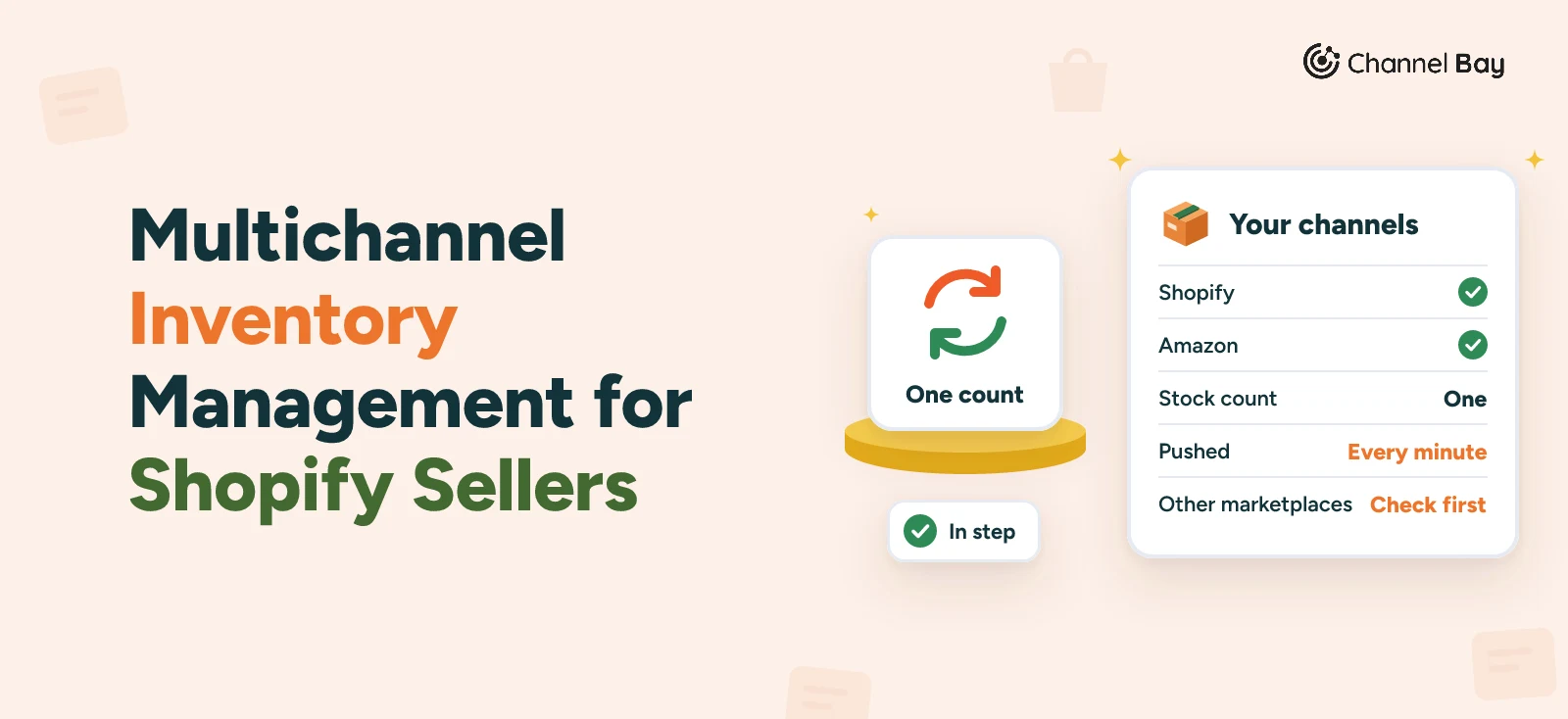
Multichannel inventory management means every place you sell reads and updates one stock count, instead of each channel keeping its own number. For a Shopify seller who also sells on Amazon or runs a second store, the smallest working version is one system that holds the count and pushes it to every channel, plus a routine for what changes it.
This guide covers what that means, how to tell whether you need it yet, the four movements a system has to carry, what to ask when you compare options and how to set it up for Shopify and Amazon.
What Is Multichannel Inventory Management?
It is the practice of tracking stock for every sales channel from one count. A channel is any place a customer can buy: a Shopify store, a second Shopify store, Amazon, a marketplace or a physical shop.
Without it, each channel holds its own number. Say you have one unit left. A customer buys it on Amazon. Shopify still shows one, a second customer buys it there, and one order can't be filled. With it, the sale changes the one count and the other channel hears about it.
You will also see the word omnichannel. It usually describes the wider goal of making stores, online and fulfilment feel like one experience to the customer. It depends on the same shared count underneath, so the work in this guide applies to both.
When Is Shopify Alone Enough?
Not always. The test is how many places a product is for sale, and which places.
| Where you sell | What usually works |
|---|---|
| One channel, one or a few locations | Shopify's admin: tracking, purchase orders, transfers and stock counts. See Shopify inventory management for where each stops. |
| Shopify plus Amazon, or two Shopify stores | One system that holds the count and pushes it to both. This is where a spreadsheet stops working. |
| Shopify plus other marketplaces such as eBay | A tool that lists those marketplaces on its own page. Shopify's own Marketplace Connect app covers marketplaces beyond Amazon (Shopify Help Center: Marketplace Connect). Channel Bay connects Shopify and Amazon only, so it isn't the answer here. |
If you are in the first row, stay there until a product is listed in a second place. If you are in the third, check the channel list of any tool before you read its feature page.
The Four Movements That Change Your Count
Syncing a sale is the obvious part. A system also has to carry every other movement that changes the count, or the channels drift apart anyway.
| Movement | What has to happen | More detail |
|---|---|---|
| A sale on any channel | The one count changes and every other channel is updated. | Shopify and Amazon inventory sync |
| A delivery from a supplier | Units land at the right location and every channel updates, including when a delivery arrives in parts. | Multi-location purchase orders, Shopify Help Center: purchase orders |
| A transfer between locations | Stock leaves the source and its channels on dispatch, then appears at the destination when received. | Shopify inventory transfers |
| A stock count | The difference between expected and counted stock is applied and every channel updates. | How to do a stocktake in Shopify, Shopify Help Center: inventory counts |
Here is the same idea with invented figures. One mug sits at one location and is listed on Shopify and Amazon. The one count is the only number anyone edits.
| Step | What happens | The one count | Shopify and Amazon show |
|---|---|---|---|
| Start | You count the shelf | 5 | 5 and 5 |
| Sale | A customer buys 1 on Amazon | 4 | 4 and 4 |
| Delivery | A purchase order of 10 is received | 14 | 14 and 14 |
| Stock count | The shelf holds 13, so the difference of 1 is applied | 13 | 13 and 13 |
Example, invented figures. Each channel catches up on the next sync cycle, so the two columns match only once the push has run. A tool that only syncs sales would leave the delivery and the count as manual edits in several places, which is the problem you started with. Our guide to connected inventory in Shopify walks through each movement in more detail.
Where Does Multichannel Inventory Go Wrong?
Most problems come from four causes:
- A restock typed into one place. A delivery is added in Shopify but not on the other channel, so that channel shows too little and misses sales. Or the other way round.
- Listings that were never matched. The same product exists on two channels, but nothing ties them together, so a change on one reaches nothing. Matching usually runs on SKU, which makes a blank or duplicate SKU a common cause.
- Stock the marketplace holds itself. Amazon FBA stock sits in Amazon's warehouses, outside your own count. Counting FBA and merchant-fulfilled stock shows how to split it.
- The sync gap. Every sync runs on a cycle, so a product down to its last unit can still be sold twice inside it.
Counts that were wrong before you connected are a fifth cause that no system fixes. A sync copies whatever number it starts from, so count first. The inventory accuracy guide covers how.
How Do You Choose a Multichannel Inventory System?
Compare facts, not adjectives. These are the questions that separate systems, and each has an answer a vendor can give you in a sentence.
- Which channels does it connect? Read the list, not the marketing. A tool that says "multichannel" may mean two channels or twenty.
- How often does it push stock? Ask for the interval as a number. "Real time" is not a number.
- Is there one count per location? If you stock more than one warehouse or shop, you need one count for each.
- How are listings matched? Ask what happens when a SKU is blank or shared by two products.
- What does it do with marketplace-held stock? Ask about FBA by name if you use it.
- Can you pause a product, a location or a channel? You will need to, the first time a count is wrong.
- Does it cover the other movements? Deliveries, transfers and counts, not only sales.
For a side-by-side look at the apps that cover these, see our guide to the best inventory management software for Shopify. If you only need listings, orders and stock for Amazon, Shopify's own Marketplace Connect app may be enough.
Set It Up for Shopify and Amazon in Five Steps
The order matters more than the tool. The steps below follow how Channel Bay connects a store, and they apply to most systems.
- Count your stock first. A sync copies the number it starts from, so a wrong count in Shopify becomes a wrong count on Amazon.
- Connect Shopify and choose who is right on day one. Either Shopify's numbers are correct today and are copied in, or the new system's numbers are used and overwrite the store.
- Connect Amazon. Amazon's pricing page lists "Sell with apps and APIs" under its Professional plan and not under Individual (Amazon, selling plans), so plan on a Professional Seller account. Channel Bay doesn't read Amazon's quantities when you connect: the Channel Bay count is the one Amazon is set to, so any existing Amazon stock needs counting first. Our Shopify and Amazon sync guide has the detail.
- Check the matches. Extra Shopify stores match by SKU or barcode and Amazon by seller SKU, only where exactly one product matches. Link the rest by hand. For more than one Shopify store, see how to sync inventory between Shopify stores.
- Watch the first sync. Change a count on one channel and confirm the other follows.
Channel Bay is our app, so weigh this paragraph with that in mind. Channel Bay holds one count for each product at each location and pushes stock changes to every connected Shopify store and Amazon every minute. You can pause one product, one Shopify location or a whole channel, or set a channel to fetch-only so Channel Bay stops pushing stock to it. It doesn't sync Amazon FBA stock, and it doesn't connect channels beyond Shopify and Amazon. The step-by-step screens are in connected inventory in Shopify and on the multichannel sync page.
What Should You Measure Once It Runs?
Three numbers are enough to start, and none needs a benchmark from anyone else. Compare each against your own last month.
- Inventory accuracy. How closely the recorded count matches the shelf, found by counting a sample of products. A stock count is the test. See inventory accuracy.
- Stockouts. How many products reached zero available while people still wanted them, and for how long. This is the cost of a count that is too low or a reorder that was late.
- Sell-through by channel. Units sold on a channel divided by the units available to it in the period. If 120 units were available to Amazon in a month and 30 sold, sell-through is 25%. It shows which channel moves stock and which one only holds it. (Example figures, invented.)
Start With One Count and One Pair of Channels
Multichannel inventory management is one count that every channel sells from, kept right by carrying every movement to every channel. If a product is listed in a second place, start there. Count first, connect one pair of channels and check the first sync before you add more.
Frequently Asked Questions
What is the difference between multichannel and omnichannel inventory management?
Do I need software to sell on two channels?
How often should stock sync between channels?
Can I manage inventory across several Shopify stores?

Guides from the team that builds and supports Channel Bay, the Shopify inventory app for purchase orders, stocktakes, stock transfers and multichannel stock sync. About Channel Bay