Purchase Order Financing: How It Works, Costs and Alternatives
Purchase order financing pays your supplier so you can fill a customer's order. How it works, what 1% to 6% a month costs, who qualifies and the alternatives.
On this page
- What is purchase order financing?
- How purchase order financing works
- A purchase order financing example
- What purchase order financing costs
- What lenders look for
- Does purchase order financing suit an online store?
- Purchase order financing vs invoice factoring and inventory financing
- Alternatives to purchase order financing
- Questions to ask a purchase order financing company
- How Channel Bay fits with purchase order financing
- Common purchase order financing mistakes
- Where to start with purchase order financing
Key Takeaways
- Purchase order financing (PO financing) is a lender paying your supplier so you can fill a confirmed customer order. The customer pays the lender, who keeps its fee and sends you the rest. The purchase order is your customer's order to you, not the one you send your supplier.
- Shopify's guide puts the fee at 1% to 6% of the supplier's cost per month. The longer your customer takes to pay, the more you pay. A 3% fee per 30 days works out to about 36.5% a year.
- In the mug example, a $9,600 supplier bill on a $21,000 order costs $576 in fees if the customer pays on day 60 and $864 if it pays on day 90. That is 5.5% and 8.2% of the $10,500 gross profit. On a thin margin the same fee takes more than a quarter of the profit.
- It suits wholesale orders from a creditworthy buyer with a healthy margin, which Shopify's guide puts at 20% or more. It does not suit restocking your own store, where there is no customer PO to finance. Inventory financing, a line of credit, Shopify Capital or better supplier terms fit that case.
- Channel Bay does not offer financing. It keeps each PO's supplier cost, payment terms and expected date, and shows ordered value and open units in the Purchase Order Register, so you know what you have committed before you take on a big order.
Purchase order financing (PO financing) is short-term funding that pays your supplier so you can fill a confirmed customer order you could not otherwise afford to produce. A lender pays the supplier, your customer pays the lender when the goods arrive, and the lender keeps its fee and sends you the rest.
The purchase order in the name is your customer's order to you, not the one you send your supplier. That decides who can use it. If you sell wholesale to retailers or distributors, it can fund an order bigger than your cash. If you restock your own online store, there is no customer PO to finance, and other options fit better.
This guide covers how it works step by step, a worked example on the mug from our other purchase order guides, what it costs, what lenders look for, how it differs from invoice and inventory financing, the alternatives for an online seller, and where Channel Bay fits. It is a companion to the purchase order guide. It is a general explainer, not financial advice, so talk to your accountant or a lender before you sign anything.
What Is Purchase Order Financing?
Shopify's guide describes it as a financing agreement in which a lender pays a supplier on a business's behalf, covering up to 100% of the costs (Shopify, purchase order financing, published 7 August 2024, read 11 November 2026). The lender is repaid from your customer's payment, and Shopify's guide lists the absence of monthly loan payments as a benefit.
Two purchase orders are involved, and they are easy to mix up:
| Customer's PO | Your PO to the supplier | |
|---|---|---|
| Sent by | Your customer, such as a retailer | You |
| Sent to | You | Your supplier |
| Role in PO financing | The order you have won, and what the lender checks first | The cost the lender pays, backed by the supplier's quote |
HubSpot's guide lists the businesses it suits as manufacturers with custom orders, import and export businesses, wholesale distributors, seasonal businesses and startups without a long credit history (HubSpot, purchase order financing, updated 20 February 2025, read 11 November 2026). What they share is a buyer who has already committed to an order and a supplier who needs paying before it ships.
How Purchase Order Financing Works
A typical sequence looks like this:
- A customer sends a PO you cannot fund. The order is confirmed, but the supplier wants payment before it ships and your cash is tied up elsewhere.
- Get the supplier's cost. Ask for a quote or pro forma invoice for the whole order.
- Apply with both documents. Shopify's guide names copies of the customer's purchase orders and pro forma invoices as what lenders ask for. Approval takes from a few days to several weeks. The lender looks hardest at your customer's creditworthiness and the supplier's reliability, then at your financial and credit history.
- The lender pays the supplier. Often through a letter of credit, for up to 100% of the supplier's cost. Some lenders cover only part, such as 85%, and you fund the gap.
- The supplier delivers to your customer. The lender gets confirmation of delivery.
- You invoice the customer, who pays the lender. Not you.
- The lender deducts its fees and pays you the rest.
Step 6 is the part to think about first. Shopify's guide notes that customers paying a third party can strain relationships or inconvenience their accounts payable teams. Tell the buyer before you apply, and check that they will accept it.
A Purchase Order Financing Example
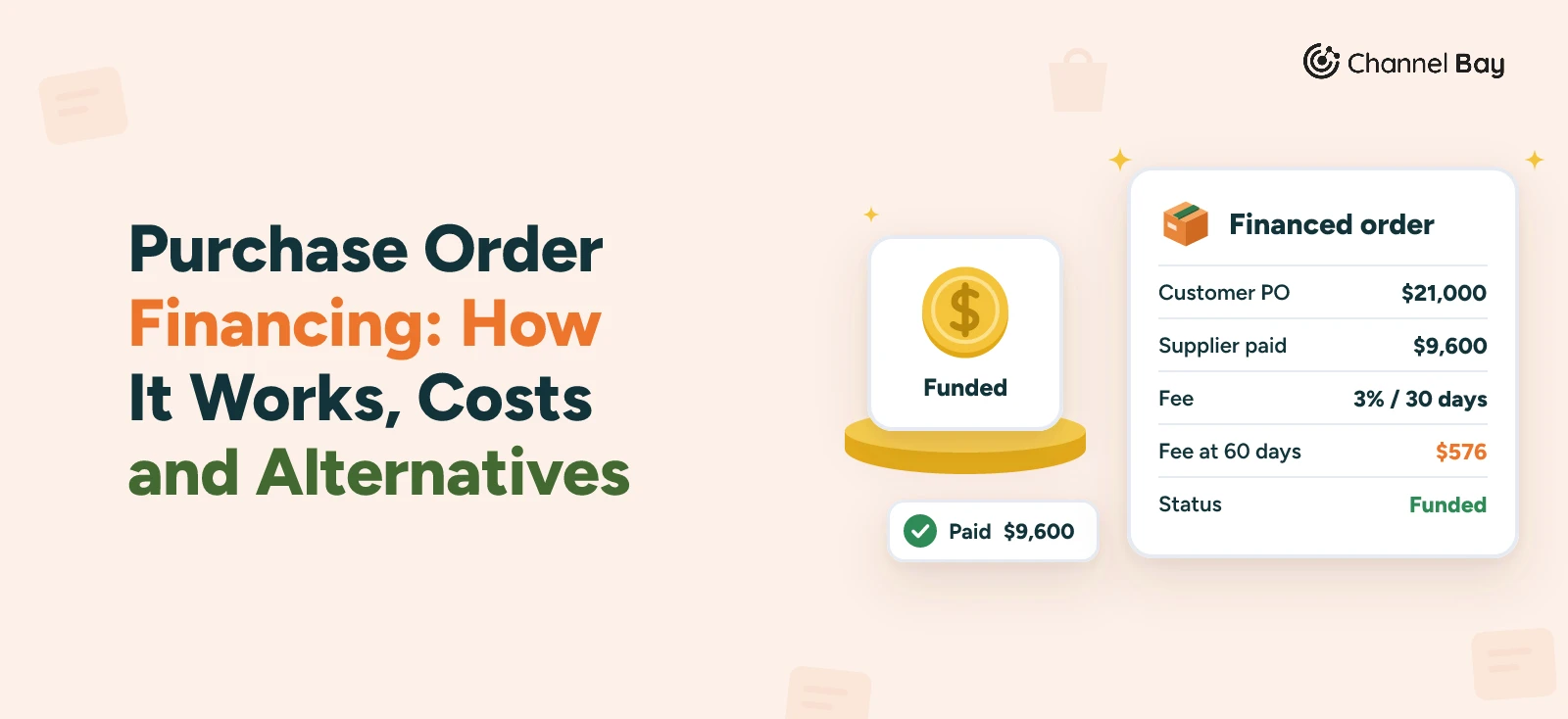
Take the mug used across our purchase order guides. The brand buys white mugs (MUG-WHT-12) at $3.20 and has a 25-day lead time, as in the reorder point guide. A café group sends a PO for 3,000 mugs at $7.00 each, payable 30 days after delivery. The supplier wants its money before it ships. The brand does not have it.
| The order | Amount |
|---|---|
| Customer's PO: 3,000 mugs at $7.00 | $21,000 |
| Supplier's cost: 3,000 mugs at $3.20 | $9,600 |
| Freight to the customer, paid by the brand | $900 |
| Gross profit before financing | $10,500 (50%) |
Suppose a lender offers to fund the $9,600 for a fee of 3% per 30 days. It pays the supplier on day 0. The goods reach the café group on day 30: the 25-day lead time plus about 5 days of shipping. The café group's 30 payment days then end on day 60.
| Customer pays on day 60 | Customer pays on day 90 | |
|---|---|---|
| Customer pays the lender | $21,000 | $21,000 |
| Lender's advance to the supplier | -$9,600 | -$9,600 |
| Fee at 3% per 30 days (2 or 3 periods) | -$576 | -$864 |
| Paid to the brand | $10,824 | $10,536 |
| Freight the brand paid | -$900 | -$900 |
| Gross profit after financing | $9,924 | $9,636 |
| Fee as a share of the $10,500 gross profit | 5.5% | 8.2% |
The order still makes money either way, and without the lender the brand could not have taken it. The fee is the price of 60 or 90 days of someone else's cash, and it rises by $288 for every 30 days the customer is late.
Now change the price. If the café group paid $4.20 a mug, the sale would be $12,600 and the gross profit $2,100, or 17%. On this simple gross basis that is below the 20% minimum Shopify's guide cites, and the $576 fee would take 27% of the profit. Whether PO financing works depends on the margin on the order as much as on the rate.
These figures are an example, not a quote from a lender. The 3% fee is a mid-range figure inside the range the guides give, and real offers differ in what the fee is charged on, how the clock runs and what else is added.
What Purchase Order Financing Costs
Shopify's guide says fees typically range from 1% to 6% of the supplier's costs per month, charged per 30-day period. HubSpot's guide gives the same range. The fee grows the longer your customer takes to pay. Shopify's example is a $25,000 supplier cost at 5% per 30 days: $1,250 if the customer pays in 30 days and $2,500 if it takes 60.
A monthly fee hides the annual cost. Simple annualised, with no compounding:
| Fee per 30 days | About a year |
|---|---|
| 1% | 12% |
| 3% | 36.5% |
| 6% | 73% |
HubSpot's guide puts bank loans and lines of credit at 5% to 15% a year. PO financing costs more a year, but it is short and tied to one order, so the dollars on this order matter more than the annual rate. That is why the example above counts the whole fee against the gross profit.
To compare offers, work out these three figures for the same order:
- The fee if the customer pays on time. Use the real payment terms, not the best case.
- The fee if the customer pays 30 days late. The clock keeps running.
- The fee as a share of the gross profit. If it takes a quarter of the profit, the order may not be worth financing.
What Lenders Look For
- Your customer's credit. The lender is relying on your customer to pay. A large, reliable buyer helps. Shopify's guide ranks customer creditworthiness and supplier reliability above your own credit.
- A supplier that delivers. The lender is paying the supplier and needs the goods to arrive as ordered.
- A healthy margin. Shopify's guide cites at least 20% on the covered order. The fee comes out of that margin.
- An order of the right size. HubSpot's guide puts typical order sizes at $50,000 or more and names lenders whose minimums start at $10,000 and $20,000. Check each lender's minimum.
- The right documents. The customer's PO and the supplier's pro forma invoice, plus your financial statements and credit history.
- A cost the lender will pay. It funds the supplier's cost of the order, not general working capital. Shopify's guide lists this as a limit.
Does Purchase Order Financing Suit an Online Store?
Mostly not, with one exception.
At your own checkout the shopper pays as they order. There is no customer PO waiting to be funded, so there is nothing for a PO financer to rest on. If you are buying stock ahead of sales, the options in the next section fit better.
The exception is wholesale. A retailer or business buyer who sends you a purchase order is the customer PO case, whether it comes by email, as a draft order or as a PO number at B2B checkout. Our Shopify B2B purchase orders guide covers how those orders reach your store, and sales order vs purchase order shows how your order and the buyer's PO line up.
It also needs the margin. A wholesale price that leaves under 20% on the order is hard to finance and may not be worth taking.
Purchase Order Financing vs Invoice Factoring and Inventory Financing
The three solve different gaps in the same cash cycle:
| Purchase order financing | Invoice financing or factoring | Inventory financing | |
|---|---|---|---|
| What it funds | Your supplier's cost for a confirmed customer order | Cash against an invoice you have issued | Buying stock |
| When | Before you ship | After you ship and invoice | Before you sell |
| What it rests on | The customer's PO and credit | The invoice and your customer's credit | Your business and the stock |
| Repaid from | Your customer's payment | Your customer's payment | Your sales, on a loan or credit line |
Purchase order financing covers the cost of making the sale. Factoring covers the wait for the customer to pay. Shopify's inventory financing guide describes inventory financing as a loan or line of credit used to buy inventory, with the goods as collateral, and says lenders ask for financial statements, tax returns, bank statements, a current inventory list and sales forecasts (Shopify, inventory financing, published 26 August 2025, read 11 November 2026). HubSpot's guide notes that a lender can combine purchase order and receivable financing, so an order can be funded first and the invoice bridged later.
Alternatives to Purchase Order Financing
For an online seller the better-fitting options are usually these. Try the cheapest first.
| Option | How it helps | How it is priced | What it needs |
|---|---|---|---|
| Better supplier terms | A deposit with the balance on shipment or after delivery, or a smaller first order | Often nothing extra, though a supplier may raise the unit price | The supplier's agreement |
| A customer deposit | The buyer pays part of a large order up front | Nothing, but some buyers will not agree | A buyer who accepts it |
| Invoice financing or factoring | Cash against an issued invoice, so it covers the wait for payment | A fee, by lender | Invoices from creditworthy customers |
| Inventory financing | A loan or credit line to buy stock, with the stock as collateral | Interest, set by the lender | Financial statements and a stock list |
| A business line of credit | Draw only what you need | HubSpot's guide cites 5% to 15% a year for bank loans and lines | Credit history |
| Shopify Capital | A loan repaid from a daily share of your Shopify sales | A fixed fee or a monthly fee, set in your offer | An offer from Shopify |
Two of these need a closer look.
Supplier terms. A supplier minimum is often what forces a big cash outlay, and it can be negotiated. The minimum order quantity guide shows what a minimum costs on the mug, and the blanket purchase order guide shows how a commitment can buy smaller, cheaper releases. Both cut the cash you need at one time, so you may not need financing at all.
Shopify Capital. Shopify's help page for the United States says a Capital loan is a lump sum in return for a fixed borrowing cost, repaid from a daily percentage of your sales, with a maximum term of 18 months and two minimum payments, 30% of the total by month 6 and 60% by month 12. You choose a fixed fee, such as the 13% of the loan amount in Shopify's example, or a monthly fee. The loan is secured: the agreement includes a security interest in business assets, and a UCC-1 financing statement may be filed. Funding is not guaranteed, and an offer can expire or change (Shopify Help Center, Shopify Capital loans and repayment for merchants in the United States, read 11 November 2026). The 13% is Shopify's example, not your offer. Rules differ by country, so check the page for yours.
Questions to Ask a Purchase Order Financing Company
- What is the fee, and what is it charged on? The supplier's cost, or the whole invoice? Per 30 days, or on a different clock?
- Does the rate change after the first period? A lower rate for late days changes the cost of a slow payer.
- How much of the supplier's cost does it fund? And does that include freight, or only the goods?
- How does it pay the supplier, and how fast?
- How does your customer pay it, and does it contact them? Agree this with the buyer first.
- What happens if your customer pays late, or not at all? Who carries that loss?
- What are the minimums and extra fees? Minimum order size, minimum fee, application or processing fees.
- How long from application to funding? The supplier's lead time starts only when it is paid.
- What if the order is cancelled or the customer rejects the goods? Ask which fees still apply.
How Channel Bay Fits With Purchase Order Financing
Channel Bay does not offer financing, connect to lenders or forecast your cash. It does not hold your customer's purchase order either, since those reach you as Shopify orders, draft orders or email. What it keeps is the supplier side, which is where the money goes out. This is how it works, as of November 2026:
- Each PO holds its terms. The form takes the supplier, unit costs, Payment terms, Expected Delivery and Supplier Cancel Date, and the PO can be emailed to the supplier as a PDF. A lender asks for the supplier's cost, and your PO is a clean record of what you agreed.
- Invoice details sit on the PO. Invoice #, Invoice Date, Payment Date and Invoice Notes are fields on the PO, so a supplier's invoice and when you paid it are in one place.
- Receiving is by batch on the Basic plan and above. Each delivery is booked in as its own batch with its freight and invoice number, so the goods that arrived are checked against what was funded. See goods receipt.
- The Purchase Order Register shows what is committed. It lists each PO, or each PO line, with its supplier, expected date, status, units ordered, units received, open units and ordered value, and exports to CSV. Reports need the Basic plan or above. Set the date range, because it starts on the last 7 days and applies to the PO's creation date.
- Landed cost covers the supplier's charges. The fee you pay a lender is a separate cost, so work it into the margin on the order yourself. The landed cost guide shows the freight side.
Neither Shopify nor Channel Bay ties a purchase order to a lender, so keep the financing agreement, the fee and the payment days in your own records. The broader job, from the first order to the last receipt, is the one in our guide to purchase order management, and the purchase orders page shows how Channel Bay handles it.
Common Purchase Order Financing Mistakes
- Reading the monthly fee as the whole cost. It repeats for every 30 days the customer takes to pay. Count it against the gross profit.
- Using it for a thin-margin order. At a 17% margin, the fee in the example took over a quarter of the profit.
- Assuming it fits a store's own restock. With no customer PO there is nothing to finance. Look at supplier terms, inventory financing or a credit line.
- Not telling the customer. They pay the lender, not you, and some buyers dislike that.
- Ignoring late payment. Work out the fee for 30 days late before you accept the offer.
- Skipping the supplier's side. A lender needs a supplier that delivers on time. A late shipment adds fee days.
- Forgetting the minimums. Many lenders have a minimum order size, so a small order may not qualify.
- Not trying cheaper options first. A deposit or a smaller order can solve the same cash gap with no fee.
Where to Start With Purchase Order Financing
Before you apply, work out the order on one page: the customer's price and payment terms, the supplier's cost and lead time, freight, and the gross profit. Calculate the fee at 3% per 30 days for on-time and 30-days-late payment, and see whether the profit holds. If you have not yet asked your supplier for a deposit-and-balance schedule, or a smaller first order, ask first. If the order still needs financing, ask two or three lenders the questions above and compare the dollar cost on your order.
Frequently Asked Questions
What is purchase order financing?
How does purchase order financing work?
How much does purchase order financing cost?
What are the requirements for purchase order financing?
What is the difference between purchase order financing and invoice factoring?
Can an online store use purchase order financing?
Does Shopify offer purchase order financing?
Does Channel Bay offer purchase order financing?

Guides from the team that builds and supports Channel Bay, the Shopify inventory app for purchase orders, stocktakes, stock transfers and multichannel stock sync. About Channel Bay