Blanket Purchase Order: What It Is and When to Use One
A blanket purchase order is one agreement for repeat orders at agreed prices, drawn down in releases. See an example, when to use one and how to track it.
On this page
- What is a blanket purchase order?
- How a blanket purchase order works
- A blanket purchase order example
- Blanket PO vs standard, planned and contract PO
- When a blanket purchase order makes sense
- Questions to ask before agreeing to a blanket PO
- Blanket purchase orders in Shopify
- How Channel Bay handles a blanket purchase order
- Common blanket PO mistakes
- Where to start
Key Takeaways
- A blanket purchase order (blanket PO) is one agreement with a supplier for repeat orders of set items at agreed prices, up to a ceiling in units or money and within a period. It orders nothing by itself. Each delivery is a release against it.
- It suits steady, repeat buying from one supplier, such as packaging, labels and proven best sellers. It suits new products and uncertain demand badly, because the ceiling can be a commitment you have to meet.
- In the mug example, a 1,200 unit blanket PO with releases of 300 cuts each order from $1,600 to $960 and from 125 days of stock to 75. Freight per mug rises from $0.36 to $0.60, because there are more shipments.
- Plan stock on the releases, not on the blanket. Microsoft's Business Central documentation says quantities on a blanket order do not affect item availability.
- Neither Shopify nor Channel Bay has a blanket PO type, ceiling or release. In Channel Bay, raise each release as its own PO from a duplicate of the last one, and start every PO number with the blanket's number.
A blanket purchase order (blanket PO) is one agreement with a supplier that covers repeat orders of set items at agreed prices, up to a ceiling in units or money and within a set period. It orders nothing by itself. Each time you want a delivery, you place a release against it that quotes the blanket PO's number, instead of raising a new PO.
Most explanations stop at the definition. This guide goes on to how the arrangement runs, a worked example using the mug from our other purchase order guides, how a blanket PO differs from a standard, planned or contract PO, when it is worth asking a supplier for one, and how to run one in Shopify and Channel Bay, neither of which has a blanket PO type. It is a companion to the purchase order guide, which sets out the four types of PO.
What Is a Blanket Purchase Order?
A blanket PO is a long-term buying agreement written as a PO. Oracle's JD Edwards documentation describes a blanket order as covering a set quantity or amount over a period of time, and gives 100 widgets a month for 12 months as a blanket order for 1,200 widgets (Oracle JD Edwards, Understanding Blanket Orders). Three things define it:
- Agreed items and prices. The goods and the unit price are fixed up front, usually for the whole period.
- A ceiling. A total quantity or a total spend. Wayne State University's purchasing policy describes a blanket PO as issued to a single vendor for a limited total dollar amount and a specified length of time (Wayne State, APPM 2.3.3, read 11 November 2026).
- A period. A start date and an end date. The same policy allows no further releases once the dollar limit is reached unless an amendment raises it, and none once the time has run out.
What the blanket PO leaves open is the quantity and date of each delivery. You fill those in as demand arises, one release at a time.
The arrangement goes by several names. A blanket PO is also called a blanket order or a blanket purchase agreement (BPA). The US federal acquisition rules call a BPA a simplified method of filling anticipated repetitive needs for supplies or services (FAR 13.303-1, read 11 November 2026). A release is also called a release order or a call-off. From the supplier's side, the same arrangement is a blanket sales order. See sales order vs purchase order for how the two documents mirror each other.
How a Blanket Purchase Order Works
The sequence is the same in most systems and on paper.
- Agree the terms. Settle the items and prices, the ceiling, the start and end dates, the smallest and largest release the supplier will accept, delivery and freight, payment terms, and what happens if you take less than the ceiling.
- Issue the blanket PO. Give it its own number and write the terms on it (see purchase order terms and conditions for the clauses). It commits nothing to a delivery date.
- Place a release when stock calls for it. A release states the quantity and delivery date and quotes the blanket PO number. When you place it is still decided by your reorder point, not by the blanket.
- Receive and invoice each release on its own. Each delivery is booked in against its release, and each invoice is matched to it. The three-way match works on the release.
- Track what is left. Oracle's documentation says each blanket order shows the original quantity, the quantity released to date and the quantity remaining. On paper, that is three numbers you keep up to date.
- Close it or renew it. When the ceiling is used up or the end date passes, the blanket PO ends. Wayne State's policy requires an amendment to raise the amount before any further release.
A blanket PO is a planning document, not stock on order. Microsoft's Business Central documentation says that quantities entered on a blanket order do not affect item availability, and that you can use them as a worksheet for monitoring, forecasting and planning. Each shipment is turned into an order when it is needed, the blanket order stays for the next one, and an order made from a blanket line cannot exceed that line's quantity (Microsoft Learn, blanket sales and purchase orders, read 11 November 2026). In practice, plan your stock on the releases. Only a release is a delivery on its way.
A Blanket Purchase Order Example
The mug example used across our purchase order guides shows what a blanket PO changes. The brand sells about 4 white mugs a day (MUG-WHT-12), buys at $3.20 each in cartons of 20, and its supplier has a minimum order of 500. The minimum order quantity guide shows what that costs: each order is 500 mugs, $1,600 of cash and 125 days of stock, when the plan called for 190 mugs.
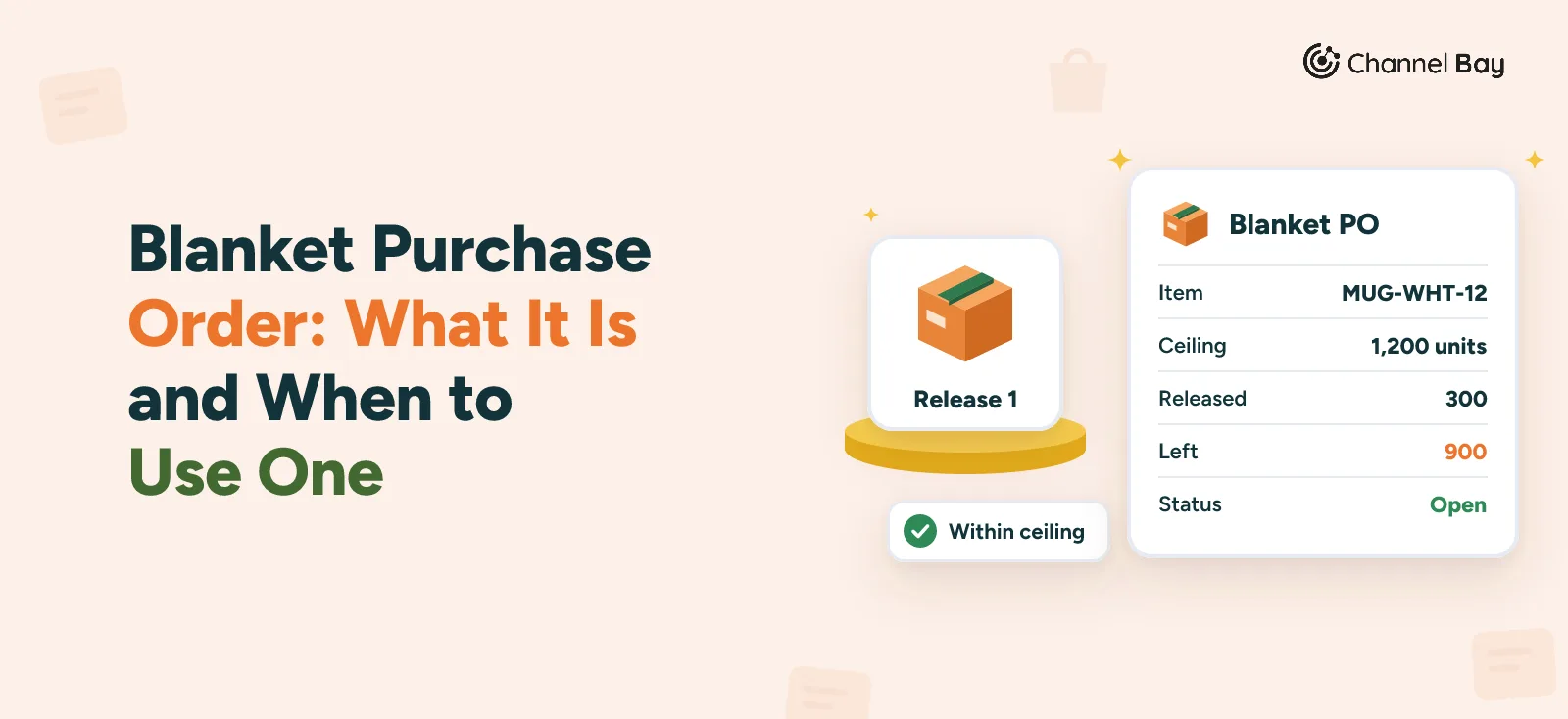
Suppose the brand asks for a blanket PO instead. It expects to sell about 1,460 mugs in a year, so it offers a commitment of 1,200, less than it expects to sell. In return it asks for releases of 300 (15 cartons) at the same $3.20, with the supplier's usual minimum waived for releases. Freight is $180 a shipment, as on PO-2026-0142 in the purchase order guide.
| Order the minimum each time | Blanket PO, releases of 300 | |
|---|---|---|
| Commitment | None beyond each order | 1,200 mugs over 12 months |
| Mugs per order | 500 (25 cartons) | 300 (15 cartons) |
| Cash for the mugs per order | $1,600 | $960 |
| Days of stock per order | 125 | 75 |
| Freight per mug at $180 a shipment | $0.36 | $0.60 |
| Cost per mug with freight | $3.56 | $3.80 |
The blanket PO shrinks each order by 200 mugs, which frees $640 of cash and takes 50 days of stock off each delivery. It also adds shipments, so each mug carries more freight. A blanket PO smooths cash and stock. It does not make freight cheaper unless the supplier combines shipments or gives a better price for the commitment. The landed cost guide shows how to compare the two on cost per unit.
These figures are an example, not data from a real supplier. Whether a supplier agrees to a smaller release in return for a commitment is a negotiation, and some will not. The method carries over. Size the ceiling to what you are sure to sell rather than your best case, ask for the price at the commitment and at the quantity you buy today, and compare landed cost per unit and cash tied up, not the unit price alone.
Blanket PO vs Standard, Planned and Contract PO
The types of PO differ in how much is fixed when the PO is issued.
| Type | What is fixed up front | Who triggers each delivery | Typical use |
|---|---|---|---|
| Standard PO | Items, quantity, price and delivery date | Nobody. One order, one delivery | One-off or batch restocks |
| Planned PO | Items, quantity and price, with tentative dates | You release each delivery on the schedule | A committed volume delivered in batches |
| Blanket PO | Items and price, with quantity open up to a ceiling | You place a release when you need stock | Frequent reorders from one supplier |
| Contract PO | Commercial terms only | Later standard POs refer to it | Master supplier agreements |
The difference from a standard PO is the number of orders. A standard PO is one order, issued, received and closed in one cycle. A blanket PO is a framework that several orders are drawn against.
A planned PO commits you to a total quantity and a delivery schedule, such as 2,500 bottles a quarter. A blanket PO fixes the price and a ceiling but leaves the schedule to you. A contract PO is a set of terms with no goods on it.
A standing order, or recurring PO, repeats the same order on a schedule without anyone raising it each time. A blanket PO leaves the timing to you. Suppliers use "blanket order", "standing order" and "call-off" loosely, so ask what the document does: does it fix a quantity, a date, a price or only a ceiling?
When a Blanket Purchase Order Makes Sense
A blanket PO pays off when you buy the same things from the same supplier again and again, at a rate you can predict.
A good fit:
- Packaging and consumables. Mailer boxes, labels, inserts and tape sell at a steady rate, run to a price list and rarely change.
- A proven best seller. A product with months of steady sales, one supplier and a long shelf life, where a price lock is worth having.
- A supplier minimum that costs you cash. A commitment can be the thing that earns a smaller release or a lower unit price. See minimum order quantity for the other ways to negotiate one.
- Several small orders a year. When the paperwork of each PO is the cost, one agreement and short releases save time.
A poor fit:
- A new or untested product. If sales could stop, a commitment can leave you holding stock you cannot sell.
- One-off buys. A single order needs a standard PO.
- Uncertain demand. A seasonal product with swings the ceiling does not allow for will blow through it, or fall short.
- A supplier you may leave. A commitment is hard to walk away from if quality or lead times slip.
Questions to Ask Before Agreeing to a Blanket PO
The ceiling can be a promise or only a limit, so ask before you sign.
- Is the quantity a commitment or a ceiling? What happens if you take less by the end date: a shortfall charge, a lower price tier, nothing?
- Is the price fixed for the whole period? Can it move with materials or currency, and how much notice do you get?
- What is the smallest and largest release? Does your usual minimum order quantity apply to each release?
- How much notice does a release need? And does the lead time hold when you release the last of the stock?
- How is freight charged? Per release, per shipment or on a minimum?
- Who holds the stock? Some suppliers will warehouse the unreleased quantity. Others expect delivery in full.
- Can the ceiling or dates change? What does an extension or an early end cost?
- How are releases made and confirmed? By email, through a portal or on a form, and who confirms them?
Get the answers in writing before the blanket PO goes out. This is a buying guide, not legal advice, so ask a lawyer to read any agreement that commits a large amount.
Blanket Purchase Orders in Shopify
Shopify's help pages describe a purchase order as the place to record the commercial agreement with a supplier. A purchase order holds a supplier, a destination, products with quantities, costs and tax, a reference number and a note to the supplier. It has two statuses, Draft and Ordered, and receiving is tracked on a linked inventory transfer, with one linked transfer at a time for each purchase order. The pages describe no ceiling, validity period or release, and no way to draw several orders from one parent (Shopify Help Center, purchase orders and inventory transfers, read 11 November 2026).
To run a blanket arrangement in Shopify, treat each release as its own purchase order:
- One purchase order for each release. Put the blanket number and the release in the reference number, such as "BPO-2026-01 release 2 of 4", so the supplier quotes it on the packing slip and invoice.
- Let the price carry over. When you add a product you have ordered from the supplier before, Shopify fills in the cost from your previous purchase orders with that supplier. If you have used several costs, you can pick one from a list.
- Keep the ceiling elsewhere. Shopify does not track the remaining quantity or the end date, so keep the three numbers (ceiling, released, remaining) in a sheet.
Our guides to creating a purchase order in Shopify and receiving inventory in Shopify cover each release's steps.
How Channel Bay Handles a Blanket Purchase Order
Channel Bay has no blanket purchase order type. There is no ceiling, no end date and no release drawn from a parent order, so the commitment itself lives in your supplier agreement and your own sheet. What the app does give you is what each release needs. This is how it works, as of November 2026:
- One PO for each release, numbered from the blanket. Each release is an ordinary PO. Channel Bay lets you type your own PO number of up to 24 characters, so start every release with the blanket's number, such as BPO-2026-01-R1 and BPO-2026-01-R2. The supplier quotes the PO number on the delivery and the invoice, and that carries the link back to the agreement.
- Duplicate the last release. Open the previous release and choose More Actions then Duplicate PO. The new PO form opens with the supplier and the lines copied, with their quantities and unit costs. Received quantities, the expected delivery, the supplier invoice number and dates, freight, adjustments, tax, the order discount, line discounts and internal notes start from zero or blank. Payment terms and invoice notes come across. Set the quantity and dates, and check the supplier cancel date, which also comes across and cannot be in the past.
- Later releases can wait as drafts. A draft needs only a supplier and a delivery warehouse, and one with an expected delivery more than 90 days away is labelled Planned. That label is only a status for far-off drafts, not the planned PO type described above. You can lay out the year's releases as drafts and use Activate PO when each is due. Drafts and planned POs cannot be received, and they do not count as incoming stock.
- Only open releases count as incoming. Channel Bay counts the unreceived units on open, partly received, overdue and expired POs as incoming stock, and the forecast's suggested order subtracts them. With each release on its own PO, the incoming figures show what is really on the way. If you put the whole 1,200 mugs on one open PO, all 1,200 would count as incoming, and the forecast would suggest no new order while that stock was on the way. The forecast needs the Pro plan.
- A single PO can be received in batches for a short schedule. If a supplier ships one PO in lots over a few weeks, receive each lot as its own batch. Each is saved as its own batch, and the PO moves to Partially Received. The unreceived remainder counts as incoming until it arrives, and a PO with any received batch can be closed but not cancelled. For a schedule that runs for months, use a PO for each release.
- Set the supplier's cost and minimum for the term. New lines built from a restock list or the forecast take the unit cost stored on the supplier's product, and Channel Bay refuses to save a PO below that product's minimum order quantity. A duplicated line keeps the cost it was copied with, so a price change reaches only new lines. If the blanket PO fixes a price or allows releases below your usual minimum, update the cost and the MOQ on the supplier's product for the term, then put them back when it ends. The MOQ section of our minimum order quantity guide has the details.
- Totalling what you have released. Search the PO list for the number shared by every release and add the Units Ordered, Units Received and Units Outstanding columns. The search matches any part of a number, so "BPO-2026-01" also finds "BPO-2026-010". The default list leaves out closed POs, so include Closed in the status filter, and leave out cancelled and draft releases when you add up what you have released against the ceiling.
Some limits to know about:
- No ceiling or end date. Channel Bay does not check a release against a total or warn you when the period is ending. Keep both in your sheet or calendar.
- No running balance. Nothing shows the quantity remaining on the blanket. You work it out from the PO list.
- One cost for each product and supplier. A price that changes by release quantity or date has to be entered by hand on each PO.
- Releases are POs. They go through the usual statuses, receiving and invoices. A release is received like any PO, so see goods receipt for short deliveries and backorders, and our open purchase order guide for reviewing and closing the releases that are still outstanding.
Suppliers and purchase orders follow the Purchase Orders module, which is on every plan including Free, so check the pricing page for the plan you are on. The purchase orders page shows how POs, receiving and costs fit together.
Common Blanket PO Mistakes
- Treating the ceiling as stock on order. Only releases are deliveries. Reorder from stock plus releases already placed, not from the blanket.
- Committing to your best case. Size the ceiling to what you are sure to sell, so a bad quarter does not leave you with a shortfall charge or unsold stock.
- Skipping the shortfall terms. Ask what happens if you take less, before you agree to the quantity.
- No end date or renewal date. A blanket PO that runs on with no review keeps old prices and old quantities. Put the end date in a calendar.
- Releases that don't quote the blanket number. Without it the supplier cannot price the release at the agreed rate, and you cannot trace the delivery back.
- Not tracking what is left. Keep the ceiling, the amount released and the amount remaining in one place, and update it with every release.
- Forgetting freight and landed cost. More, smaller releases can mean more freight on each unit. Compare landed cost per unit, not unit price.
- Using one for a new product. Wait until you have months of steady sales.
Where to Start
Pick one product or supply you reorder at least three times a year from the same supplier. Write down its yearly use, the supplier's minimum, the carton size and what each order costs you in freight. Ask the supplier for the price at a commitment of about four-fifths of your expected use, the smallest release it will accept, and what happens if you take less. If the answers beat what you pay now, put it in writing, give the blanket a number, and start every release's PO number with it.
Frequently Asked Questions
What is a blanket purchase order?
What is a release against a blanket PO?
What is the difference between a blanket PO and a standard PO?
Is a blanket purchase order binding?
What is the difference between a blanket PO and a contract PO?
What is the difference between a blanket order and a standing order?
Does Shopify support blanket purchase orders?
Does Channel Bay support blanket purchase orders?

Guides from the team that builds and supports Channel Bay, the Shopify inventory app for purchase orders, stocktakes, stock transfers and multichannel stock sync. About Channel Bay