Purchase Order Terms and Conditions: What to Include
Purchase order terms and conditions cover payment, delivery, inspection, returns and law. See the clauses to include, where to put them and a sample set.
On this page
- What are purchase order terms and conditions?
- Where to put the terms
- The order terms to put on every PO
- The standing terms: eleven clauses
- What to look for in a supplier's terms
- A sample set of terms: the mug PO
- How to put terms in place
- Common mistakes with purchase order terms and conditions
- Purchase order terms in Shopify
- How Channel Bay handles purchase order terms
- Where to start
Key Takeaways
- Purchase order terms and conditions are the rules that travel with a PO: price, payment, delivery, inspection, returns, warranty, cancellation and which law applies. Once the supplier accepts the PO, they are part of the deal.
- Split them in two. Order terms (payment terms, delivery date, shipping term) go on every PO. Standing terms (inspection, returns, warranty, liability, governing law) can live in one short document that each PO refers to.
- Where a PO is silent, the law fills the gap, and it often says only 'a reasonable time'. Put a number on it: an inspection window, a notice period, a cancel date.
- Name the rule, the place and the version, for example 'FOB Shenzhen, Incoterms 2020'. 'FOB' alone does not say who carries the risk.
- Shopify's help page lists payment terms on a PO and describes no terms and conditions field. Channel Bay has none either, but it prints payment terms, expected delivery, supplier cancel date and free-text invoice notes on the PO document, and its email template body pre-fills every PO email.
Purchase order terms and conditions are the written rules that go with a purchase order (PO): what you pay and when, how and where the goods arrive, how long you have to inspect them, what happens if they are late or wrong, and which law applies. When the supplier accepts the PO, those terms become part of the deal.
This guide separates the terms that belong on each PO from the standing terms that can live in one short document. It lists the clauses a small online seller needs, shows a sample set on a running example, and covers what Shopify and Channel Bay give you for them. It builds on the purchase order guide, which explains when a PO becomes binding. This is general information, not legal advice, and for large or cross-border orders it is worth having a lawyer read your terms once.
What Are Purchase Order Terms and Conditions?
They come in two layers:
| Layer | What it holds | Where it lives | How often it changes |
|---|---|---|---|
| Order terms | Price, quantity, currency, payment terms, delivery date, ship-to address, shipping term | On each PO | Every order |
| Standing terms | Acceptance, inspection, returns, warranty, cancellation, liability, governing law | One short document the PO refers to | Rarely, with a version date |
People say "PO terms" for either one. The short Payment terms field on a PO ("Net 30") belongs to the first layer. A block of legal text at the back of the page or on a linked page belongs to the second.
Why Write Them Down?
Because where a PO is silent, the law fills the gap, and the gap-fillers are often loose. In the US, Article 2 of the Uniform Commercial Code (UCC) covers sales of goods, and three of its default rules turn on "a reasonable time". (For the Shenzhen mug order they may not be the rules that apply, as the governing law section below explains. They show the kind of gap a clear term closes.)
- A buyer may inspect goods before payment or acceptance "at any reasonable place and time and in any reasonable manner" (UCC 2-513, Cornell Law School).
- A rejection must be "within a reasonable time after their delivery or tender", and it is ineffective unless the buyer "seasonably notifies the seller" (UCC 2-602).
- After accepting goods, a buyer who does not notify the seller of a breach within a reasonable time after discovering it, or after it should have been discovered, loses the remedy (UCC 2-607).
"Reasonable" is left open, and in a dispute it is for a court to decide. A term that says "14 days" gives both sides a number first. Other countries have their own default rules, and the clauses below are the same ones to settle wherever you buy.
Where to Put the Terms
There are three places, and most small sellers use the first two:
| Place | Best for | Watch for |
|---|---|---|
| On the PO itself | The order terms: price, payment, delivery date, shipping term | Space. A PO is a page, not a contract |
| A standing terms page or PDF that the PO refers to | The standing terms, for every supplier | The supplier needs to have seen it. Send it with the PO and put a version and date on it |
| A signed supplier agreement | A supplier you buy from often, or very large orders | Each PO then orders against it, as with a blanket purchase order |
Two habits make this work. First, put one line on every PO that points to the standing terms, for example "This order is subject to Purchase Terms v1, 1 October 2026, sent with this PO." Second, add an order of precedence clause that says which document wins if they disagree: the PO face, then the supplier agreement if there is one, then the standing terms.
When the Supplier Has Its Own Terms
Suppliers have standing terms too, and they tend to arrive on the acknowledgement, the invoice or the packing slip. What happens when two sets of terms meet is a legal question. For US sales of goods, UCC 2-207 says that between merchants, additional terms in a reply become part of the contract unless, among other exceptions, "the offer expressly limits acceptance to the terms of the offer" (UCC 2-207). That is why the first clause in the standing terms below limits acceptance to your terms. It does not settle every case, particularly where terms are different and not just additional, so our sales order guide treats it as a question for a lawyer on larger orders. The practical habit does not change: read what comes back (see the acknowledgement guide) and object in writing to anything you did not agree to.
The Order Terms to Put on Every PO
These are specific to the order, so they belong on the PO and not in a separate document:
| Term | What to state | Example for the mug PO |
|---|---|---|
| Parties and number | Your legal name, the supplier's legal name, the PO number (PO numbers) | PO-2026-0142 |
| Products and quantity | SKU, supplier item code, quantity, pack size, and whether the supplier's minimum order quantity applies | 500 white mugs, MUG-WHT-12 |
| Price and currency | Unit price, currency, and whether freight, duty and tax are in or on top | $3.20 a mug, USD, freight $180 on top |
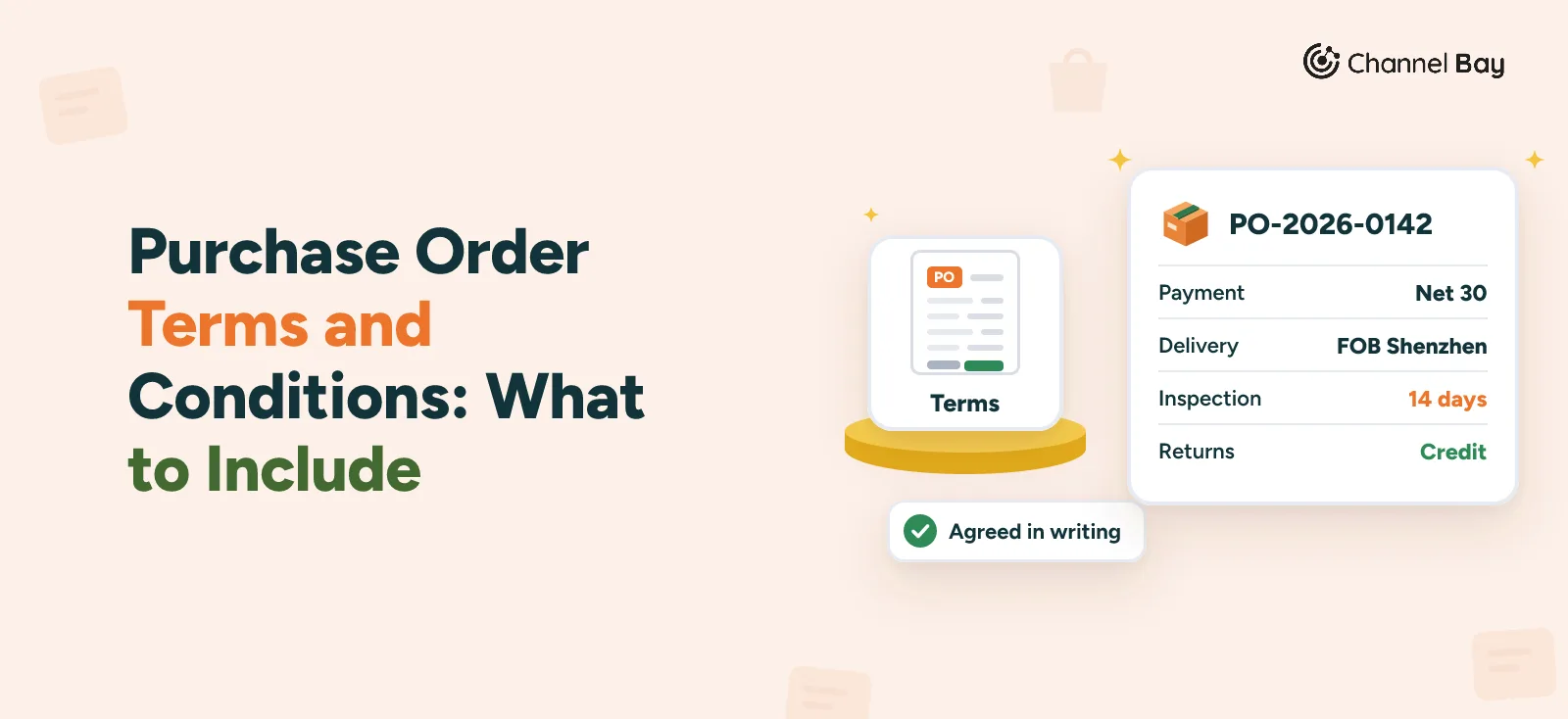
| Payment terms | Days, when the clock starts, any deposit or early payment discount | Net 30 from receipt of goods and a correct invoice |
| Delivery date and place | The date, the ship-to address and whether partial deliveries are allowed | By 10 November 2026, one delivery |
| Shipping term | The named place and the rule, so it is clear who carries the cost and the risk | FOB Shenzhen, Incoterms 2020 |
| Cancel date | The date after which an undelivered order can be cancelled | 17 November 2026 |
The cancel date, the terms version date and the other figures in these examples are invented. The purchase order template guide has the full list of PO fields. The two that cause the most arguments are below.
Payment Terms: Say When the Clock Starts
"Net 30" on its own leaves open whether the 30 days run from the invoice date, the day the invoice arrives or the day the goods arrive. Each side can read it in its own favour. Write the trigger. If the supplier invoices on dispatch and the goods take three weeks to arrive, "from invoice date" leaves you nine days to pay for stock you have only just received. Our purchase order vs invoice guide and three-way match guide cover checking the invoice before you pay.
Delivery Terms: Name the Rule and the Place, Not Just "FOB"
"FOB" means different things depending on the rule behind it. In a US sale of goods, UCC 2-319 says that with "F.O.B. the place of shipment" the seller must ship the goods at that place and bears the expense and risk of getting them into the carrier's possession, while with "F.O.B. the place of destination" the seller must transport them at its own expense and risk (UCC 2-319). The place changes who carries the risk.
For goods that cross a border, Incoterms 2020 is a common choice. It is a set of eleven rules, seven for any mode of transport (EXW, FCA, CPT, CIP, DAP, DPU, DDP) and four for sea and inland waterway only (FAS, FOB, CFR, CIF) (US Department of Commerce, Know Your Incoterms, undated, read 11 November 2026). Under the Incoterms FOB rule, the seller delivers the goods loaded on board the vessel the buyer names at the port of shipment, and the risk passes to the buyer once they are loaded (ICC Academy, 13 May 2025). The same article says that for containerised goods, parties should use FCA instead. The example PO says FOB Shenzhen to match the PO in our template guide, so if your goods travel in a container, ask your freight forwarder whether FCA fits better.
Whichever you choose, write the rule, the named place and the version ("FCA Shenzhen, Incoterms 2020"). Incoterms also leave things out. The US Department of Commerce page says they do not set the price, the method or timing of payment, when title passes, or liability for goods that do not match the contract or arrive late, so those need their own clauses. Freight and duty also feed your landed cost.
The Standing Terms: Eleven Clauses
These are the same for every order, so they can sit in one short document:
| Clause | What it says | What to watch |
|---|---|---|
| Acceptance | The order is offered on these terms only, and the supplier accepts in writing | Supplier terms on the acknowledgement or invoice |
| Changes | Price, quantity, dates and terms change only if both sides agree in writing | Your own team too: no side deals in chat |
| Delivery and late delivery | The date matters, the supplier says at once if it will slip, and you can cancel the late part after the cancel date | A ship date is not a delivery date |
| Inspection | You do not treat the goods as accepted until you have had a set number of days to inspect them | Set it to how long your receiving takes (goods receipt). Using or selling goods can still count as accepting them, so ask a lawyer how this clause works with the law that applies |
| Rejection and returns | What counts as wrong, how you notify, who pays return freight, and whether you get a credit, a refund or a replacement | Make the choice yours (return to vendor) |
| Warranty | Goods are new, as specified or sampled, free of defects and legal to sell where you sell them, for a stated period | Do not let "as is" in |
| Limits on liability | A cap on what either side owes and what is excluded | The clause to have a lawyer write |
| Cancellation | When you can cancel for free, and what happens to made-to-order goods | Custom products usually cost more to cancel |
| Intellectual property | Your artwork, labels and packaging are not used or sold to anyone else | Only matters for custom or private label goods |
| Governing law and disputes | Which law applies and where disputes are heard | Cross-border orders |
| Order of precedence | Which document wins if they disagree | Needed if a supplier agreement exists |
Inspection and Returns: Put a Number on It
The law's "reasonable time" is the thing to replace. Pick an inspection window that matches how fast you can unpack and count a delivery, say 14 days, and say what must happen inside it: you tell the supplier in writing, with the PO number, the SKU and the quantity wrong, and ideally a photo. For problems you find later, such as a defect that only shows in use, say that you will report it promptly after you find it, which fits what UCC 2-607 asks of a buyer in any case. Then say what the supplier owes: credit, refund or replacement at your choice, and who pays to send the goods back. Our return to vendor guide covers the paperwork on the other side of that clause.
Warranty and Liability: What to Keep and What to Read For
In the US, a warranty that goods are merchantable is implied in a contract for their sale when the seller is a merchant in goods of that kind (UCC 2-314). A seller can disclaim it, but the disclaimer must mention merchantability and, in a writing, be conspicuous (UCC 2-316). Remedies can also be narrowed. The parties can limit the buyer's remedy to repair and replacement of non-conforming goods, and can limit or exclude consequential damages unless that would be unconscionable (UCC 2-719). So in your own terms, keep the implied warranty and add an express one. In a supplier's terms, read the warranty and remedy clauses first, because the UCC allows a clause that limits you to "replacement only" when both sides agree to it.
Governing Law, and Orders From Abroad
Name the law and where disputes are heard. For a sale of goods between businesses in different countries there is a second question. UNCITRAL's summary says the UN sales convention (CISG) applies to contracts for the sale of goods between parties whose places of business are in different Contracting States (UNCITRAL, a summary page, read 11 November 2026). So for an order placed with a supplier in another country, such as the Shenzhen mug order, the CISG may apply, and the UCC rules above may not. Whether to keep it or to choose other law is a decision for a lawyer, and it is the clause most worth paying to have checked on a large import order.
What to Look for in a Supplier's Terms
When the supplier's terms arrive, scan for these first:
| In the supplier's terms | Why it matters |
|---|---|
| "All sales final" or no returns | Short, damaged or wrong goods may stay with you |
| Payment in full before shipping | The money has gone before you can inspect anything |
| Goods sold "as is" or the warranty disclaimed | Your warranty protection may be gone. See the warranty section above, and ask a lawyer what "as is" wording does under the law that applies |
| Remedy limited to replacement | Fine for a defect, but not if the replacement arrives after the season |
| No liability for consequential damages | Lost sales from a late or faulty batch are yours |
| Price subject to change before shipment | A price you approved can rise after approval (approval guide) |
| A cancellation fee, or no cancellation once confirmed | Know it before you confirm a large order |
| Disputes in a foreign court or arbitration seat | Costly to use, so a claim may not be worth bringing |
You do not have to accept all of it or none of it. Mark up the terms, say which you accept, and agree in writing which document wins.
A Sample Set of Terms: The Mug PO
Here are standing terms for a small seller, applied to the running example, PO-2026-0142. The order terms are in the table above. The numbers in the sample (two working days, 14 days, 12 months, the cancel date) are invented for this example, and the wording is a starting point to adapt and not a legal document. It adds two clauses that are not in the table above, packing and payment, and leaves out some that are. It leaves out limits on liability, cancellation, intellectual property and governing law on purpose, because those depend on your products and on where you and your supplier are.
| Clause | Sample wording |
|---|---|
| 1. Acceptance | This order is an offer on these terms only. Different or additional terms in your acknowledgement, invoice or packing slip do not apply unless we agree to them in writing. Please confirm this order in writing within two working days. |
| 2. Changes | Neither of us may change the price, quantity, dates or terms unless both agree in writing. |
| 3. Delivery | Delivery by the date on this order matters to us. Tell us at once if it will be late. If the goods are not delivered by the supplier cancel date, we may cancel the undelivered part at no charge. |
| 4. Packing | Mark each carton with the PO number, the SKU and the quantity. |
| 5. Inspection | We have 14 days from receipt to inspect the goods. We do not treat them as accepted until then. |
| 6. Rejection and returns | We may reject goods that are short, damaged, not as ordered or not as described, by telling you in writing within the inspection period. We will report any defect we find later promptly after we find it. For rejected or defective goods we choose a credit, a refund or a replacement, and you pay the return freight. |
| 7. Warranty | The goods are new, match the specification and approved sample, are free from defects in materials and workmanship for 12 months after we receive them, and may be lawfully sold where we sell them. |
| 8. Payment | We pay undisputed amounts on the payment terms. The invoice must show the PO number. We may withhold payment on disputed goods until it is resolved. |
| 9. Order of precedence | If documents disagree, the order face comes first, then any signed supplier agreement, then these terms. |
How It Plays Against the Acknowledgement
In our acknowledgement guide, the supplier's reply to PO-2026-0142 cuts 500 mugs to 400, moves the ship date to 14 November and changes net 30 to net 15. Under clauses 1 and 2 your position is that those are proposals and nothing changes until you agree in writing. Whether that holds depends on the facts and the law that applies, so on a larger order ask a lawyer. The clauses give you a position. They do not remove the need to answer the reply, because silence can still cost you. The acknowledgement guide explains the 10-day rule under UCC 2-201(2) for orders of $500 or more.
How to Put Terms in Place
- Start from what has gone wrong. A late shipment, a short delivery, an invoice that did not match. Each of those is a clause you want.
- Write the standing terms on one page. Plain words, one clause per paragraph, and a number wherever the law says "reasonable".
- Put the order terms on every PO. Payment terms, delivery date, shipping term and cancel date, in fields where your system has them and on the document where it does not, and not only in an internal note.
- Add the reference line. One sentence on each PO that names the standing terms, with a version and date.
- Send the terms with the PO. Attach the document or link to it in the email, so the supplier cannot say it never saw it.
- Ask for written confirmation. Then read the confirmation against your PO and your terms. Our purchase order approval guide covers who signs off before a PO goes out.
- Keep a version history. Note which version applied to which PO, so a dispute in March is judged on the terms that were sent in October.
- Have a lawyer read it once. Before large orders or a new country, then revisit it after any dispute and about once a year.
Common Mistakes With Purchase Order Terms and Conditions
- Copying a corporate template. A university's standing terms are written for a procurement office. Keep what your orders need.
- Leaving "reasonable time" in. Inspection, notice and delivery all need a number.
- Writing "FOB" with no rule or place. The rule and the place together decide who carries the risk.
- "Net 30" with no start point. Say from when.
- Never sending the terms. Terms the supplier has not seen are hard to rely on.
- Not reading the supplier's terms. They arrive on the acknowledgement, the invoice and the packing slip.
- Putting terms in internal notes. Notes your team writes for itself are not terms the supplier has agreed to.
- Changing terms after the PO is accepted. A new payment term or date is a change both sides must agree to in writing.
Purchase Order Terms in Shopify
Shopify's purchase orders page says a PO "lists the products, quantities, costs, payment terms, and supplier details for an order" (Shopify Help Center, no date shown, read 11 November 2026). The same page describes supplier records that hold contact details, payment terms and currencies, and it does not describe a terms and conditions field. Our Shopify purchase order template guide adds that Shopify's help describes no way to change the PO PDF, so do not count on adding a terms block to it. Keep the standing terms as a separate document and send them with the PO.
How Channel Bay Handles Purchase Order Terms
Channel Bay has no terms and conditions field, no clause library and no place to store a standing terms document. It has fields for the order terms, and two places to point at the standing ones, as of November 2026:
- Payment Terms. A free-text field on every PO, up to 25 characters, under Order & Delivery. That fits "Net 30 from receipt" but not the full trigger wording from the payment terms section, so put the short version here and the full wording in Invoice Notes. The supplier record has its own payment terms field, and the PO keeps its own, so check it when you raise the PO. The PO history records a change to it.
- Expected Delivery and Supplier Cancel Date. Neither can be in the past. A PO whose supplier cancel date has passed shows as Expired.
- The PO document. It prints the payment term, the expected delivery date and the supplier cancel date in its footer, so the order terms reach the supplier on the page.
- Invoice Notes. A free-text field in the Invoice Detail card, with the prompt "Notes to display on this purchase order invoice". It prints on the PO document under an "Invoice Notes" heading. Nothing fills it in for you, so paste the reference line, or a short set of terms, on each PO, and check how it prints on the document before you send the first one. The field has no shipping term of its own either, so "FOB Shenzhen, Incoterms 2020" goes here too.
- The email template. The body in Settings, Organisation Profile, Email Template pre-fills every PO email, and you can edit it per email. A line such as "This order is subject to our Purchase Terms, linked below" can sit in the template, so it appears in every email by default. You attach the PDF, a CSV or both.
- Custom PDF templates. Where your account has them, the team builds a PDF layout from your design (see our Shopify template guide). Ask the team whether a standing terms block can go in one before you count on it.
Limits to know about:
- Internal Notes are internal. They do not print on the PO document, so don't use them for terms.
- No terms record. The app does not store which version of your terms applied to which PO, or whether the supplier accepted them. Our acknowledgement guide covers what Channel Bay does and does not track there.
- The version is manual. A line in the email template is the same for every PO, and Invoice Notes is typed per PO, so noting which version of your terms applied is up to you (step 7 above).
- Terms go in the body, not as an attachment. Channel Bay's help describes attaching the PO PDF, the CSV or both, and nothing else, so send the standing terms as a link in the email body or as a separate message.
For many small teams that is enough: payment terms and dates in the fields, one reference line in Invoice Notes or the email, and the standing terms linked in the email body or sent separately. Channel Bay's purchase orders page shows what the rest of the PO flow covers.
Where to Start
Write the standing terms on one page, using the eleven clauses and the sample as a base. Put a number on inspection, notice and cancellation. Add the reference line to your next PO, send the document with it, and read the supplier's reply against both. After the first dispute, add the clause it would have prevented.
Frequently Asked Questions
What are purchase order terms and conditions?
Are purchase order terms and conditions legally binding?
Do I need terms and conditions on every purchase order?
What payment terms should a purchase order state?
What if the supplier sends its own terms and conditions?
Can I use a free purchase order terms and conditions template?
What is the difference between PO terms and a supplier agreement?

Guides from the team that builds and supports Channel Bay, the Shopify inventory app for purchase orders, stocktakes, stock transfers and multichannel stock sync. About Channel Bay