Physical Inventory Count: How It Works and What to Do at Year End
A physical inventory count checks your stock against your books. See periodic vs perpetual, cut-off, valuing the count and a year-end checklist.
On this page
- What is a physical inventory count?
- Why do a physical inventory count at year end?
- Periodic vs perpetual inventory: what the count does in each
- Cut-off: which stock goes into the year-end figure
- Valuing the count: from units to dollars
- A year-end physical inventory checklist
- What your accountant or auditor will want to see
- Do you need a full physical inventory every year?
- Taking a physical inventory in Shopify, on Amazon and in Channel Bay
- Taking a physical inventory in Channel Bay
- Common year-end physical inventory mistakes
Key Takeaways
- A physical inventory count checks the stock you hold against your records. In a periodic system the count sets your closing stock figure, and in a perpetual system it checks the figure your records already show.
- Run through a periodic and a perpetual system, the same year can end on the same cost of goods sold. The perpetual route shows the shortfall as its own line, so you can investigate it.
- Cut-off decides which stock belongs in which year. Post every receipt, shipment and transfer dated before the cut-off, include goods you own that are still in transit, and take stock held by Amazon or a 3PL from their report.
- The count gives a quantity. The value is quantity times unit cost, with landed costs included, and stock worth less than cost written down to what you could sell it for.
- Keep the count sheets, the cut-off note, the variance report with causes, and the valuation workings. Your accountant or auditor will ask for them.
A physical inventory count is a count of the stock you actually hold, compared with what your records say you hold. It is the same thing as a stocktake: "physical inventory" is the usual term in the US, and stocktake is the word in the UK, Australia, New Zealand, South Africa and India. Our stocktake guide covers how to run the count, step by step. This post covers what comes with it at year end: why the count matters to your accounts, how it works with periodic and perpetual records, which stock belongs in the figure, and how a count becomes a stock value your accountant can use.
This is general information, not tax or accounting advice. The rules differ by country and by business, so treat the sections below as questions to take to your accountant.
What Is a Physical Inventory Count?
A physical inventory count verifies the quantity of each item you hold by counting it, then compares the result with your inventory records. It produces two things: a counted quantity for every item, and a list of the lines where the count and the records disagree.
The year-end version is usually a full count, sometimes called wall to wall, of every item in every location around one cut-off time. It differs from a cycle count, which counts a small rotating slice all year. The count is the same activity as the one in the stocktake guide. What changes at year end is who reads the result. Your accountant uses the quantities to set closing stock, and the closing stock feeds cost of goods sold, gross profit and the balance sheet.
Why Do a Physical Inventory Count at Year End?
Three reasons, and the first two are about money.
- It sets or checks your closing stock. In a periodic system the count is the only way to get the closing figure. In a perpetual system it is the check that the figure in your records is real.
- Tax authorities expect your stock figure to be backed by a count. The IRS says that if you keep book (perpetual) inventory, you must take a physical inventory at reasonable intervals and adjust the book amount to agree with it (IRS Publication 538, Perpetual or Book Inventory). It does not define "reasonable". Other countries have their own rules.
- Someone else may need to see it. If your accounts are audited, the auditor may attend or test the count. The standards behind that are covered in the stocktake guide, and what an auditor does at a count is in our inventory audit guide.
Periodic vs Perpetual Inventory: What the Count Does in Each
A periodic inventory system updates the inventory account only when a physical count is made. Between counts, purchases build up in a separate purchases account, and cost of goods sold is worked out at the end: opening inventory plus purchases, minus the closing count (AccountingTools, periodic inventory system).
A perpetual inventory system updates the records as things happen. Receipts, sales and transfers between locations all change the inventory figure, so the system always shows an expected quantity. AccountingTools notes that a perpetual system still has to be paired with regular counts, because the book balances can drift from the real quantities through unrecorded transactions or theft (AccountingTools, perpetual inventory system). A Shopify store works this way, since every order changes the quantity on hand.
Here is the same year through each system. The numbers are made up, for a small gift store with opening stock of $40,000, purchases of $120,000 and a year-end count of $35,000.
| Step | Periodic | Perpetual |
|---|---|---|
| Cost of goods sold during the year | Not tracked sale by sale | $121,500, booked as items sold |
| Inventory in the books at year end | Not known until the count | $38,500 ($40,000 + $120,000 - $121,500) |
| Physical count | $35,000 | $35,000 |
| Adjustment | None needed | Reduce inventory by $3,500 |
| Cost of goods sold for the year | $40,000 + $120,000 - $35,000 = $125,000 | $121,500 + $3,500 = $125,000 |
Both routes end at $125,000, assuming the $3,500 shortfall is expensed through cost of goods sold. Your accountant may show it as a separate shrinkage line instead. The difference is what you can see. In the periodic books the $3,500 disappears into cost of goods sold and nobody asks where it went. In the perpetual books it is a variance with SKUs behind it, so you can recount them, trace the cause and fix it. That is the practical reason to keep perpetual records and still count.
Cut-Off: Which Stock Goes Into the Year-End Figure
Cut-off is the moment that separates one year from the next. Every unit has to be in exactly one year's figure, never both and never neither. A cut-off error can leave the year-end figure wrong even when the count itself was accurate.
Work through these cases before the count:
- Stock in transit to you. The IRS says purchased goods are included in inventory once title has passed to you, even if they are still in transit, and that goods ordered for future delivery are not included if you do not yet hold title (IRS Publication 538, Items Included in Inventory). Title depends on the shipping terms with your supplier, so check them on the purchase order.
- Deliveries on the dock. Anything that arrived before the cut-off should be received against its purchase order before you compare counts with records. Otherwise it looks like surplus stock.
- Orders shipped before and after the cut-off. Make sure every order that left before the cut-off is fulfilled in your system, and that nothing is shipped from the counted area during the count. Log movements after the cut-off separately.
- Returns to suppliers. Post any return to vendor that left before the cut-off. A box still on your shelf at cut-off is still counted.
- Stock you hold but do not own. Consignment stock is on your shelf but usually not in your figure.
- Stock you own but do not hold. Stock at Amazon fulfillment centers or a third-party warehouse is usually still yours. You cannot count it yourself, so take the quantity from their inventory report for the cut-off date and ask your accountant how to show it. Keeping Shopify and Amazon inventory in sync covers how the channels' quantities line up.
Write a short cut-off note on the day: the last goods receipt number, the last order shipped, and any transfers still in transit. It is the first thing an auditor asks for.
Valuing the Count: From Units to Dollars
The count gives you quantities. A stock value is each quantity multiplied by its unit cost, added up, then reduced for any stock worth less than it cost.
Unit cost. Include what it cost to get the item to your shelf, not just the supplier's price. IAS 2, the international inventory standard, lists purchase costs and other costs of bringing inventories to their present location and condition (IFRS Foundation, IAS 2 Inventories). For an importer that means freight, insurance and duties, which our landed cost guide explains.
Cost formula. If identical units were bought at different prices, you need a rule for which cost leaves first. IAS 2 allows first in, first out (FIFO) or weighted average cost for interchangeable items. US tax guidance also lists specific identification and last in, first out (LIFO) (IRS Publication 538, Identifying Cost). Your accountant picks the method, and a business usually keeps the same one year after year. Our FIFO vs LIFO vs weighted average guide compares the three on one example.
Write-downs. IAS 2 measures inventory at the lower of cost and net realisable value, which is the estimated selling price minus the costs to sell. A write-down is expensed in the period it happens (IFRS Foundation, IAS 2). The IRS lists a similar lower of cost or market method, applied item by item rather than to the inventory as a whole (IRS Publication 538, Valuing Inventory). In practice this is where damaged, expired and marked-down stock gets valued at what you could actually get for it.
Here is a small example, with made-up figures. The seasonal mugs cost $3.60 each, but after markdowns each is expected to net $2.20 after selling costs, so they are valued at $2.20.
| Product | Counted | Unit cost | Value at cost or net realisable value |
|---|---|---|---|
| White mug, 12 oz | 410 | $3.20 | $1,312.00 |
| Blue mug, 12 oz | 150 | $3.35 | $502.50 |
| Tote bag | 220 | $4.10 | $902.00 |
| Seasonal mug (marked down) | 90 | $3.60 cost, $2.20 net realisable value | $198.00 |
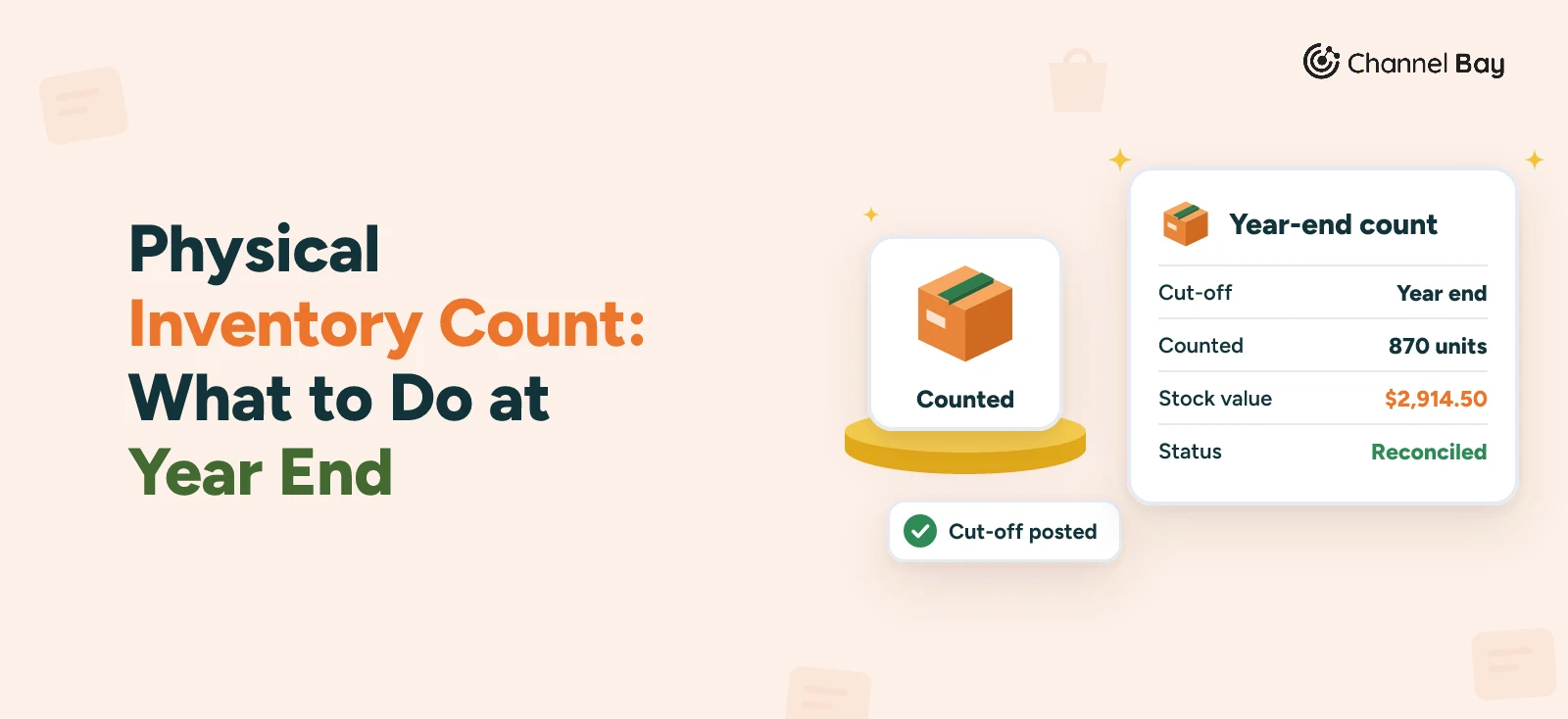
| Total | $2,914.50 |
At cost alone the seasonal mugs would be worth $324, so the write-down is $126. A stock value is only as good as the unit costs behind it, so check the costs on your highest-value lines before the count, not after.
A Year-End Physical Inventory Checklist
The counting steps are in the stocktake guide, and a printable count sheet and checklist are in our stock take template. This is what to add around them for a year-end count.
Before the Count
- Agree the count date and cut-off time with your accountant, and tell your auditor if you have one.
- Check that unit costs on your highest-value products are current.
- Receive open deliveries, finish open transfers and post returns, so the records are up to date before anyone counts.
- Plan the teams, the zones and the recount rule, and run one count per location, all at the same cut-off.
On the Day
- Write the cut-off note: last receipt, last shipment, transfers in transit.
- Count blind, recount any line outside your tolerance, and decide what happens to uncounted items.
- Keep damaged, expired and returned stock in labeled areas so it can be valued separately.
After the Count
- Investigate the biggest variances and log a cause for each before posting any adjustment.
- Post the adjustments, then value the count using your accountant's cost method, with write-downs.
- Reconcile the total stock value to the inventory balance in your accounting software.
- File the records in the next section for as long as your accountant tells you to.
What Your Accountant or Auditor Will Want to See
Keep one folder per year-end count:
- The count sheets, or the count log showing who counted what and when.
- The cut-off note and the documents behind it, such as the last goods receipt and the last shipment.
- The variance report, with the recounts and the cause logged for each adjustment.
- The valuation workings: unit costs, the cost method and the write-downs.
- The reconciliation of the stock value to the accounting ledger.
A report that lists only the final quantities is not enough. A reader needs to see how you got from the first count to the posted number.
Do You Need a Full Physical Inventory Every Year?
Not always, and the answer depends on where you are.
In the US, the IRS rule above asks for a physical inventory at reasonable intervals without saying whether cycle counts qualify. The US auditing standard for observing inventory accepts counts during or after the year when perpetual records are well kept and regularly checked (PCAOB AS 2510.10). Our cycle counting guide covers what a schedule has to show to stand in for a year-end count.
Some small businesses can also skip keeping an inventory for tax. The IRS says a small business taxpayer, defined by average annual gross receipts below an inflation-adjusted threshold, can choose not to keep an inventory, but it must still use a method that clearly reflects income (IRS Publication 538, Exception for Small Business Taxpayers). In Australia, a small business with aggregated turnover under $10 million (or under $50 million in some cases) can skip a formal stocktake in a year when it reasonably estimates that its stock value changed by $5,000 or less, and it can still choose to do one (ATO, simplified trading stock rules, updated 27 May 2026). Even where the tax rules let you skip the count, your own records still need checking, so a count remains useful.
Taking a Physical Inventory in Shopify, on Amazon and in Channel Bay
In Shopify
Shopify's stock counts live in the admin under Inventory > Stock counts. A count covers one location, staff record quantities with a barcode scanner or manual entry, and a manager approves the result before the difference is applied, with each change logged in adjustment history (Shopify Help Center, stock counts). A count gives you quantities. The value comes from the cost per item you keep on each variant, which is why the cost check in the checklist matters. Shopify keeps one cost per item for each variant, and a new value replaces the last, so a value built from it is at your latest cost. If your accountant uses FIFO or average cost, work that out outside Shopify, using the steps in Shopify cost per item and landed cost. How to do a stocktake in Shopify walks through each counting tool and its limits.
On Amazon
Stock at Amazon fulfillment centers is not on your shelves, so the year-end count covers what you hold yourself: your own shelves, a prep area, a third-party warehouse and returns waiting to be restocked. Add the FBA quantities from Amazon's inventory report for the cut-off date, and keep the report with your count records. Counting FBA and merchant-fulfilled stock explains the split between the two.
Taking a Physical Inventory in Channel Bay
In Channel Bay, a stocktake is a session for one location. For a year-end count, create one session per location, add the products by vendor, type, collection or tag, or import a SKU list from CSV, and have your team scan or key in the counts. Several people can count the same session, and their counts are added together. Each scan is logged against the person who made it, and the stocktake has a timeline of what happened and when.
Before you submit, the variance report shows expected and counted quantities per line and the value of the stock difference. The report exports as CSV and lists the cost price and retail price beside the expected and counted quantity for each product, so a stock value at cost is one multiplication away in a spreadsheet. You can also export the count log, which records who added, counted or removed each product and when. Together they cover the count sheets and the count log in the folder above.
The valuation method and the journal entries are decisions for your accountant and stay in your accounting software. Channel Bay gives you counted quantities with costs, and the audit trail behind them.
Common Year-End Physical Inventory Mistakes
| Mistake | What goes wrong | Fix |
|---|---|---|
| No cut-off note | Stock is counted twice or missed, and nobody can show which | Write the last receipt, last shipment and transfers in transit on the day |
| Ignoring goods in transit | Closing stock is too low and the supplier's invoice is in the books | Check title and shipping terms for everything ordered but not yet received |
| Valuing at selling price | Stock value and profit are overstated | Value at cost, then write down anything worth less than cost |
| Stale unit costs | The count is right but the value is wrong | Review costs on the highest-value lines before the count |
| Posting adjustments without a cause | The same shortfall returns next year | Recount, log the cause and fix the process |
| Counting only the shelves | Damaged stock, returns and consignment stock distort the figure | Count them in separate labeled areas and treat each as your accountant says |
Frequently Asked Questions
What is a physical inventory count?
What is the difference between periodic and perpetual inventory?
How often do you need a physical inventory count?
Does a physical inventory have to be counted on the last day of the year?
Is a physical inventory the same as a stocktake?
How do you value a physical inventory count?

Guides from the team that builds and supports Channel Bay, the Shopify inventory app for purchase orders, stocktakes, stock transfers and multichannel stock sync. About Channel Bay